

Raising Emotionally Intelligent Kids
Social-Emotional Learning for Toddlers Through Age 10
Parenting516 pagesPublished 31 May 2026Kindle, paperback & hardcoverParenting
You are not just trying to stop tantrums, sibling fights, yelling, or emotional outbursts. You are raising a person.
A child who can name what they feel.
A child who can pause before they react.
A child who can repair after conflict.
A child who can face disappointment, friendship struggles, frustration, anger, and big feelings without being ruled by them.
That kind of emotional intelligence does not appear overnight. It is built slowly, through ordinary family life, one conversation, one repair, one hard moment, and one steady adult at a time.
Raising Emotionally Intelligent Kids gives parents a warm, practical, science-backed framework for helping children ages 2–10 develop the emotional and social skills they will carry for life.
Inside, Joanna Voss shows you how to help your child:
- Name feelings with confidence
- Understand body signals before emotions take over
- Build self-regulation through co-regulation
- Strengthen impulse control and frustration tolerance
- Develop empathy and social awareness
- Build healthy friendship skills
- Communicate feelings clearly and respectfully
- Repair conflict after hard moments
- Grow resilience through supported struggle
- Create a family culture where emotions are understood, not ignored
This is not about raising a child who never gets angry, never melts down, never argues, and never struggles.
It is about raising a child who knows what to do when those moments come.
With clear explanations, age-by-age guidance, parent-child practices, and grounded scripts you can use in real life, this book helps you turn everyday parenting moments into emotional intelligence training your child can actually absorb.
Because every tool leads here.
One feeling named.
One pause practiced.
One conflict repaired.
One hard thing survived.
One honest conversation at a time.
Raise the child who can feel deeply, connect well, recover bravely, and move through the world with emotional confidence.
Read the first chapter
Chapter One
Chapter 2: Strengths and Struggles 38
Part Two 54
Chapter 3: From Co-Regulation to Self-Regulation 56
Chapter 4: Impulse Control 70
Chapter 5: Frustration Tolerance 84
Part Three 99
Chapter 6: Empathy 101
Chapter 7: Reading the Room 116
Part Four 131
Chapter 8: Communication That Connects 133
Chapter 9: Conflict Resolution 148
Chapter 10: Friendship Skills 164
Part Five 180
Chapter 11: Raising a Resilient Child 182
Chapter 12: The Emotionally Intelligent Family 197
Conclusion 213
The EQ Development Milestones Chart 221
The Five Family Culture Practices 226
The Empathy Curriculum Summary 229
The Conflict Resolution Protocol 231
Friendship Skills by Age Guide 234
Resilience Language Reference 239
Strengths and Struggles Map 241
Inner Weather Report Page 243
Family EQ Plan 245
When to Seek Extra Support 247
Complete Series Reading Guide 251
A Note to the Child 255
Acknowledgments 257
❧
Introduction
Every Tool Leads Here
Whether this is your first book in the Big Feelings, Calm Families series or the final one you are reading, this book is about the larger destination every tool has been pointing toward. Not just fewer tantrums. Not just less yelling. Not just smoother bedtimes, calmer transitions, better discipline, or fewer angry explosions.
Those things matter. Of course they matter. Real family life happens in the grocery store, the car seat, the school morning, the sibling fight, and the bedtime that somehow requires seventeen separate negotiations, two drinks of water, one missing stuffed animal, and a deeply philosophical discussion about why teeth exist.
But underneath all of those moments is something larger. You are raising a person. A person who will one day carry their emotional patterns into friendships, classrooms, workplaces, partnerships, parenthood, and their own quiet moments alone with themselves. Every breath tool, every repair script, every calm boundary, every “I wonder what was underneath that anger,” every moment you choose understanding before shame, all of it is building something.
Emotional intelligence. Not a child who never feels big feelings. A child who can understand them, move through them, communicate them, repair after them, and stay connected to themselves and others while doing it. That is the work. And it starts in the ordinary days of childhood. Emotional intelligence can sound like a polished, grown-up concept. It can sound like something from a workplace training or a school curriculum binder. But at home, with real children, it looks much more ordinary.
It looks like a preschooler saying, “I’m mad,” instead of only throwing the truck. It looks like a seven-year-old realizing, “My stomach hurts when I’m nervous.” It looks like a ten-year-old saying, “I need a break before we talk.” It looks like a child noticing that their sibling is sad. It looks like a child learning to say, “Can I try again?” after words come out sharp.
It looks like a parent saying, “I should not have yelled. I was frustrated, and I am responsible for my voice.” It looks like a family learning that conflict does not have to mean disconnection forever. It looks like repair. Again and again and again. Emotional intelligence is not a single skill. It is a collection of capacities that help a child understand themselves, manage themselves, understand others, and build healthy relationships. These capacities grow slowly, unevenly, and very much not on the schedule we might prefer when we are trying to leave the house.
A two-year-old will not have the emotional intelligence of an eight-year-old. An eight-year-old will not have the emotional intelligence of a calm, rested, emotionally mature adult. And, to be fair, many calm, rested, emotionally mature adults become much less impressive when hungry, criticized, stuck in traffic, or trying to assemble furniture.
So we begin with realistic expectations. Children are not born knowing what to do with disappointment, jealousy, embarrassment, fear, anger, frustration, loneliness, guilt, shame, excitement, or the uniquely volcanic grief of not getting the blue cup. They learn. They learn first through relationship.
Before children can manage feelings, they borrow our steadiness. Before they can name emotions, they need us to lend them language. Before they can repair, they need to experience repair. Before they can show empathy, they need to receive empathy. Before they can stay connected during conflict, they need to see that conflict can be survived.
This does not mean parents must respond perfectly. It means parents matter. Your words matter. Your repair matters. Your pauses matter. Your limits matter. Your apologies matter. Your willingness to return after a hard moment matters. The good news is that emotional intelligence is not built only in the beautiful moments. It is not reserved for the families who have calm mornings, tidy playrooms, and children who say things like, “Mother, I am experiencing frustration and would appreciate co-regulation.”
Emotional intelligence is built in the messy middle of real family life. In the moment after someone grabs. In the moment after someone yells. In the moment after the tower falls. In the moment after the game is lost. In the moment after a child says, “Nobody likes me.” In the moment after a parent thinks, “I handled that badly.”
Hard days are not evidence that the work is failing. Hard days are part of the curriculum. That does not mean every hard moment must become a lesson. Sometimes a child is too dysregulated to learn. Sometimes a parent is too tired to teach. Sometimes the most emotionally intelligent choice available is to lower the lights, offer a snack, separate the children, and say fewer words.
But over time, ordinary moments become patterns. Patterns become family culture. Family culture becomes the emotional air a child breathes. And that emotional air teaches.
What Emotional Intelligence Means in Real Family Life
For the purposes of this book, emotional intelligence means a child’s growing ability to understand feelings, manage behavior, notice other people’s experiences, communicate needs and boundaries, repair after conflict, and recover from hard things. That is a lot, so we will make it smaller. The first domain is *self-awareness*.
Self-awareness is the ability to notice what is happening inside. It includes feelings, body signals, thoughts, needs, strengths, struggles, and patterns. A young child may begin with, “Mad.” A slightly older child may say, “My body feels tight.” An older child may begin to notice, “I get worried before school on Mondays,” or, “I get mean when I feel left out.”
Self-awareness gives children a map of their inner world. Without it, feelings can feel like weather that comes from nowhere and knocks everyone sideways. With it, children begin to understand that feelings have names, signals, causes, and needs. The second domain is *self-management*. Self-management is the ability to work with feelings and impulses without being completely ruled by them. It includes regulation, impulse control, frustration tolerance, coping skills, and the ability to pause before acting.
For a toddler, self-management may mean accepting a parent’s help to calm down. For a preschooler, it may mean using a simple phrase instead of hitting once in a while. For a school-age child, it may mean choosing a calming tool, asking for space, taking a breath before responding, or trying one more step before quitting.
Self-management does not mean children stop having big feelings. It means they gradually build more choices inside those feelings. The third domain is *social awareness*. Social awareness is the ability to notice other people and the emotional information in the room. It includes empathy, perspective-taking, reading facial expressions, noticing body language, hearing tone, understanding context, and recognizing that other people have thoughts, feelings, needs, and experiences too.
A young child may notice, “Baby sad.” An older child may say, “She looked embarrassed when everyone laughed.” A child with growing social awareness begins to understand that their actions land on other people. This is the beginning of empathy, kindness, repair, and social responsibility. The fourth domain is *relationship skills*.
Relationship skills are the tools children use to connect with others. These include communicating clearly, listening, asking for needs, setting boundaries, joining play, taking turns, handling rejection, resolving conflict, apologizing, negotiating, and repairing. Relationship skills are not automatic. Children are not born knowing how to join a group of children already playing. They are not born knowing how to lose a game gracefully, say sorry meaningfully, disagree respectfully, or tell a friend, “I did not like that.”
Those are learned skills. And home is the first classroom. This book also adds two long-game layers: *resilience and family culture*. Resilience is the ability to move through hard things and recover. It is not toughness. It is not emotional suppression. It is not pretending everything is fine while quietly falling apart inside. Resilience means, “This is hard, and I can get through it with support, tools, time, and practice.”
Family culture is the emotional pattern of the home. It is what your family returns to after things go wrong. It is the way feelings are handled, the way limits are held, the way apologies happen, the way conflict is repaired, and the way children learn what it means to be loved while they are still learning.
You can teach emotional intelligence through individual tools. But it grows deepest inside a culture.
Why This Matters Beyond Behavior
Many parenting books begin with behavior because behavior is what parents can see. The hitting. The yelling. The refusal. The whining. The meltdown. The slammed door. The child who will not share. The child who grabs. The child who collapses over homework. The child who says, “I don’t care,” while clearly caring with their entire nervous system.
Behavior matters. Unsafe behavior must be stopped. Limits matter. Children need guidance. Families cannot run on chaos and good intentions. But behavior is not the whole story. Behavior is the part above the surface. Underneath behavior are skills, needs, emotions, body states, stress levels, developmental capacities, temperament, relationship patterns, and learned responses.
A child who grabs may need impulse control, language, patience, and practice asking. A child who melts down over losing may need frustration tolerance, emotional vocabulary, and repeated experiences of recovering from disappointment. A child who says something cruel may need help finding the true feeling underneath the sharp sentence.
A child who seems not to care after hurting someone may need regulation before empathy can come online. A child who quits everything hard may need supported struggle, not a lecture on perseverance. When we only focus on stopping behavior, we may miss the skill the child needs to build. When we only ask, “How do I make this stop?” we can accidentally skip the deeper question:
“What does my child need to learn, practice, or receive so they can handle this differently over time?” That question changes parenting. It does not make parenting permissive. It makes parenting developmental. It helps us hold limits while teaching skills. “I will not let you hit” can live beside “You were furious and need help with what to do next.”
“You may not speak to me that way” can live beside “Let’s find the feeling underneath those words.” “You need to repair with your sister” can live beside “We will wait until your body is calm enough to mean it.” This is the heart of emotionally intelligent parenting. Warmth without weakness. Limits without shame.
Understanding without excusing. Repair without humiliation. Teaching without turning every moment into a lecture so long that even the houseplants lose interest.
Where This Fits in the Series
If you are new to the Big Feelings, Calm Families series, you can begin here. This book gives you the broad, long-term framework for raising emotionally intelligent children from toddlerhood through age ten. If you have read the earlier books, you will see how each one connects to this larger picture.
Book 1 focused on the developing brain and helped explain why young children feel and behave the way they do. Book 2 focused on tantrums and meltdowns: how to prevent them when possible, respond to them when they happen, and recover afterward. Book 3* gave parents scripts to replace yelling and helped families practice repair after parent-child rupture.
Book 4 taught emotional vocabulary, coping skills, body awareness, and regulation practices for children with big feelings. Book 5 built a discipline system rooted in limits, teaching, connection, and accountability without shame-based punishment. Book 6* offered practical calming tools children can use with adult support and, over time, more independently.
Book 7 focused on anger: how children experience it, how to understand what is underneath it, and how to repair after angry behavior. Book 8* brings the full framework together. It asks not only, “How do we handle today’s hard behavior?” It asks, “What kind of emotional capacities are we building for the long run?”
This is why Book 8 is slower and broader. It is not only a crisis guide. It is a long-game guide. There will still be tools. There will still be scripts. There will still be practical activities, because nobody needs a parenting book that floats above the kitchen floor while the children are arguing over who breathed near whom.
But the focus here is larger. We are looking at the child your child is becoming.
The Long-Game Mindset
Parenting often pressures us to think in short-term outcomes. Did the tantrum stop? Did the child obey? Did the morning go smoothly? Did the sibling fight end? Did bedtime happen on time? These questions are understandable. Parents live inside the immediate. There are lunches to pack, shoes to find, teeth to brush, forms to sign, and small people with surprisingly strong opinions about sock seams.
But emotional intelligence asks us to hold two timelines at once. There is today’s behavior. And there is tomorrow’s capacity. Today’s behavior may need a limit. Tomorrow’s capacity needs a skill. Today’s behavior may need safety. Tomorrow’s capacity needs practice. Today’s behavior may need repair.
Tomorrow’s capacity needs a child who believes repair is possible. The long-game mindset does not mean we ignore the present. It means we respond to the present in ways that build the future. When a child melts down, we are not only trying to get through the meltdown. We are helping the child’s nervous system learn what it feels like to return.
When a child hurts someone, we are not only trying to make them say sorry. We are helping them notice impact, take responsibility, and repair connection. When a child loses a game and collapses, we are not only trying to stop the tears. We are helping them learn that disappointment can be survived. When a child says, “I can’t do it,” we are not only trying to complete the homework, puzzle, shoe-tying, or impossible craft kit designed by someone who clearly dislikes parents. We are helping them build a relationship with hard things.
This is why emotional intelligence cannot be rushed. It is not installed. It is grown. Children grow it through repeated experiences of being seen, guided, limited, supported, and given another chance. And another. And another.
Emotional Intelligence by Age
Because this book focuses on children ages two through ten, we need to keep development in the room. At ages two to four, emotional intelligence is mostly borrowed from adults. Young children rely heavily on co-regulation. They need simple language, predictable routines, physical comfort, playful practice, and adults who can name what is happening without expecting too much reflection.
A two-year-old may not be able to say, “I felt excluded when my sibling took the toy, and my impulse control was insufficient.” A two-year-old may bite. Then they need safety, limits, support, and teaching. At ages five to seven, children begin to use more emotional language and simple tools, but they are still very much under construction. They may understand a coping skill when calm and completely forget it when overwhelmed. This is not hypocrisy. It is development.
Children in this range can begin to practice “I feel,” “I need,” “Can I have a turn?” “Stop, I don’t like that,” and “I can try again.” They can participate in repair, but often need adult coaching. At ages eight to ten, children can reflect more deeply. They can begin to notice patterns, mixed feelings, friendship dynamics, fairness, embarrassment, rejection, boundaries, and the difference between intention and impact. They can use more independent tools, but they still need adults. They may look big one minute and very young the next.
This is normal. Development is uneven. A child may be advanced in language and delayed in regulation. A child may be deeply empathetic and still impulsive. A child may understand friendship beautifully in conversation and then exclude someone at recess because real-time social pressure is harder than talking in the car.
A child may know the right words and not yet have the capacity to use them under stress. This is why the goal is not instant maturity. The goal is repeated practice.
What This Book Will Not Promise
This book will not promise that your child will always be calm. It will not promise that your child will always be kind. It will not promise that your child will become endlessly cooperative, socially graceful, emotionally articulate, and mature enough to calmly discuss bedtime limits while putting on pajamas the first time you ask.
I would love that for you. I would also love a laundry basket that folds the clothes itself. We work with reality here. Emotionally intelligent children still have big feelings. They still get jealous. They still shout sometimes. They still misunderstand. They still avoid hard things. They still say unkind words.
They still struggle with impulse control. They still need limits. They still need adults. The difference is not that hard moments disappear. The difference is what happens around those moments over time. A child learns to name more feelings. A child begins to notice body signals. A child accepts help sooner.
A child pauses once where they used to hit immediately. A child repairs after harm. A child recognizes that someone else has feelings too. A child can say, “I need help,” or “I want to try again,” or “I was embarrassed,” or “I didn’t mean to hurt you.” A parent recovers faster. A family repairs sooner.
Conflict becomes less final. Feelings become less frightening. The home becomes a place where emotional life can be understood, not avoided. That is success. Not perfection. Growth.
The Framework Ahead
This book is organized as a practical emotional intelligence framework for family life. In Part One, we begin with self-awareness. Children need to know their own inner world before they can manage it well. We will explore feelings, body signals, needs, strengths, struggles, and the honest self-concept that helps children grow without shame.
In Part Two, we move into self-management. We will look at co-regulation, self-regulation, impulse control, and frustration tolerance. These are the skills that help children pause, recover, try again, and gradually become less ruled by every feeling that passes through them. In Part Three, we turn toward social awareness. We will explore empathy and the skill of reading the room. Children need help noticing faces, bodies, tone, context, and the emotional experiences of other people.
In Part Four, we focus on relationship skills. We will practice communication, conflict resolution, repair, negotiation, and friendship. This is where emotional intelligence becomes visible in daily life with siblings, friends, classmates, and family members. In Part Five, we step back and look at the long game: resilience and family culture. We will ask how children learn to recover from hard things, and how families become emotional intelligence schools through everyday practices of awareness, limits, repair, empathy, and connection.
That is the end of chapter one.
The rest of Raising Emotionally Intelligent Kids is waiting for you.

Or take the whole collection
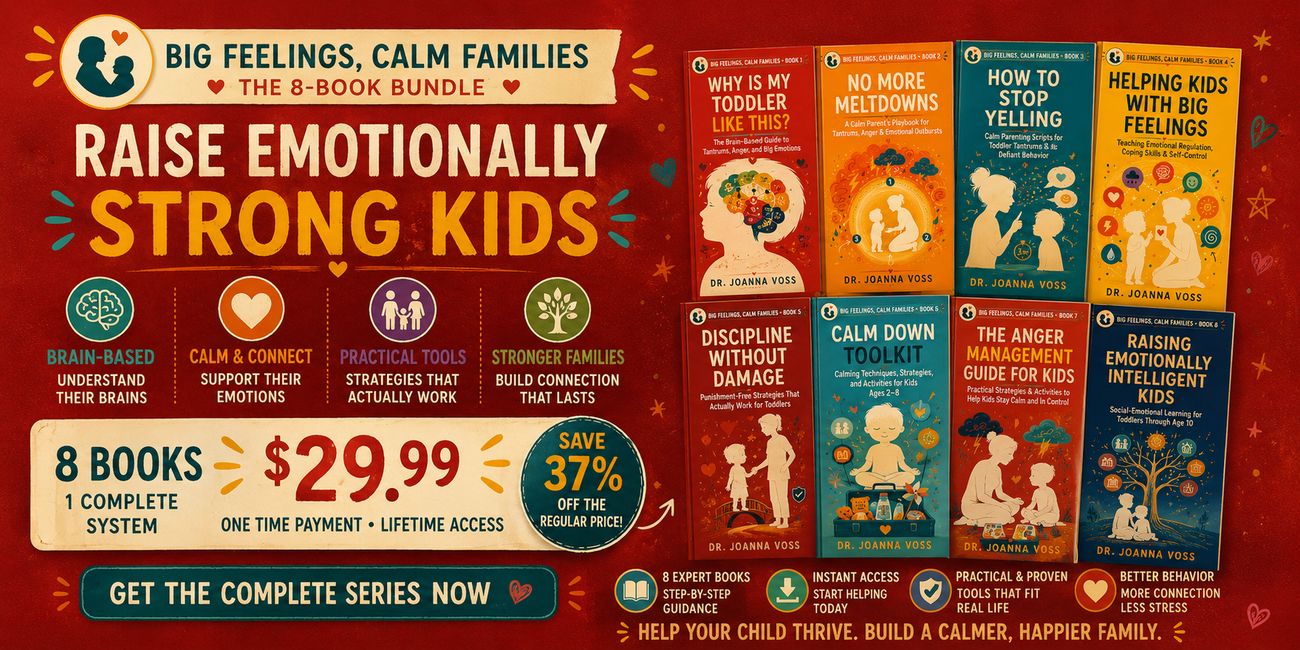
Big Feelings, Calm Families
A brain-based route through tantrums, meltdowns, anger and the emotional regulation nobody teaches you.
Get the series, from $29.99Joanna Voss · 8 books · instant download, read on any device
The series
Big Feelings, Calm Families
- Book 1Why Is My Toddler Like This?

- Book 2No More Meltdowns

- Book 3How to Stop Yelling

- Book 4Helping Kids With Big Feelings

- Book 5Discipline Without Damage

- Book 6Calm Down Toolkit

- Book 7The Anger Management Guide for Kids

- Book 8Raising Emotionally Intelligent KidsYou are here


About the author
Joanna Voss
Calm Parenting Scientist
Joanna Voss is a developmental psychologist, certified parent coach, and the author of the Big Feelings, Calm Families series.
More about Joanna Voss