

Helping Kids With Big Feelings
Teaching Emotional Regulation, Coping Skills, and Self-Control
Parenting497 pagesPublished 26 May 2026Kindle, paperback & hardcoverParenting
Helping children handle big feelings is not about forcing calm.
It is about teaching the skills underneath calm.
In Helping Kids With Big Feelings, developmental psychologist and parent coach Joanna Voss gives parents a warm, practical guide to teaching emotional regulation, coping skills, and self-control to children ages 2–10.
Children are not born knowing how to name feelings, read body signals, express emotions safely, pause before reacting, or ask for help when their feelings get too big. These are skills. And like all skills, they are built slowly through modeling, repetition, practice, and repair.
Inside, you will learn how to help your child:
- build an emotional vocabulary beyond “mad,” “sad,” and “fine”
- notice body signals before feelings become overwhelming
- understand the hidden feelings underneath anger
- release big emotions safely without hurting people or property
- use simple feeling words during conflict
- open up gently when they shut down or say “I’m fine”
- create a calm-down space that feels supportive, not punitive
- practice breathing, movement, and body-based regulation tools
- build a small coping skills menu that actually fits
- use STOP-THINK-CHOOSE to practice self-control
- recover after hard moments and build emotional resilience over time
This is not a promise of instant calm, perfect behavior, or children who never melt down.
It is a parent-led teaching guide for helping children gradually develop emotional awareness, safer expression, coping strategies, problem-solving skills, repair, and resilience.
With short sections, practical scripts, Teach It activities, age adjustments, realistic progress markers, and weekly practice prompts, Helping Kids With Big Feelings gives parents a clear way to teach emotional regulation without needing a therapy background, a perfect home environment, or unlimited patience.
Because children do not learn calm by being told to calm down.
They learn calm one word, one practice, one safe adult, and one repair at a time.
Read the first chapter
Chapter One: The Feelings Vocabulary: Giving Emotions a Name
Ask most children how they feel and you will get one of three answers:
Good.
Bad.
Fine.
Sometimes you get “I don’t know,” which is often the most honest answer in the room.
Not because the child is not feeling anything.
Children are almost always feeling something. Often many somethings. Loud somethings. Contradictory somethings. Somethings that seem wildly disproportionate to the fact that a granola bar broke in half.
The problem is not usually a lack of feeling.
The problem is a lack of words.
There is a significant difference between bad and disappointed.
Between mad and embarrassed.
Between sad and lonely.
Between fine and quietly overwhelmed but unwilling to discuss it with the committee at this time.
Adults use emotional language constantly, often without noticing. We say we are stressed, touched, irritated, resentful, relieved, nervous, discouraged, proud, conflicted, drained, or hopeful.
Children may be navigating those same emotional neighborhoods with three words and a crayon map.
Then we wonder why they cannot explain themselves.
Emotional vocabulary is not decoration. It is not a nice extra for families who have feelings charts and matching baskets. Emotional vocabulary is one of the first building blocks of emotional regulation.
A child who can name a feeling has a better chance of understanding it.
A child who can understand a feeling has a better chance of expressing it safely.
A child who can express a feeling safely has a better chance of getting help before the feeling turns into behavior.
Not every time.
Not perfectly.
But more often than before.
And that is where emotional regulation begins.
Opening Window
Maya is four. Her older brother has just been invited to a neighbor’s house without her.
She stands at the front window watching him cross the driveway. Her hands curl into fists. Her lower lip pushes out. When her mother says, “You’re disappointed,” Maya shouts, “No, I’m mad!”
Then she kicks the wall.
Her mother gently blocks the second kick and says, “You can be mad. You cannot kick the wall.”
Maya bursts into tears.
“I wanted to go,” she cries.
There it is.
Not only mad.
Disappointed.
Left out.
Maybe jealous.
Maybe lonely.
Maybe embarrassed that she was not chosen.
But at four, “mad” is the word she has. So mad becomes the container for everything.
This is common. Many children use their strongest available word, not their most accurate word. Anger especially becomes an all-purpose label because it is big, active, and easy to feel in the body.
But once Maya has more words, her world gets more understandable.
Not easier every time.
Understandable.
And understandable feelings are easier to support than mysterious explosions.
What’s Happening
Children are not born with a ready-made emotional vocabulary.
They are born with emotional capacity. Even babies experience distress, comfort, fear, pleasure, frustration, and connection. But the ability to understand and label those internal experiences develops over time through language, relationships, brain development, and repeated experience.
In plain parent language: children need us to lend them words until they can use their own.
At first, we name the obvious:
“You’re sad.”
“You’re mad.”
“That scared you.”
“You’re excited.”
“You’re tired.”
Later, we add more detail:
“You wanted another turn. That feels disappointing.”
“You worked hard and it fell down. That is frustrating.”
“You hid behind me when everyone sang. Maybe that felt overwhelming.”
“You laughed when you won. You looked proud.”
These small moments matter.
Every time you connect a feeling word to a child’s experience, you help build a bridge between the child’s inner world and their ability to communicate it.
There is a reason the phrase “name it to tame it” has become popular in parenting spaces. It can be oversimplified, but the basic idea is useful: naming a feeling can help reduce its intensity. When a child can put words to an experience, the feeling becomes less mysterious and less all-consuming.
The feeling moves from “this is happening to me” toward “this is something I can notice.”
That shift matters.
Of course, naming a feeling does not magically calm every child. You can say, “You’re disappointed,” and your child may still cry, yell, or collapse dramatically on the rug as though gravity itself has betrayed them.
That does not mean naming failed.
It means naming is a skill, not a spell.
We are not saying the right word so the child will instantly calm down. We are teaching the child, over many repetitions, that feelings have names and names give us a place to begin.
Why Common Approaches Fall Short
One common approach is asking, “How do you feel?” and expecting the child to answer accurately.
This is reasonable. It is also often too hard.
If a child has limited emotional vocabulary, “How do you feel?” is like handing them a blank form in a language they barely speak.
They may shrug.
They may say, “I don’t know.”
They may say, “Bad.”
They may get irritated because now, on top of the original feeling, they also feel pressured to explain it.
Another common approach is telling the child what they feel too quickly.
“You’re sad.”
“You’re jealous.”
“You’re embarrassed.”
“You’re angry because you didn’t get your way.”
Sometimes we are right. Sometimes we are not. And children, bless them, are often very willing to inform us when we have chosen incorrectly.
“I’m not sad! I’m MAD!”
That correction is not a problem. In fact, it can be progress. A child who corrects your feeling word is engaging in emotional discrimination. They are saying, “That word does not fit what is happening inside me.”
Wonderful.
Annoying in the moment, perhaps. But wonderful.
The goal is not to become the official narrator of your child’s emotional life. The goal is to offer language and let your child begin to sort what fits.
A third common approach is only talking about feelings during crisis.
This is understandable because big feelings get our attention. When a child is screaming, hiding, hitting, or sobbing, we suddenly become very interested in emotional education.
But crisis is the hardest time to teach vocabulary.
A flooded child does not have easy access to language. Their body is busy. Their thinking brain is not in its best office hours.
Calm moments are better.
Reading a book.
Watching a show.
Driving in the car.
Playing with stuffed animals.
Talking about a small disappointment after it has passed.
Noticing your own feeling out loud.
These ordinary moments are where emotional vocabulary grows.
You are not trying to give a lecture. You are sprinkling words into daily life until your child begins to pick them up.
The Skill
The skill in this chapter is simple and foundational:
Children learn to identify and name their emotions with increasing accuracy.
That does not mean they will always name feelings during the hardest moments.
Early emotional vocabulary may show up after the fact.
A child may scream for ten minutes and later say, “I was mad.”
That counts.
A child may point to a sad face on a chart.
That counts.
A child may say, “I’m not scared. I’m nervous.”
That counts.
A child may use a feeling word for a character in a story before using it for themselves.
That counts too.
We want to move children gradually from broad feeling words to more precise ones.
Ages two to three usually begin with simple words:
Happy.
Sad.
Mad.
Scared.
Tired.
Excited.
Ages four to five can begin adding:
Frustrated.
Disappointed.
Nervous.
Lonely.
Proud.
Embarrassed.
Worried.
Calm.
Ages six to eight can usually handle more nuance:
Jealous.
Discouraged.
Confused.
Left out.
Guilty.
Relieved.
Irritated.
Unsure.
Ages nine to ten can begin exploring mixed and layered feelings:
Conflicted.
Resentful.
Insecure.
Grateful.
Ashamed.
Determined.
Rejected.
Pressured.
Misunderstood.
The exact ages matter less than the progression. We start with broad words, then add detail, then add mixed feelings.
Because children often experience more than one feeling at a time.
Excited and nervous.
Angry and hurt.
Happy and jealous.
Proud and worried.
Sad and relieved.
If adults struggle with mixed feelings - and we do, because we are human and not emotional spreadsheets - children need plenty of time and support to understand them.
The Feeling Word Ladder
One practical way to expand your child’s vocabulary is to use a feeling word ladder.
Start with the word your child already knows, then gently offer nearby words with more detail.
For example:
Mad → frustrated → disappointed → embarrassed → overwhelmed
A child may say, “I’m mad!”
You might respond:
“You are mad. I wonder if it is also frustrating because the puzzle piece will not fit.”
Or:
“You are really mad. Sometimes when plans change, that feeling is disappointment.”
Or:
“You yelled when everyone laughed. I wonder if that felt embarrassing.”
Or:
“That was a lot of noise and people. Your mad may have had some overwhelmed underneath it.”
You are not forcing a new label.
You are offering possibilities.
The words “I wonder” are very helpful here.
“I wonder if you felt disappointed.”
“I wonder if that was embarrassing.”
“I wonder if your body felt overwhelmed.”
“I wonder if mad was the biggest feeling, and hurt was underneath.”
Wondering leaves space.
It gives the child permission to accept, reject, or revise.
This matters because children need ownership over their feelings. If adults constantly announce what children feel, children may become defensive or disconnected from their own inner signals.
We want to teach language without taking over the child’s emotional experience.
Think of yourself as a guide holding up possible signs.
“Could it be this one?”
“No?”
“Maybe this one?”
“Ah. That one fits.”
Everyday Ways to Build Emotional Vocabulary
You do not need a formal lesson plan to teach feeling words.
In fact, most children learn emotional language best when it is woven into normal life.
Start with books.
Storybooks are emotional vocabulary gold. Characters lose things, want things, fear things, try things, fail things, misunderstand things, and occasionally behave in ways that make adults question the author’s home life.
As you read, pause briefly and ask:
“How do you think she feels?”
“What do you think he wanted?”
“Does that look like a sad face or a worried face?”
“I think he might feel proud because he kept trying.”
Do not turn every page into an interrogation. Nobody enjoys being quizzed through a bedtime story. Keep it light.
You can also use shows and movies.
“That character looks nervous.”
“He seemed embarrassed when everyone looked at him.”
“She was excited and scared at the same time.”
Everyday life works too.
At the playground:
“She wanted a turn. She might feel frustrated.”
At the grocery store:
“That baby is crying. Maybe he feels tired.”
At home:
“You smiled when your tower stayed up. You look proud.”
During your own day:
“I feel disappointed that our plan changed. I can handle it, but I need a minute.”
This is not oversharing. This is modeling. You are showing your child that feelings have names and can be talked about in ordinary ways.
The key is to keep it brief.
Children do not need a full emotional analysis of every moment. They need repeated exposure to language they can eventually use.
Think of feeling words as seeds.
You scatter them often.
You do not dig them up every five minutes to see if they are growing.
Teach It: The 60-Second Feelings Check-In
The 60-Second Feelings Check-In is a short, low-pressure way to help your child practice naming emotions.
The goal is not deep conversation.
The goal is familiarity.
Once a day, during a calm moment, ask:
“What is one feeling in your body right now?”
That is it.
Not “Tell me everything you felt today.”
Not “Let’s process your entire emotional landscape before dinner.”
One feeling.
Sixty seconds.
For younger children, offer choices:
“Do you feel happy, mad, sad, scared, tired, or excited?”
If that is still too much, narrow it further:
“Happy or sad?”
“Mad or tired?”
“Excited or calm?”
For children around four to five, add more specific options:
“Is it more frustrated, disappointed, nervous, proud, or lonely?”
For older children, try:
“Is there one feeling that was strong today?”
Or:
“Did you feel more calm, pressured, annoyed, hopeful, embarrassed, or unsure?”
After the child answers, resist the urge to make it a large conversation every time.
Simply say:
“Thank you for telling me. Feelings are information.”
That sentence is important.
Feelings are information.
They are not commands. They are not emergencies. They are not character flaws. They are signals that tell us something about needs, limits, preferences, fears, disappointments, hopes, and experiences.
If your child says, “I don’t know,” you can respond:
“That’s okay. Sometimes feelings are hard to find.”
Then offer:
“Would it help if I gave you two choices?”
If your child still does not know, let it go.
You might say:
“No problem. We can try another time.”
This keeps the check-in safe.
The fastest way to make a child hate emotional vocabulary is to turn every feeling question into a performance.
Keep it light.
Keep it brief.
Keep it optional enough that the child does not feel trapped.
A feelings check-in should feel like opening a small window, not being dragged into a meeting.
Age Adjustments
For ages two to three, use simple words and visible cues.
At this age, children need concrete language. Use faces, tone of voice, body posture, and your own expressions.
“You are sad. Tears are here.”
“You are mad. Your hands are tight.”
“You are excited. You are jumping.”
“You are scared. You came close to me.”
Do not expect long answers. A two-year-old saying “mad” while crying is meaningful progress. So is pointing to a feeling face. So is repeating a word after you.
For ages four to five, expand the vocabulary.
This is a wonderful age for adding words like frustrated, disappointed, nervous, lonely, proud, embarrassed, surprised, worried, calm, and overwhelmed.
Use stories, pretend play, puppets, stuffed animals, and daily moments.
“Bear feels disappointed because Bunny got the first turn.”
“You look proud of that drawing.”
“That was a loud room. I wonder if your body felt overwhelmed.”
Children this age often enjoy correcting adults, and emotional language gives them another opportunity. Lucky us.
If you say, “You felt sad,” and your child says, “No, I was frustrated,” try to welcome it.
“You’re right. Frustrated fits better.”
That correction means the child is learning precision.
For ages six to ten, introduce nuance and mixed feelings.
Older children can begin to understand that feelings are layered.
“You can be excited for the party and nervous about who will be there.”
“You can feel happy for your friend and jealous that they got chosen.”
“You can feel angry and embarrassed at the same time.”
“You can love someone and still feel irritated by them.”
This is also the age when some children become more private. They may not want to discuss their feelings on command, especially in front of siblings.
That is the end of chapter one.
The rest of Helping Kids With Big Feelings is waiting for you.

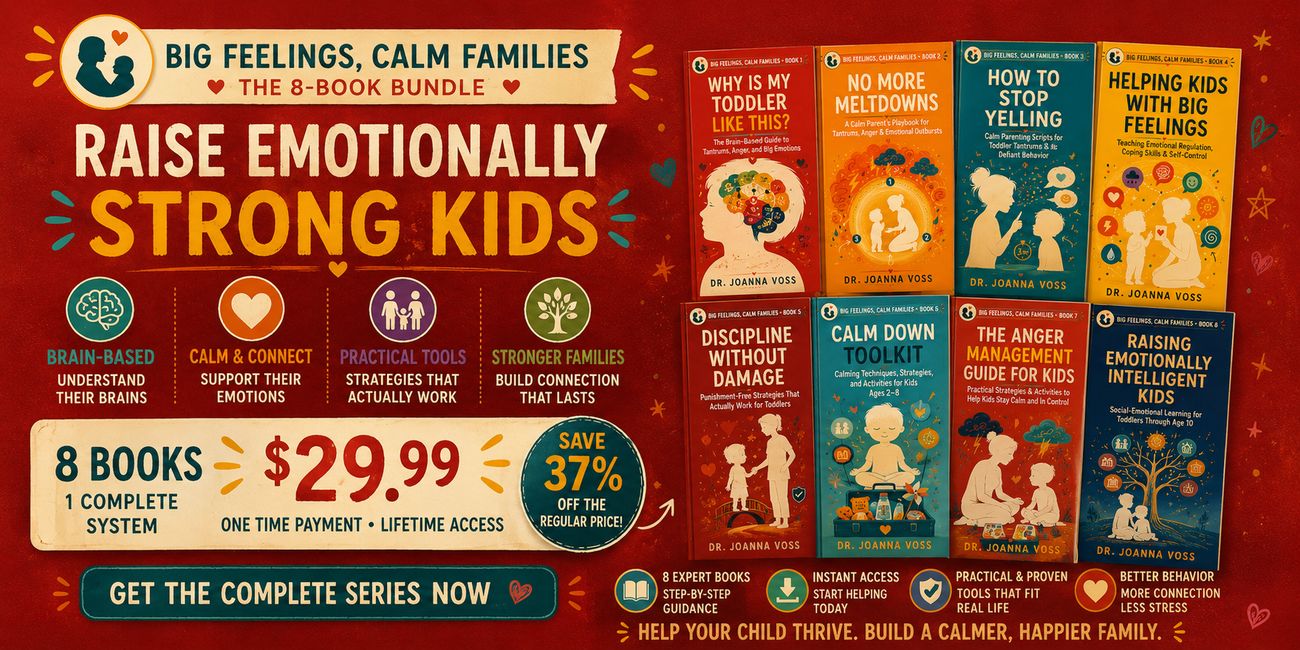
Or take the whole collection
Big Feelings, Calm Families
A brain-based route through tantrums, meltdowns, anger and the emotional regulation nobody teaches you.
Get the series, from $29.99Joanna Voss · 8 books · instant download, read on any device
The series
Big Feelings, Calm Families



About the author
Joanna Voss
Calm Parenting Scientist
Joanna Voss is a developmental psychologist, certified parent coach, and the author of the Big Feelings, Calm Families series.
More about Joanna Voss