

Discipline Without Damage
Punishment-Free Strategies That Actually Work for Toddlers and Young Kids
Parenting552 pagesPublished 1 June 2026Kindle, paperback & hardcoverParenting
Discipline does not have to mean yelling, threats, shame, or punishment.
If you are trying to raise a toddler or young child with clear limits and a strong relationship, but you keep getting stuck in power struggles, this book gives you a practical way forward.
Discipline Without Damage is the punishment-free discipline system in the Big Feelings, Calm Families series. Written in Joanna Voss’s warm, practical, science-informed voice, this guide helps parents understand what discipline is really for: not making children pay for mistakes, but teaching them what to do next time.
Inside, you will learn how to:
- set clear expectations before behavior falls apart
- hold firm limits without becoming harsh or cold
- replace punishments with natural and logical consequences that teach
- respond to hitting, biting, throwing, refusing, arguing, and running away
- discipline toddlers ages 2–3 with simple, immediate strategies
- guide children ages 4–6 with choices, repair, and problem-solving
- reduce repeated discipline battles through structure and prevention
- work more consistently with co-parents, grandparents, babysitters, and caregivers
- repair after hard moments without removing the limit
This is not permissive parenting. Children need structure, boundaries, consistency, and adult authority. But authority does not have to be built on fear.
With clear frameworks, realistic scripts, age-by-age guidance, and printable discipline tools, this book helps parents build cooperation while preserving connection.
Punishment may stop behavior for a moment. Discipline teaches the child what to do for a lifetime.
Read the first chapter
Chapter One: The Discipline Myth: What We Were Taught vs. What Actually Works
You are standing in the kitchen.
Your child has thrown the cup again.
Not dropped it. Not accidentally nudged it. Thrown it with the kind of dramatic follow-through usually reserved for Olympic javelin.
Milk is spreading across the floor. Your child is staring at you. Maybe smiling. Maybe crying. Maybe preparing to throw the spoon next, because apparently we are doing a full tableware release ceremony this morning.
You feel the old sentence rising in your throat.
“If you do that one more time…”
Or maybe:
“That’s it. Time-out.”
Or:
“No TV today.”
Or:
“I’m counting to three.”
Or the classic parental phrase that has echoed through generations:
“What is wrong with you?”
You may not say it.
But you feel it.
That is the moment discipline usually begins.
Not when we are calm. Not when we are reflective. Not when we are sitting with a cup of tea and an annotated child development textbook.
Discipline begins when something has gone wrong and the parent’s nervous system has opinions.
Most of us reach for what we know. We reach for the tools we saw, received, absorbed, rejected, repeated, or promised we would never use. We reach for whatever sounds like authority when we feel our authority slipping.
And that is why so many parents end up disciplining the way they were disciplined, not because it worked beautifully, but because it is the model stored in the body.
The Default Response: Inherited Discipline
Inherited discipline is the discipline we did not consciously choose.
It is the voice that comes out of us before we have time to think.
It may sound like our own parent. Or a teacher. Or a coach. Or the general cultural soundtrack of childhood: children should obey, adults should be in charge, bad behavior deserves consequences, and if a child is not listening, the consequence probably needs to be bigger.
Inherited discipline often includes tools like time-outs, counting to three, taking things away, sending children to their rooms, threatening consequences, yelling, and using rewards to control behavior.
These tools are not all the same. They are not equally harmful. They do not all come from bad intentions. Many were developed or popularized because adults were trying to move away from harsher discipline. Time-outs, for example, were introduced as a more humane alternative to physical punishment. For many families, that was a meaningful step forward.
But the way a tool is intended and the way it is used in a stressed household at 6:18 p.m. can be very different things.
A time-out intended as a brief pause may become isolation.
Counting intended as a reminder may become a threat countdown.
A consequence intended to teach may become revenge with better branding.
A reward chart intended to encourage may become a control system that teaches a child to cooperate only when payment is visible.
A parent who starts with calm authority may become louder and harsher each time the child does not immediately comply.
Again, this is not because parents are bad.
It is because the old system often gives parents only one lever: pressure.
If the child does not listen, add pressure.
If they still do not listen, add more pressure.
If they still do not listen, the parent either explodes or collapses.
Neither feels good. Neither teaches much.
What These Tools Often Produce
Let’s look at what many traditional tools are meant to produce, and what they often produce instead.
Parents use time-outs hoping the child will calm down, think about what they did, and return ready to behave better.
Sometimes a pause does help. Some children need space. Some children calm more easily with reduced stimulation. Some older children can benefit from a quiet reset when it is offered supportively and not as rejection.
But when time-out is used as banishment, “Go away until I like your behavior again”, many young children do not sit there reflecting on cause and effect. They sit there angry, ashamed, frightened, or disconnected. They may be waiting for it to end. They may be rehearsing resentment. They may be learning that when they lose control, they also lose connection.
A supported break is different.
A supported break says, “Your body is having a hard time. We are going to take a pause together, or I will stay nearby while you calm.”
Punitive isolation says, “You are too much. Go away.”
The difference is not just location.
The difference is the message.
Parents use counting to three hoping it gives the child a warning and a chance to comply.
Sometimes it does. A child hears “one…” and moves because they know the parent means business.
But counting can also train children to ignore the first request. They learn that they do not need to respond until the countdown begins. The parent says, “Put your shoes on,” and the child’s body says, “Interesting suggestion. I’ll wait for numbers.”
Counting can become less about teaching cooperation and more about building suspense.
Parents take things away hoping children will understand that behavior has consequences.
Sometimes removing an item is exactly right. If a toy is being thrown at people, the toy needs to be put away. If markers are being used on the wall, markers need to pause. That is not punishment; that is a related consequence.
But when the thing removed has no connection to the behavior, “You hit your sister, so no dessert tonight”, the lesson becomes blurry. The child may learn that upsetting the adult makes something good disappear. They may not learn what to do with anger, how to repair, or how to keep hands safe.
Parents send children to their rooms hoping they will calm down and think.
Sometimes a child’s room is genuinely a calming space. Some children benefit from quiet, privacy, and a reset.
But if the room becomes a place of rejection, humiliation, or exile, the child may learn to associate separation with being bad. The behavior may stop, but the relationship pays a price.
Parents threaten consequences hoping to regain control.
“If you don’t stop, we are leaving.” “If you do that again, I’m throwing it away.” “If you don’t listen, no birthday party.” “If you keep this up, no screen time for a week.”
Threats can create movement. They can also create fear, bargaining, panic, or power struggles. And when the threat is too big to enforce, the parent loses credibility.
Children are excellent little researchers. They gather data.
If a parent regularly announces consequences they cannot or will not follow through on, the child learns that adult words are sometimes weather: loud, dramatic, and not always meaningful.
Parents yell because they need the behavior to stop.
Sometimes yelling does stop behavior. A loud voice can startle a child into compliance.
But yelling often teaches the child that the parent is not in control yet. It can flood the child’s nervous system, especially if the child is already dysregulated. It may produce obedience in the moment while increasing fear, defensiveness, or escalation over time.
Parents use reward charts hoping to motivate positive behavior.
Rewards can be useful in specific, short-term situations. A child learning a new routine may benefit from a visual tracker. A sticker chart can help make progress visible. External motivation is not evil. Most adults still enjoy external motivation. This is why coffee loyalty cards exist.
The problem comes when rewards become the entire discipline system.
If every act of cooperation requires payment, the child may begin asking, “What do I get?” instead of learning, “This is how we live together.”
The goal is not to eliminate every reward.
The goal is to avoid building a family culture where cooperation depends on prizes and correction depends on pain.
Why It Underdelivers
Traditional discipline often underdelivers because it focuses on the surface behavior without teaching the missing skill underneath.
A child grabs because they lack impulse control, language, patience, or confidence that they will get a turn.
A child hits because anger has flooded the thinking brain and the body acted faster than words.
A child refuses because transitions are hard, the expectation is unclear, the task feels overwhelming, or the child has discovered that refusal creates an interesting amount of adult activity.
A child throws food because they are done, bored, sensory-seeking, experimenting, or trying to say, “No more,” with peas.
The behavior still needs a limit.
But if we only punish the behavior, we may miss the lesson.
Fear and shame are especially poor learning states for young children. When a child feels frightened, humiliated, or relationally unsafe, the brain prioritizes protection. The child may freeze, fight, flee, or submit. They may become quiet. They may say sorry. They may appear compliant.
But compliance is not the same as integration.
A scared child may remember the punishment without absorbing the principle.
A shamed child may think, “I am bad,” instead of, “I need to practice a different behavior.”
A disconnected child may focus more on the rupture than the repair.
This is why a child can be punished for the same behavior again and again and still repeat it.
The punishment may be memorable.
The skill may still be missing.
Discipline that teaches asks a better question: What does my child need in order to do this differently next time?
Do they need a clearer expectation? A shorter instruction? More supervision? A physical boundary? A replacement phrase? A chance to repair? A logical consequence? A calmer nervous system? A more realistic developmental demand?
This is the shift from inherited discipline to intentional discipline.
Inherited discipline says, “This is what adults do when children misbehave.”
Intentional discipline says, “This is what this child needs to learn in this moment.”
The Three Jobs of Discipline
Discipline should do three things.
It should stop what cannot continue.
It should teach what should happen instead.
It should preserve enough connection for the lesson to land.
Let’s stay with the thrown cup.
What needs to stop?
The cup throwing.
What does the child need to learn?
Maybe: cups stay on the table. Maybe: say “all done” when finished. Maybe: ask for help. Maybe: throwing is for balls, not cups. Maybe: when angry, push the cup away instead of launching it into dairy orbit.
How can you teach that without damaging trust?
You move close. You stop the throwing. You use a calm, short limit.
“Cups are not for throwing. The cup is going away.”
If the child is two, that may be enough.
If the child is five, you might add:
“If you are done, say, ‘All done.’ We can try again at snack.”
If you yelled first, you repair later:
“I got too loud. I was frustrated about the milk, and I still should not have shouted. Cups are not for throwing. Next time, you can say, ‘All done.’ Let’s clean this together.”
Notice that repair does not erase the limit.
Repair is not, “Never mind, throw whatever you like, my precious emotional teacher.”
Repair says, “I am responsible for my behavior, and you are still responsible for yours.”
That is powerful modeling.
Children learn responsibility partly by watching adults take responsibility.
The Three Discipline Questions
Before choosing a discipline response, pause and ask:
1. What needs to stop?
This keeps discipline from becoming vague emotional discharge.
Instead of “You are being impossible,” name the behavior.
“Hitting needs to stop.” “Food throwing needs to stop.” “Running away in the parking lot needs to stop.” “Screaming in my face needs to stop.” “Markers on the wall need to stop.”
When you name the behavior clearly, you make the limit clearer for both of you.
2. What does my child need to learn instead?
This is the question punishment often skips.
If hitting stops, what should the child do with anger?
If grabbing stops, how should the child ask for a turn?
If running stops, what should the child do in a parking lot?
If screaming stops, how can the child show frustration?
If wall drawing stops, where can the child use markers?
Every “don’t” needs a “do.”
Young children learn better when we tell them what to do, not only what to stop doing.
“Don’t run” becomes “Walking feet.”
“Don’t hit” becomes “Hands down.”
“Don’t throw food” becomes “Food stays on the table.”
“Don’t scream at me” becomes “Use a strong voice, not a hurting voice.”
“Don’t grab” becomes “Say, ‘Can I have a turn?’”
3. How can I teach that without damaging trust?
This question does not mean your child will enjoy the lesson.
Children can dislike a limit and still trust the adult holding it.
A child can cry while remaining emotionally safe.
A child can be angry at you and still know you are on their side.
Teaching without damaging trust means you do not use shame, fear, rejection, humiliation, or love withdrawal as the teaching tool.
It means the message is:
“I will stop what is unsafe or unkind. I will help you learn what to do instead. You are still my child. We are still connected.”
That is discipline without damage.
Step by Step: What to Do When Behavior Happens
When behavior happens, use this sequence.
1. Pause before reacting.
Not a long pause. Not a meditative retreat. Just enough space to avoid letting your first surge choose the whole response.
Take one breath.
Put your feet on the floor.
Lower your shoulders.
Say to yourself:
SAY THIS TO YOURSELF: “My job is not to make them pay. My job is to teach what comes next.”
This sentence is not sentimental. It is a steering wheel. It turns you away from revenge and toward teaching.
2. Name the behavior that cannot continue.
Be specific.
“I won’t let you hit.” “Food is not for throwing.” “Markers are not for walls.” “You may not scream in my face.” “Parking lots are not for running.”
Children need clear labels for the behavior. “Stop being bad” is not useful. “Hands stay off your brother’s body” is useful.
3. Identify the missing skill.
Ask silently: What skill is missing?
Impulse control? Language? Waiting? Transitioning? Problem-solving? Emotional regulation? Understanding the rule? Handling disappointment? Respecting someone’s body?
This question softens the parent’s interpretation without removing the limit.
The child is not “getting away with it.”
You are getting more accurate.
4. Choose a response that teaches the skill.
If the child threw the toy, the toy pauses.
If the child hit, bodies separate and repair happens later.
If the child drew on the wall, markers pause and cleanup happens with help.
If the child ran in the parking lot, hand-holding becomes non-negotiable.
If the child screamed for a snack, the snack does not arrive through screaming; you practice the phrase.
Use the consequence that connects to the behavior.
Use the teaching that points to next time.
5. Repair if your delivery becomes harsher than intended.
You will miss it sometimes.
You may yell. You may threaten something too big. You may say the thing your own parent said. You may use your “I have become a courtroom judge” voice over a spilled smoothie.
That is the end of chapter one.
The rest of Discipline Without Damage is waiting for you.

Or take the whole collection
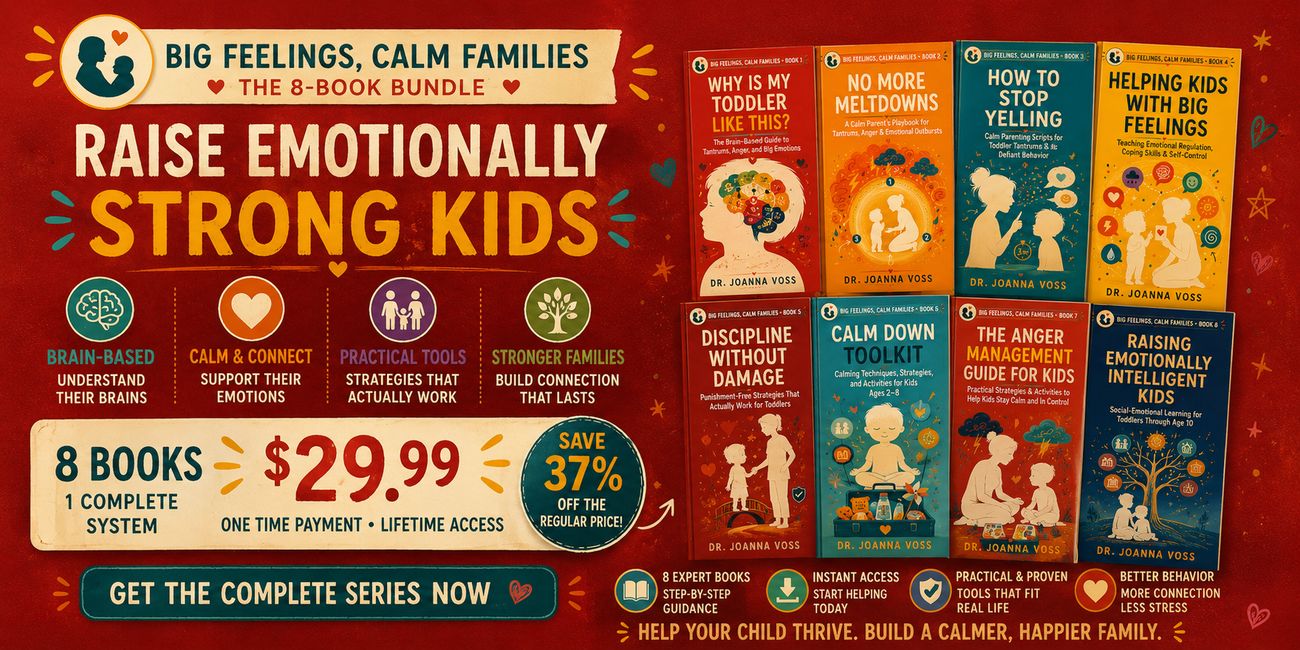
Big Feelings, Calm Families
A brain-based route through tantrums, meltdowns, anger and the emotional regulation nobody teaches you.
Get the series, from $29.99Joanna Voss · 8 books · instant download, read on any device
The series
Big Feelings, Calm Families



About the author
Joanna Voss
Calm Parenting Scientist
Joanna Voss is a developmental psychologist, certified parent coach, and the author of the Big Feelings, Calm Families series.
More about Joanna Voss