

Calm Down Toolkit
Calming Techniques, Strategies, and Activities for Kids Ages 2–8
Parenting407 pagesPublished 31 May 2026Kindle, paperback & hardcoverParenting
Your child does not need another lecture in the middle of a meltdown. They need a tool.
Calm Down Toolkit is the hands-on tool library of the Big Feelings, Calm Families series, giving parents, caregivers, and educators sixty practical calming techniques for children ages 2–8.
Inside, Joanna Voss offers clear, child-friendly strategies for helping children move through anger, anxiety, overstimulation, shutdown, transition stress, bedtime struggles, and big feelings that arrive faster than words.
You’ll find:
- Breathing exercises children can actually understand
- Movement tools for high-energy and sensory-seeking kids
- Sensory calming tools using touch, sound, sight, smell, pressure, and temperature
- Creative calming activities using drawing, playdough, tearing, puppets, and collage
- Co-regulation scripts and together tools for parents and caregivers
- Daily calm routines for mornings, after school, bedtime, and transitions
- A Personal Toolkit Builder to help your child choose the tools that fit them best
This book does not promise that every tool will work for every child. Instead, it helps you find the right few: tools your child knows, trusts, practices, and can return to when feelings get too big.
Warm, practical, science-informed, and deeply usable, Calm Down Toolkit is designed for real families, real classrooms, real meltdowns, and real children who need a way through.
Read the first chapter
Chapter One: Why Calming Tools Work Better Than Calming Lectures
“Calm down” is one of the most common things adults say to overwhelmed children.
It is also one of the least useful.
Not because calm is the wrong goal.
Calm is a very reasonable goal. Calm is lovely. Calm is what we all hope will return before someone peels a sticker off the furniture, launches a shoe, or screams because their banana is no longer shaped like the banana they had emotionally committed to.
The problem is not the goal.
The problem is that “calm down” gives the child no route.
It names the destination without handing them a map.
Imagine standing in the middle of a busy city, lost, exhausted, overstimulated, hungry, and slightly furious. Someone walks by and says, “Get home.”
Helpful? Not especially.
Now imagine someone says, “Turn left. Breathe. I’m staying with you. Walk to the corner. We’ll cross together.”
That is different.
That is support.
Children need the same kind of support when their feelings get too big. A child in the middle of a big feeling needs something more specific than an instruction to become calm.
They need a route.
Push the wall. Blow the candle. Hold the ice. Trace your fingers. Squeeze the pillow. Sit with me and breathe. Watch the glitter settle. Walk the anger route. Hum like a bee. Tear the paper, not the book.
Those are routes.
A calming tool works because it gives the child’s nervous system something to do other than escalate.
And that matters because calming is not a moral achievement. It is not proof that your child is “good.” It is not proof that you are a patient, glowing, perfectly regulated adult who definitely did not mutter something unprintable in the pantry at 5:17 p.m.
Calming is a physiological process.
The body has to come back toward safety before the child can think clearly, listen well, use words, solve problems, or accept correction.
That is why tools work better than lectures.
A lecture asks the child to use the part of the brain that is least available during dysregulation.
A tool gives the body a job.
“Calm Down” Is Not a Strategy
Most adults do not say “calm down” because they are trying to be unhelpful.
We say it because we are overwhelmed too.
We see the screaming, crying, kicking, hiding, refusing, bolting, clinging, arguing, or collapsing, and our adult brain leaps toward the outcome we want.
We want calm.
So we say, “Calm down.”
Unfortunately, from the child’s perspective, that phrase can land in several unhelpful ways.
It can sound like criticism: “You are too much.”
It can sound like pressure: “You need to fix this quickly.”
It can sound like dismissal: “Your feeling is inconvenient.”
It can sound impossible: “Do something you do not know how to do right now.”
For some children, “calm down” even escalates the feeling. Now they are upset, and they feel misunderstood, rushed, or ashamed about being upset.
A delightful two-for-one special, except nobody wanted it.
This does not mean you can never use the word calm. Calm is a perfectly fine word. The issue is using “calm down” as if it were a tool.
It is not a tool.
It is a command.
And during dysregulation, commands often collide with the child’s nervous system instead of guiding it.
A better approach is to translate the command into an action the child can actually do.
Instead of “Calm down,” try:
SAY THIS: “Your body needs help. Let’s try one tool.”
Instead of “Stop crying,” try:
SAY THIS: “This is a big feeling. I’m going to sit with you.”
Instead of “You need to relax,” try:
SAY THIS: “Push the wall with me.”
Instead of “Use your words,” try:
SAY THIS: “Point to what you need. Words can come later.”
Instead of “You’re fine,” try:
SAY THIS: “You’re having a hard moment. We can help your body through it.”
Notice the difference.
The first set of phrases demands an outcome.
The second set offers a route.
Calming Is a Body Process First
When a child is dysregulated, the body is involved before reasoning is available.
The heart may beat faster. Breathing may become shallow. Muscles may tighten. The child may feel hot, shaky, trapped, restless, frozen, heavy, or explosive. Their voice may get louder. Their movements may become bigger. Their ability to process language may shrink dramatically.
This is why a child can seem completely unreachable during a meltdown.
It is not that they have forgotten everything you have ever taught them. It is that their body is in charge for a while.
Big feelings are not just thoughts.
They are body states.
Anger can feel like heat, pressure, energy, and forward motion.
Anxiety can feel like tightness, buzzing, nausea, freezing, or needing to escape.
Sadness can feel heavy and slow.
Overstimulation can feel like the world is too loud, too bright, too close, too itchy, too many.
Shame can make a child hide, lash out, deny everything, or go silent.
Exhaustion can look suspiciously like defiance, especially in children who have not yet learned to say, “I am depleted and need reduced cognitive and sensory demands,” because they are four.
When we understand calming as a body process, we stop treating dysregulation as a character flaw.
A child who cannot calm yet is not failing a test.
They are showing us that their current tools are not strong enough for the size of the feeling.
That is where we come in.
We lend regulation. We reduce demands. We offer structure. We choose tools. We practice later.
We do not shame the child for needing help.
The Child Does Not Need More Words
Words are wonderful.
I am very fond of words. I have built much of my professional life around them, and I still believe there are few things more powerful than a well-timed sentence.
But during a child’s peak dysregulation, words have limits.
Many children cannot process long explanations when overwhelmed. Some cannot answer questions. Some hear only fragments. Some become more upset because questions feel like pressure. Some children interpret every word as correction, even when you are trying to help.
This is why the classic meltdown speech rarely works:
“You need to understand that when you throw the truck, it could hurt someone, and we have talked about using gentle hands, and now you need to make a better choice because this is not acceptable.”
Accurate? Possibly.
Useful mid-meltdown? Usually not.
The child is not calmly taking notes.
A dysregulated child often needs fewer words, not better paragraphs.
Try one sentence.
Then a tool.
SAY THIS: “I’m here. We’re getting safe.”
Then move the truck.
SAY THIS: “Your body needs pushing. Push this wall.”
Then model it.
SAY THIS: “Too loud. Headphones or quiet corner?”
Then wait.
SAY THIS: “You don’t have to talk yet.”
Then sit nearby.
This does not mean you skip teaching. It means you teach when the child can learn.
The order is:
Regulate. Reconnect. Reflect. Repair. Practice.
Not all in the same breath. Not while someone is still crying into the carpet.
Crisis Tools and Practice Tools Are Not Always the Same
A crisis tool is for the hot moment.
A practice tool is for the calm moment.
Some tools can do both, but it helps to know the difference.
A crisis tool needs to be simple. It should not require much explanation, planning, fine motor precision, or emotional insight. It should meet the child where they are.
For example:
A furious child may need Wall Push-Ups, The Anger Stomp, Cold Water Hands, or Tear-It Paper.
An anxious child may need 5-Finger Breathing, Hand Squeeze Code, a Smell Kit, or Side-by-Side Sitting.
An overstimulated child may need Sound Shield, a quiet room, a Visual Focus Point, or reduced light.
A shut-down child may need The Quiet Anchor, a Texture Basket, Puppet Feelings, or simply a safe adult nearby without questions.
Practice tools are different. These are the tools you introduce when your child is calm enough to play, listen, experiment, and choose.
Practice tools build familiarity.
They say to the child’s body, “We know this route.”
A child who has practiced Balloon Breathing during silly play may later understand the prompt “Balloon breath with me.”
A child who has practiced pushing the wall for fun may later use Wall Push-Ups instead of pushing a sibling.
A child who has chosen their own calm card deck may be more willing to pick a card when they feel themselves rising.
A child who has used the Hand Squeeze Code in calm moments may use it in a crowded room when words feel impossible.
Tools introduced for the first time during crisis often fail because the child’s brain is already overloaded.
That does not mean the tool is useless.
It may mean the timing was wrong.
Think of practice as laying the track. Crisis is when the train needs somewhere to go.
The Tool Has to Match the Child
There is no universal calming tool.
I know. Very inconvenient.
It would be wonderful if there were one perfect technique that worked for every child in every situation. We could print it on a magnet, put it on the fridge, and all go have a calm cup of tea.
Children, however, remain committed to being individuals.
A tool that calms one child may irritate another.
One child loves deep pressure. Another shrieks if touched.
One child relaxes with humming. Another finds humming unbearable, especially if a sibling is doing it with theatrical enthusiasm.
One child needs movement. Another needs stillness.
One child likes a parent nearby. Another needs space before connection.
One child can use breathing as a first step. Another needs to stomp, push, or shake before breathing is even remotely available.
This is not a problem. It is the point of having a toolkit.
You are not looking for the tool.
You are looking for your child’s tools.
That requires observation.
When your child begins to escalate, notice:
Do they get bigger, louder, faster? Do they run, hit, throw, push, or crash? Do they hide, freeze, curl up, or go quiet? Do they cover their ears or eyes? Do they seek pressure, squeezing, or tight spaces? Do they resist touch? Do they talk more, or lose words? Do they want you close, or need you nearby but not too near? Do they calm after movement? Do they calm after food, water, rest, or quiet? Do they become worse when given choices? Do they become worse when adults talk too much?
The answers guide the tool.
Movement-First Children
Some children need to move before they can calm.
These children often appear intense, impulsive, restless, explosive, loud, or physically driven when dysregulated. They may run, jump, kick, crash into furniture, push against people, throw objects, or seem unable to keep their body still.
This can look like misbehavior.
Sometimes there is misbehavior involved, especially if someone is getting hurt or property is being destroyed. Safety still matters.
But underneath the behavior, the child’s nervous system may be asking for physical discharge.
For a movement-first child, a quiet breathing exercise may be too slow at the beginning. Their body has energy that needs somewhere safe to go.
These children may respond better to:
Wall Push-Ups. Heavy Book Carry. The Anger Stomp. Bear Walk. Frog Jumps. Push the Floor. Shake It Out. The Counting Walk.
The goal is not wild movement without limits.
The goal is safe, structured movement that gives the body input and discharge.
SAY THIS: “Your body has big energy. Push here.”
SAY THIS: “Feet on the stomp mat.”
SAY THIS: “Carry this basket to the door and back.”
SAY THIS: “Shake the mad out of your arms.”
Movement is not the opposite of regulation for these children.
Movement is often the beginning of regulation.
Stillness-First and Sensory-Avoiding Children
Other children do not calm through more input.
They calm through less.
These children may become overwhelmed by noise, touch, bright lights, crowds, tags, smells, visual clutter, or too many instructions. When dysregulated, they may cover their ears, hide under furniture, retreat to corners, cry quietly, shut down, or become rigid and resistant.
They may not need a big energetic tool.
They may need reduction.
Less talking. Less light. Less touch. Less expectation. Less audience. Less “Look at me.” Less “Tell me what happened.” Less “Take a deep breath while I hover.”
For these children, helpful tools may include:
Sound Shield. The Quiet Anchor. Visual Focus Point. Texture Basket. Side-by-Side Sitting. Weighted Blanket or Lap Pad, used safely and only if welcomed. A calm corner. A familiar comfort item.
SAY THIS: “Too much input. Let’s make it smaller.”
SAY THIS: “You don’t have to talk yet.”
SAY THIS: “Quiet corner or headphones?”
SAY THIS: “I’ll sit nearby.”
A sensory-avoiding child is not being dramatic when the world feels too much.
Their body is giving them intense information.
The tool should not add to the overload.
Connection-First Children
Some children cannot use any tool until they feel connected to a safe adult.
They may cling, cry harder when left alone, follow you, demand to be held, or repeatedly ask questions they already know the answer to.
“Are you mad at me?” “Do you still love me?” “Are you leaving?” “Am I bad?” “Are you going to tell Dad?” “Will you stay?”
These children may need connection before strategy.
Not a lecture. Not reassurance delivered in a frantic flood. Not a forced hug.
A steady adult.
Connection-first tools include:
Lower Everything. The Quiet Anchor. Co-Regulation Hold, if welcomed. Back-to-Back Breathing. Hand Squeeze Code. The One-Sentence Prompt. Side-by-Side Sitting. The Safe Grown-Up Script.
SAY THIS: “You are safe. I am here. We will get through this.”
SAY THIS: “I’m staying close.”
SAY THIS: “You don’t have to fix it right now.”
SAY THIS: “We’ll talk after your body has settled.”
Connection does not mean giving in.
It means the child does not have to be alone with a feeling they cannot yet manage.
You can hold a boundary and offer connection at the same time.
“No, I won’t let you hit. I’m staying with you.”
That sentence is doing two jobs.
It sets the limit.
It preserves the relationship.
Both matter.
Private Processors
Some children need space before they can accept help.
These children may reject comfort, avoid eye contact, hide, turn away, say “Go away,” or become more upset when an adult moves too close.
This can be hard for caring adults. We want to help, and sometimes helping looks like being close, asking questions, offering strategies, and making what I call the Concerned Parent Face.
The Concerned Parent Face is loving.
It can also be a lot.
Private processors may need low-pressure support:
Sitting nearby but not staring. Offering a tool and stepping back. Leaving a calm card within reach. Using fewer words. Providing a safe space. Checking in briefly instead of hovering. Allowing recovery time before conversation.
SAY THIS: “I’ll give you space. I’m close if you need me.”
That is the end of chapter one.
The rest of Calm Down Toolkit is waiting for you.

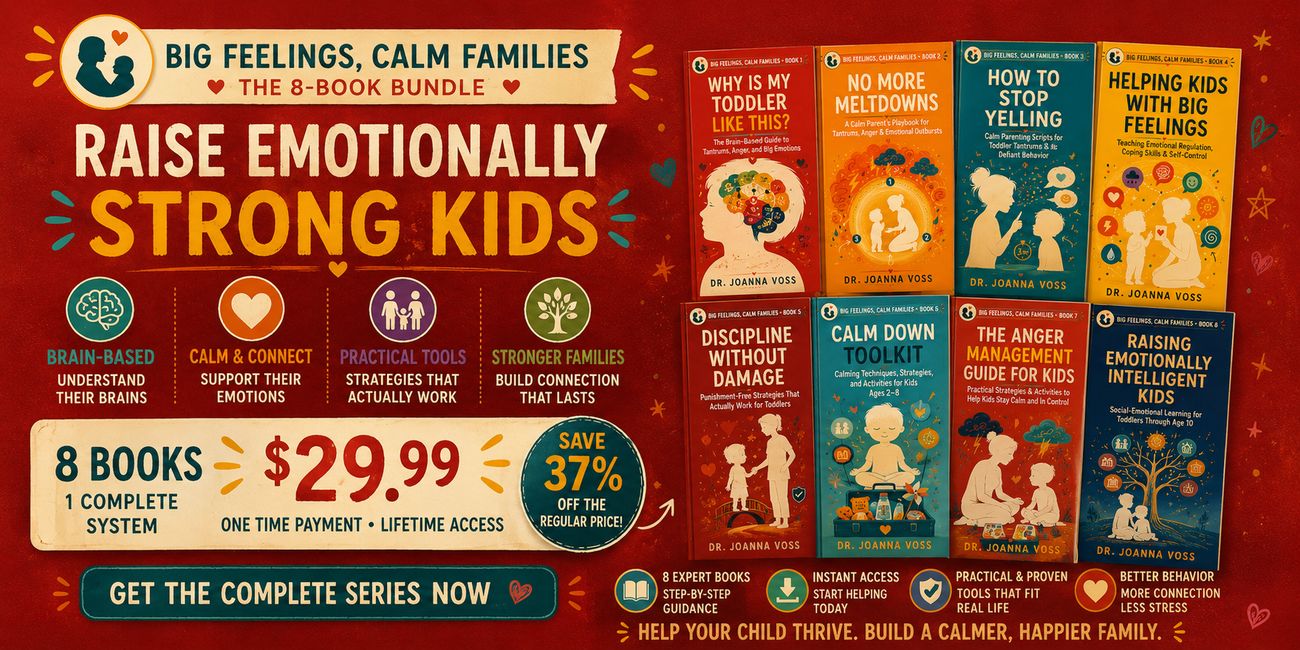
Or take the whole collection
Big Feelings, Calm Families
A brain-based route through tantrums, meltdowns, anger and the emotional regulation nobody teaches you.
Get the series, from $29.99Joanna Voss · 8 books · instant download, read on any device
The series
Big Feelings, Calm Families



About the author
Joanna Voss
Calm Parenting Scientist
Joanna Voss is a developmental psychologist, certified parent coach, and the author of the Big Feelings, Calm Families series.
More about Joanna Voss