

How to Stop Yelling
Calm Parenting Scripts for Tantrums & Defiant Behavior
Parenting380 pagesPublished 27 May 2026Kindle, paperback & hardcoverParenting
You already know yelling does not help. The problem is what to say when you are about to lose it.
If you are the parent of a toddler or young child, you may have promised yourself you would stop yelling, only to find yourself snapping during tantrums, bedtime battles, morning chaos, whining, defiance, or sibling fights.
This book is not another lecture about staying calm.
How to Stop Yelling gives parents practical, ready-to-use scripts for the hardest moments with children ages 2–6. Written in Joanna Voss’s warm, honest, science-informed voice, this guide helps you understand why yelling happens, interrupt the pattern before it takes over, and replace volume with calm, firm language your child can actually hear.
Inside, you’ll learn how to:
- identify your personal yelling triggers
- use a 3-second pattern interrupt before yelling takes over
- prepare scripts for high-risk windows like mornings and bedtime
- respond to tantrums, defiance, whining, sibling conflict, and public meltdowns
- hold limits without threats, shame, or constant repetition
- repair clearly after yelling happens anyway
- practice change without drowning in guilt
This is the script-heavy, immediately practical book in the Big Feelings, Calm Families series.
You do not have to become a perfect parent.
You need better words ready before volume takes over.
Read the first chapter
Chapter One: The Yelling Cycle: What’s Actually Happening When You Lose It
The moment before you yell, something happens in your body before it happens in your mouth.
Your child does the thing again.
The thing you just asked them not to do.
The thing that happened yesterday.
The thing that always happens when you are already late, already tired, already carrying too much, already trying very hard to be the parent who does not yell.
They refuse.
They whine.
They ignore you.
They hit their sibling.
They look directly at you while doing the exact thing you said not to do, which is a very special kind of toddler theatre.
And something in you shifts.
Your jaw tightens.
Your shoulders rise.
Your chest gets hot.
Your voice is not loud yet, but it is already on its way there.
In that tiny space before the yelling comes out, your nervous system has made a decision faster than your thinking brain can fully explain.
This is a threat.
Not a rational threat.
Not the kind of threat where your child refusing socks is actually dangerous.
But an emotional threat.
I am not being heard.
I have lost control.
This has to stop now.
No one is listening to me.
I cannot take one more second of this.
Your body responds the way bodies respond to threat.
It gets bigger.
Faster.
Louder.
This is not bad parenting.
This is a human nervous system doing what human nervous systems do under stress.
The problem is not that the alarm fires.
The problem is that no one ever taught you how to install an override system.
This chapter begins that override.
The Moment Before Yelling
Most parents think yelling begins when the voice gets loud.
It does not.
Yelling begins earlier.
It begins in the body.
It begins when your system starts preparing to take control of a situation that feels out of control.
You may notice it as heat in your face, pressure in your chest, a sudden sharpness in your tone, or the feeling that everything is happening too slowly and too loudly at the same time.
You may start moving faster.
You may start talking faster.
You may repeat yourself with increasing force.
“Put your shoes on.”
“Shoes.”
“Shoes now.”
“I said shoes.”
“How many times do I have to say shoes?”
By this point, the shoes are no longer just shoes.
The shoes have become a referendum on your authority, your schedule, your patience, your entire morning, and possibly the future of civilization.
This is how escalation works.
The child’s behavior triggers something in you. Your body activates. Your thinking narrows. The moment starts to feel urgent. You move from guiding to controlling. From speaking to warning. From warning to threatening. From threatening to yelling.
And often, it happens fast.
So fast that afterward you may think, I don’t know what came over me.
What came over you was not a mysterious parenting demon.
It was a stress response.
Your body believed it needed to do something powerful quickly.
Yelling was the tool it reached for.
The Alarm System in Your Brain
Let’s keep the brain science simple, because you do not need a lecture in neuroscience while someone is screaming because their toast is “too rectangle.”
Your brain has a built-in alarm system. One important part of that system is the amygdala. Its job is to scan for threat and help your body respond quickly.
This is very useful if you are facing actual danger.
Less useful when the “threat” is a four-year-old refusing pants.
But your nervous system does not only respond to physical danger. It can also respond to emotional danger: feeling ignored, powerless, trapped, disrespected, embarrassed, overwhelmed, or out of control.
When the alarm system fires, your body prepares for action. Your heart rate may rise. Your muscles may tense. Your breathing may change. Your voice may sharpen. Your access to thoughtful, flexible language may shrink.
This is why, in calm moments, you may know exactly what kind of parent you want to be.
You believe in connection.
You believe in respectful limits.
You believe in not yelling.
You may have read three books, saved twelve parenting posts, and even used the phrase “co-regulation” in conversation.
Then your child screams “NO!” in your face while you are trying to leave the house, and suddenly your brain offers you exactly two options:
Yell.
Yell louder.
This does not mean your values disappeared.
It means your access to those values got temporarily blocked by stress.
The thinking part of the brain does not vanish completely, but it becomes harder to reach. Your body is trying to act quickly. It is not sitting down for a thoughtful committee meeting about long-term family culture.
This is why this book focuses so much on short scripts.
Under stress, you do not need a paragraph.
You need a sentence your nervous system can retrieve.
Why Repetition Is Such a Powerful Trigger
There is a special kind of parenting exhaustion that comes from saying the same thing over and over.
Not once.
Not twice.
Not even five times.
But so many times that the instruction begins to lose meaning and becomes a sound you make while slowly losing your grip on reality.
“Please put your shoes on.”
“Please put your shoes on.”
“Please put your shoes on.”
“Please put your shoes on.”
At some point, it stops feeling like a simple request.
It starts feeling like evidence.
Evidence that no one listens.
Evidence that your child does not respect you.
Evidence that you are failing.
Evidence that you cannot get through one basic routine without a battle.
Repetition is triggering because it drains the parent’s sense of influence.
Young children need repetition because their brains are immature. They are distractible. They are driven by impulse, emotion, curiosity, fatigue, hunger, and the fascinating discovery that one sock can fit on a hand.
But parents experience repetition through an adult nervous system.
To the child, the repeated instruction may feel like background noise.
To the parent, it can feel like being ignored.
And feeling ignored is one of the fastest roads to yelling.
Not because you are petty.
Because humans are wired to need responsiveness. When you speak and no one responds, especially in a moment when you are responsible for safety, timing, or order, your body can register that as a loss of control.
The internal message becomes:
I have to get bigger to be heard.
That is where volume enters.
This is why one of the first changes we will make later in the book is this: stop repeating yourself endlessly.
Not by becoming harsher.
By becoming clearer.
Say less.
Move closer.
Use the script.
Help the next step happen.
Repetition without action builds resentment. Resentment fuels yelling.
The Three Triggers Parents Mention Most
Every parent has their own trigger map, and we will build yours in the next chapter.
But three triggers show up again and again.
Defiance.
Whining.
Not being heard.
Defiance is hard because it feels personal. Your child says no, refuses, runs away, laughs, argues, or does the opposite of what you asked. Even when you understand developmentally that young children are practicing autonomy, it can still feel like a challenge.
And sometimes, to be fair, it is a challenge.
Young children are not sitting around thinking, How can I respectfully explore agency while preserving my caregiver’s nervous system?
They are thinking, What happens if I say no?
Or, I want control.
Or, I do not want to stop playing.
Or, Pants are unacceptable.
Defiance can pull parents into a power struggle because it touches authority, control, and fear of permissiveness.
Whining is hard for a different reason. It is sensory. It is repetitive. It often arrives when the child is low on capacity and the parent is also low on capacity. The pitch itself can feel like it is entering through your spine.
Whining can make even a loving parent think, I would like to walk gently into the sea.
Not forever. Just for five quiet minutes.
Whining is triggering because it is both communication and irritation. Your child is trying to express a need, but the delivery method feels designed to dismantle your nervous system one syllable at a time.
Not being heard is perhaps the deepest trigger of all.
You ask.
Nothing.
You ask again.
Nothing.
You get closer.
Still nothing.
You begin to feel invisible in your own home.
For some parents, this feeling connects to something old. A childhood where they were not listened to. A family where they had to get loud to be taken seriously. A history of being dismissed, controlled, ignored, or punished.
Then a child’s ordinary refusal lands on a much older bruise.
That does not mean your child caused the bruise.
It means the bruise is there.
And parenting has a way of pressing on places we thought had healed.
When Old Wounds Walk Into the Room
Sometimes the intensity of your reaction is about the present moment.
Sometimes it is about the present moment plus your history.
Your child ignores you, and suddenly you feel the old panic of not mattering.
Your child talks back, and you hear echoes of how disrespect was handled in your childhood home.
Your child cries loudly, and your body remembers being punished for big feelings.
Your child refuses, and you feel the helplessness of having had no control when you were young.
This is not your fault.
It is also not your child’s job to manage.
That distinction matters.
Your history may explain why a moment feels so big. It does not make your child responsible for your reaction.
A four-year-old refusing pajamas is not attacking your worth.
A toddler screaming over the wrong cup is not trying to humiliate you.
A six-year-old saying “You’re mean” is not qualified to assess your entire character, despite the conviction with which they may deliver the review.
Children are immature. Their brains are under construction. Their feelings are loud. Their communication is clumsy. Their behavior often makes sense developmentally even when it is deeply inconvenient domestically.
But your body may not always know that in the moment.
Your body may hear disrespect, danger, rejection, failure, or chaos.
That is why part of stopping yelling is learning to ask:
What did this moment just touch in me?
Not during the explosion.
Later.
When your body is calmer.
This question is not about blaming your childhood for your parenting. It is about understanding why some moments feel larger than they look.
When you know that, you can prepare with more compassion and more accuracy.
What Lowers Your Yelling Threshold
Most parents have a yelling threshold.
Below the threshold, you can manage.
You may be annoyed, but you can stay steady.
You can say the script.
You can take the breath.
You can remember that your child is four, not a hostile board member.
Above the threshold, your capacity drops. Your voice rises more easily. Your patience thins. Your access to calm language shrinks.
The same child behavior that you handled well yesterday can send you over the edge today.
That does not mean you are inconsistent at your core.
It means your threshold moved.
Many things lower it.
Hunger lowers it.
Fatigue lowers it.
Stress lowers it.
Pain lowers it.
Sensory overload lowers it.
A loud house lowers it.
Lack of support lowers it.
Financial pressure lowers it.
Work stress lowers it.
Relationship tension lowers it.
Too much touching lowers it.
Too little sleep lowers it.
A child having an especially hard week lowers it.
A parent having an especially hard week lowers it.
Resentment lowers it dramatically.
Resentment is especially important because it often hides underneath “small” moments. You think you are yelling about the spilled cereal, but underneath that may be the fact that you have been carrying every morning routine alone for months. You think you are yelling about bedtime, but underneath that may be the fact that you have had no real break all day and bedtime feels like the only door between you and collapse.
The child’s behavior may be the spark.
Your depleted system is the dry grass.
This matters because many parents try to solve yelling only in the moment of yelling.
But some yelling has to be reduced before the moment begins.
Not with luxury self-care.
Not with a spa weekend, unless one is available, in which case please do not let me stand in your way.
But with honest capacity checks.
Have you eaten?
Are you trying to do bedtime alone while also answering work messages?
Are you expecting yourself to respond calmly after six nights of broken sleep?
Are you treating an impossible load as a personal patience problem?
Your child still needs limits.
You still need to take responsibility for your voice.
And your capacity matters.
A no-yelling plan that ignores parent depletion is not a plan. It is a motivational poster.
Why Shame Keeps the Cycle Alive
After yelling, many parents go straight to shame.
I am awful.
I sounded just like my father.
I am ruining my child.
Other parents do not do this.
I should know better.
Shame feels like accountability because it hurts.
But shame and accountability are not the same thing.
Accountability says:
“I yelled. That was not okay. I need to repair and practice a different response.”
Shame says:
“I yelled. I am bad. I am hopeless.”
Accountability leads to action.
Shame leads to collapse.
And collapse often leads to more yelling later, because the parent feels defeated before the next hard moment even begins.
Shame can also make repair harder.
If you are drowning in guilt, you may avoid the repair because facing your child feels too painful. Or you may over-apologize and accidentally ask your child to comfort you. Or you may defend yourself with, “Well, I only yelled because you wouldn’t listen,” which teaches the child that your reaction was their responsibility.
None of those help.
The way out is not to minimize yelling.
The way out is to respond to yelling with repair and practice.
A simple repair might sound like this:
SAY THIS: “I yelled. That was my responsibility. I’m sorry. I am going to try again with a calmer voice.”
That is accountability.
No drama.
No collapse.
No blaming the child.
No pretending it did not matter.
Just truth, responsibility, and reconnection.
Repair interrupts shame because it gives you something useful to do.
And useful action is what change needs.
Early Warning Signs
Before you can stop yelling, you need to know what your early warning signs look like.
Not the obvious sign of already yelling.
Earlier than that.
Your body usually tells you before your voice does.
Common early warning signs include:
jaw tightening
shoulders rising
heat in your face or chest
shallow breathing
clenched hands
moving faster
speaking faster
repeating yourself sharply
feeling an urgent need to “win”
feeling like your child is doing it on purpose
That is the end of chapter one.
The rest of How to Stop Yelling is waiting for you.

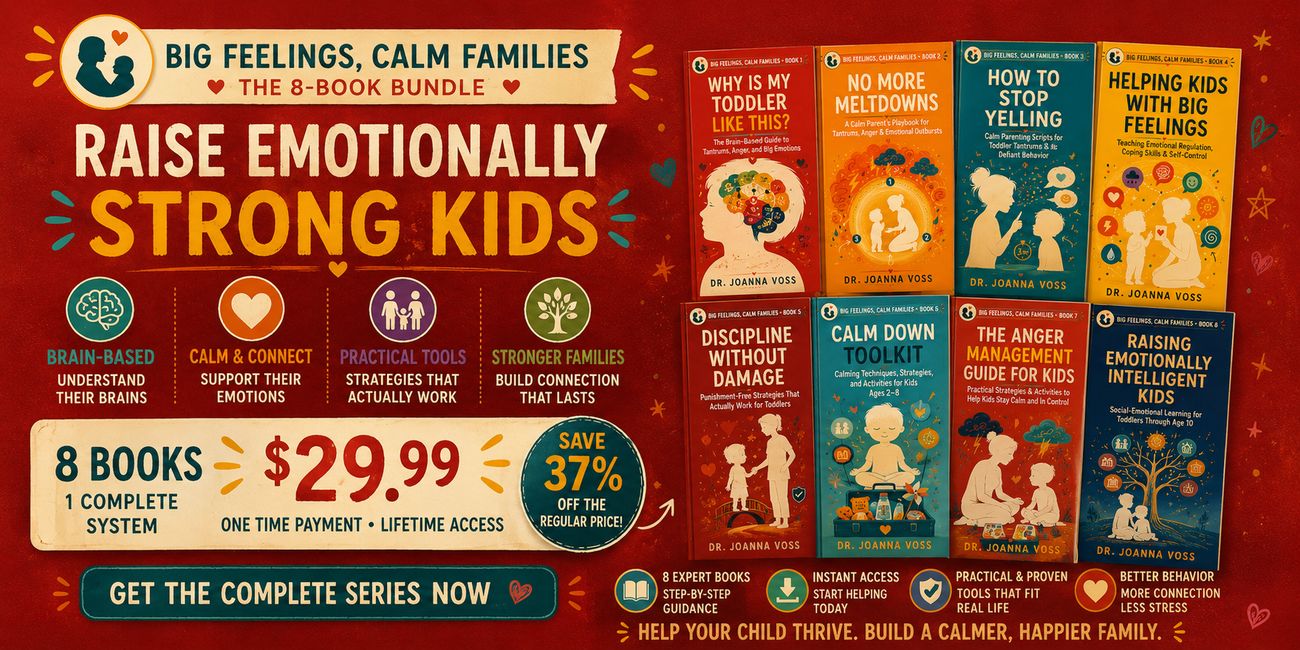
Or take the whole collection
Big Feelings, Calm Families
A brain-based route through tantrums, meltdowns, anger and the emotional regulation nobody teaches you.
Get the series, from $29.99Joanna Voss · 8 books · instant download, read on any device
The series
Big Feelings, Calm Families



About the author
Joanna Voss
Calm Parenting Scientist
Joanna Voss is a developmental psychologist, certified parent coach, and the author of the Big Feelings, Calm Families series.
More about Joanna Voss