

Why Is My Toddler Like This?
The Brain-Based Guide to Tantrums, Anger, and Big Emotions
Parenting473 pagesPublished 24 May 2026Kindle, paperback & hardcoverParenting
Why does your toddler melt down over the wrong cup, scream when it is time to leave the park, hit when frustrated, or say “no” to something they clearly want?
Your child is not broken.
And you are not failing.
In Why Is My Toddler Like This?, developmental psychologist, certified parent coach, and mother of three Joanna Voss helps parents understand the brain behind toddler tantrums, anger, meltdowns, defiance, and big emotions.
Written in a warm, practical, science-informed voice, this book explains why toddler behavior can look intentional, dramatic, or disrespectful when it is often driven by an immature brain, emotional flooding, sensory overload, fatigue, hunger, autonomy needs, or a nervous system that has moved outside its window of tolerance.
Inside, you will learn:
- Why toddlers cannot simply “calm down” on command
- The difference between a tantrum and a meltdown
- What toddler anger is really communicating
- Why the “no” phase is part of healthy development
- How sensitive, spirited, sensory-seeking, and highly emotional children may need different support
- Why your own nervous system matters during hard moments
- How connection, repair, and calm boundaries help children build emotional regulation over time
This is not a book about permissive parenting.
It is not about excusing unsafe behavior.
It is about understanding what is happening underneath the behavior so you can respond with more clarity, less shame, and a calmer plan.
If you are exhausted by toddler tantrums, confused by sudden meltdowns, worried about anger or aggression, or wondering why ordinary parenting advice does not seem to work for your child, this book will help you see the moment differently.
Because when you understand the brain behind the behavior, parenting does not become easy.
But it finally starts to make sense.
Read the first chapter
Chapter One: The Construction Zone
Understanding the Developing Brain
I
t was the kind of morning that begins badly before anyone has technically done anything wrong.
One child could not find a shoe. One child had found the shoe but refused to wear it because it was “looking at me weird.” The dog had eaten something that was not food. Coffee existed, but only in theory. And the clock, which had clearly joined the enemy, kept moving.
Your toddler wanted to pour the cereal.
You said, “I’ll help.”
They said, “No. I do it.”
You paused. You thought, Growth mindset. Independence. Fine.
They lifted the cereal box, tilted it with the confidence of a contractor and the motor control of a raccoon, and poured half of it onto the table.
You moved to steady the box.
They screamed.
You said, “I’m just helping.”
They screamed harder.
You said, “We don’t scream about cereal.”
They threw the spoon.
Now you were no longer simply managing breakfast. You were in a full emotional weather event.
And because you are human, your mind probably did not say, Ah yes, here we see the developing prefrontal cortex struggling to inhibit an impulse under conditions of frustration and time pressure.
Your mind probably said something more like:
Why are you like this?
Or:
You asked to do it yourself. I let you do it yourself. Why are we all suffering now?
This is where toddler behavior gets confusing. From the outside, it can look completely unreasonable. Your child wanted independence, but could not tolerate the difficulty. They wanted your help, but rejected your help. They created the problem, then emotionally collapsed inside the problem, then somehow made you feel responsible for the problem.
Toddlers are gifted in this area.
But underneath the chaos, something very real is happening.
Your child’s brain is not broken.
It is unfinished.
And unfinished brains behave differently from finished ones.
The Brain Is Under Construction
Think of your toddler’s brain as a house still being built.
The foundation is there. Important wiring is in place. There are rooms, pathways, alarms, and systems that already work beautifully. Your child can love, laugh, learn, explore, protest, remember routines, recognize your voice, seek comfort, and develop preferences so strong they may appear legally binding.
But some major parts of the house are not finished yet.
The walls are not fully up. The lights flicker. The communication system is unreliable. The emotional alarm is extremely sensitive. The part of the house responsible for saying, “Let’s pause and think through our options,” is still waiting on permits.
This is not a character flaw.
It is construction.
The toddler brain is developing rapidly, but unevenly. The parts responsible for big feelings, survival responses, and emotional alarms are active early. The parts responsible for impulse control, planning, flexible thinking, emotional regulation, and reasoning take much longer to mature.
This is why your child can remember the exact location of a tiny plastic dinosaur they saw three weeks ago, but cannot remember not to hit when angry.
It is why they can sing a whole song from a show you regret introducing, but cannot reliably wait thirty seconds for a snack.
It is why they can understand the rule when calm, repeat the rule proudly, and then break the rule twelve seconds later while making eye contact.
That eye contact is what really gets parents.
We see the eye contact and think, They know exactly what they’re doing.
Sometimes they do know what they are doing in the simplest sense.
They know they are touching the lamp.
They know you said not to touch the lamp.
They may even whisper, “No touch lamp,” while touching the lamp.
But knowing a rule and being able to stop an impulse are not the same skill.
Adults confuse those two constantly.
A toddler can often understand more than they can control. They can know more than they can do. They can want to cooperate and still be unable to access that cooperation in the moment it is needed.
This gap between knowing and doing is one of the defining features of early childhood.
It is also one of the most frustrating features for parents.
Because from the adult side, it looks like defiance.
From the brain side, it is often immaturity.
The Fast Alarm and the Slow Manager
Let’s keep the brain simple.
There are two broad systems we need to understand in this chapter.
The first is the emotional alarm system.
The second is the thinking and regulation system.
The emotional alarm system is fast. It scans for threat, frustration, disappointment, separation, discomfort, hunger, pain, surprise, and anything that feels wrong to your child’s body or expectations.
One important part of this system is the amygdala. You do not need to memorize that word, but it helps to know the basic idea: the amygdala is involved in detecting emotional importance and threat. In toddlers, this alarm system can be very reactive.
It does not wait politely.
It does not say, “Before we scream, let’s consider whether this is proportionate.”
It says, “Something is wrong. React now.”
The second system involves the prefrontal cortex, the part of the brain that helps with planning, impulse control, flexible thinking, reasoning, decision-making, and emotional regulation.
This is the part that helps a person pause before acting.
It helps us think, I am angry, but I should not throw this.
It helps us remember, I can wait.
It helps us consider, Maybe the green cup is not an existential crisis.
In adults, this system is far more developed, though I will gently point out that many adults still lose access to it in traffic, during customer service calls, and while assembling furniture.
In toddlers, this system is still immature. Very immature. Beautifully, normally, developmentally immature.
So your toddler has a strong emotional alarm and a still-developing internal manager.
Big feelings arrive quickly.
Impulses move faster than thought.
The body reacts before language catches up.
This is why saying “Calm down” often does not work.
Your child may not have access to the part of the brain that can hear that instruction, process it, agree with it, and carry it out.
If they could calm down on command, they probably would.
Being dysregulated does not feel good to a child. A toddler in a meltdown is not having a luxurious emotional spa day. They are overwhelmed by their own body.
They need help coming back.
Not because they are weak.
Because they are young.
The Upstairs and Downstairs Brain
A helpful way to picture this is the “upstairs and downstairs brain” model.
The downstairs brain is the more primitive, reactive part. It handles survival, emotional alarms, big impulses, and basic body responses. It is fast, protective, and not especially interested in your carefully worded explanation.
The upstairs brain is the thinking part. It helps with reasoning, problem-solving, empathy, reflection, flexibility, and self-control.
In toddlers, the upstairs brain is under construction.
There are stairs, yes.
But some days they are slippery.
Some days there is caution tape.
Some days the upstairs brain appears to have left for a long weekend.
When your child is calm, fed, rested, connected, and not being asked to transition away from something wonderful, they may have more access to the upstairs brain. They can listen better. They can follow a simple direction. They can use a word instead of a hand. They can wait for a short time. They can show surprising kindness.
Then the downstairs brain gets activated.
They are tired. Hungry. Frustrated. Overstimulated. Rushed. Disappointed. Embarrassed. Asked to leave the park. Given the wrong fork.
Suddenly, the downstairs brain takes over.
The alarm blares.
The body floods.
The thinking brain becomes much harder to reach.
This is why your previously charming child can seem to vanish during a meltdown. It is not that they have become someone else. It is that a different brain state is running the show.
And that matters because we cannot use upstairs-brain strategies on a child who is stuck downstairs.
Reasoning is an upstairs-brain strategy.
Lecturing is an upstairs-brain strategy.
Moral teaching is an upstairs-brain strategy.
Asking, “How do you think that made your sister feel?” is very much an upstairs-brain strategy.
If your child is downstairs, screaming, kicking, panicking, sobbing, bolting, throwing, collapsing, they cannot use those tools well yet.
Trying to force insight in that moment is like asking someone to solve a math problem during a fire alarm.
Could they technically do math? Perhaps.
Is this the moment? No.
Get them out of the alarm first.
Then teach.
Why “Just Calm Down” Does Not Work
Adults love the phrase “calm down,” usually because we are not calm and would very much like someone else to become calm so we can feel less activated ourselves.
But “calm down” is not a regulation strategy.
It is a desired outcome.
Imagine you are very upset. Your heart is pounding. Your face is hot. You feel misunderstood, overwhelmed, or furious. Someone stands over you and says, “Calm down.”
Do you immediately think, What a useful and compassionate instruction. I shall now regulate my nervous system with gratitude?
Probably not.
Most adults do not enjoy being told to calm down.
Toddlers enjoy it even less because they do not yet have the internal skills to make it happen reliably.
When your child is dysregulated, their body may be in a stress response. Their heart rate may be up. Their muscles may be tense. Their breathing may be fast or uneven. Their thinking may be narrowed. Their ability to process language may drop. Their tolerance for frustration may collapse.
They are not choosing the most inconvenient moment to ignore your wisdom.
They may genuinely be unable to use it.
This is why long explanations often fail during big feelings.
You may be saying something completely reasonable:
“I understand you wanted the red cup, but the red cup is in the dishwasher, and when things are dirty, we need to wash them before we use them, so today you can have the blue cup or the green cup.”
This is a fine explanation for a calm child.
For a dysregulated toddler, it may sound like:
“Words words red cup gone forever words dishwasher betrayal words blue cup doom.”
The more upset your child is, the fewer words they can process.
This does not mean you never explain. It means you explain later.
During the peak, your job is not to deliver a TED Talk on cup hygiene.
Your job is to help the nervous system come down.
The Toddler Problem: Big Feelings, Tiny Brakes
One way to understand toddlers is this:
They have big feelings and tiny brakes.
The emotional accelerator works beautifully. Too beautifully, some mornings.
Joy? Full speed.
Frustration? Full speed.
Curiosity? Full speed toward the outlet.
Anger? Full speed with sound effects.
The brake system is still developing. The ability to pause, wait, reconsider, shift gears, tolerate disappointment, and stop the body from doing the thing it wants to do takes years of practice and brain development.
This is why toddlers often act before they think.
They grab.
They run.
They hit.
They scream.
They dump.
They climb.
They say no.
They lick things that absolutely did not need to be licked.
And then, sometimes, they look surprised by what happened.
Because the impulse came first.
Thought came later.
If we interpret every impulsive behavior as intentional disrespect, we will respond with too much anger and not enough teaching.
If we interpret every impulsive behavior as something the child cannot help at all, we may fail to set necessary limits.
The middle path is more accurate:
Your toddler is responsible for learning, but not yet capable of perfect control.
Your job is to stop unsafe behavior, hold boundaries, and teach skills over time, while remembering that the part of the brain needed for those skills is still developing.
That is calm parenting in the real world.
Not passive.
Not permissive.
Not punitive.
Developmentally informed.
What You Can Realistically Expect at Ages 2, 3, 4, and 5
Every child develops differently, and there is a wide range of normal. Temperament, language, sleep, sensory processing, environment, stress, health, family dynamics, and developmental differences all matter.
Still, it helps to have realistic expectations.
Because many parents are not actually struggling because their child is unusually difficult.
They are struggling because they have been told to expect skills their child does not reliably have yet.
Age 2: The Emotional Weather System
Two-year-olds are often pure feeling in motion.
They are developing language, but their emotions are still much bigger than their words. They want independence, but they need enormous amounts of help. They understand some routines and limits, but their ability to stop themselves is very limited.
A two-year-old may be able to:
Use simple words for wants and feelings.
Follow familiar one-step directions when calm.
Show affection and seek comfort.
Play near other children.
Understand some basic limits.
A two-year-old usually cannot reliably:
Share without help.
Wait for long.
Calm down alone.
Explain what upset them.
Stop an impulse because they “know better.”
Handle big transitions without support.
Use words instead of hands every time.
At two, many behaviors that look rude or wild are simply early development with volume.
This does not mean you allow hitting or grabbing. It means you stop the behavior and teach the skill many, many times.
And then many more times after that.
Repetition is not failure.
Repetition is childhood.
Age 3: The Negotiator With No Legal Training
Three-year-olds often have more language, more opinions, and more stamina for protest.
This is a powerful combination.
A three-year-old may be able to explain more, imagine more, argue more, and remember more. They may also become more frustrated because their ideas are bigger than their abilities.
They want control. They want participation. They want to be taken seriously. They also may fall apart because you peeled the banana they asked you to peel.
A three-year-old may be able to:
Use more words to express wants.
Follow simple routines.
Make basic choices.
Begin naming some feelings.
Remember rules when calm.
Engage in pretend play.
A three-year-old usually cannot reliably:
Accept disappointment gracefully.
Understand consequences in a mature way.
Control aggressive impulses every time.
Transition quickly without protest.
See another person’s perspective during distress.
Calm down just because you explained why they should.
Three-year-olds can sound older than they are.
This is where parents get trapped.
A child with strong language can seem more emotionally mature than they actually are. But verbal ability is not the same as emotional regulation.
A three-year-old may be able to say, “I am extremely frustrated because you ruined my plan,” and still throw the shoe.
Honestly, some adults do the same thing internally. They just have better public relations.
Age 4: The Big Kid Who Is Still Little
Four-year-olds can be delightful, imaginative, hilarious, and surprisingly thoughtful. They can also be rigid, explosive, bossy, and deeply offended by changes no one else noticed.
That is the end of chapter one.
The rest of Why Is My Toddler Like This? is waiting for you.

Or take the whole collection
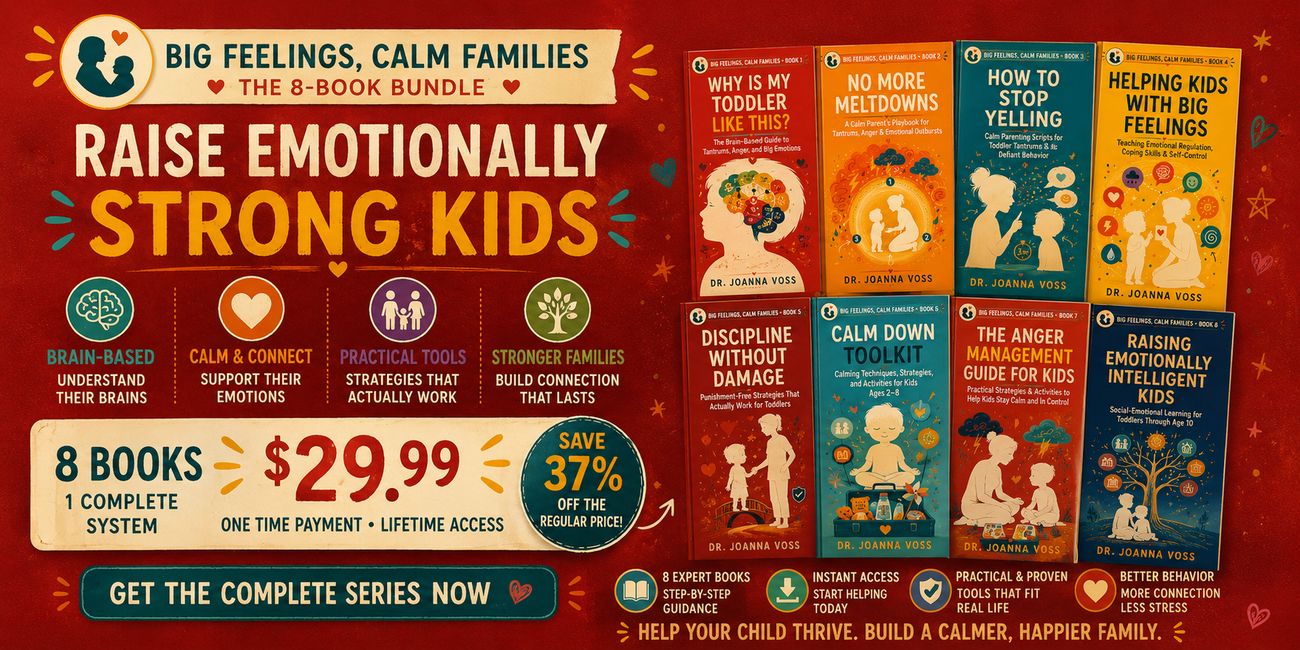
Big Feelings, Calm Families
A brain-based route through tantrums, meltdowns, anger and the emotional regulation nobody teaches you.
Get the series, from $29.99Joanna Voss · 8 books · instant download, read on any device
The series
Big Feelings, Calm Families



About the author
Joanna Voss
Calm Parenting Scientist
Joanna Voss is a developmental psychologist, certified parent coach, and the author of the Big Feelings, Calm Families series.
More about Joanna Voss