

No More Meltdowns
A Calm Parent’s Playbook for Tantrums, Anger, and Emotional Outbursts
Parenting343 pagesPublished 24 May 2026Kindle, paperback & hardcoverParenting
You do not need more patience. You need a better plan.
Every parent of a toddler or young child has been there: the screaming, the floor collapse, the public tantrum, the bedtime refusal, the sudden emotional explosion over a broken banana, the wrong cup, or leaving the park.
You know you are supposed to stay calm. You know you are supposed to be consistent. But in the middle of a meltdown, knowing what you should do is not the same as having a plan you can actually use.
No More Meltdowns gives parents that plan.
Written in Joanna Voss’s warm, practical, science-informed voice, this book helps parents of toddlers and young children understand, prevent, respond to, and recover from tantrums, anger outbursts, emotional explosions, and overwhelming meltdowns.
This is not a promise that your child will never melt down again. Young children are still developing emotional regulation, impulse control, flexibility, and frustration tolerance. Big feelings are part of childhood.
But family life can become calmer, clearer, and less reactive.
Inside, you will learn how to:
- Identify your child’s most common meltdown triggers
- Use the 5-Day Meltdown Map to spot patterns
- Check the four regulation tanks: food, rest, sensory load, and connection
- Make difficult transitions more predictable and less explosive
- Build flexible routines that lower daily stress
- Use the CALM Response Protocol in the first 60 seconds of an outburst
- Tell the difference between a tantrum and a meltdown
- Hold limits with warmth instead of harshness or giving in
- Handle public tantrums and emotional outbursts with less shame
- Repair with your child after hard moments
- Reset yourself after yelling, freezing, or reacting in a way you regret
- Track real progress without expecting perfection
Built around the simple framework Prevent → Respond → Recover, this book gives parents a calm, repeatable system for real family life.
You will not become a perfect parent.
You will become a parent with a plan.
And when the storm comes, that changes everything.
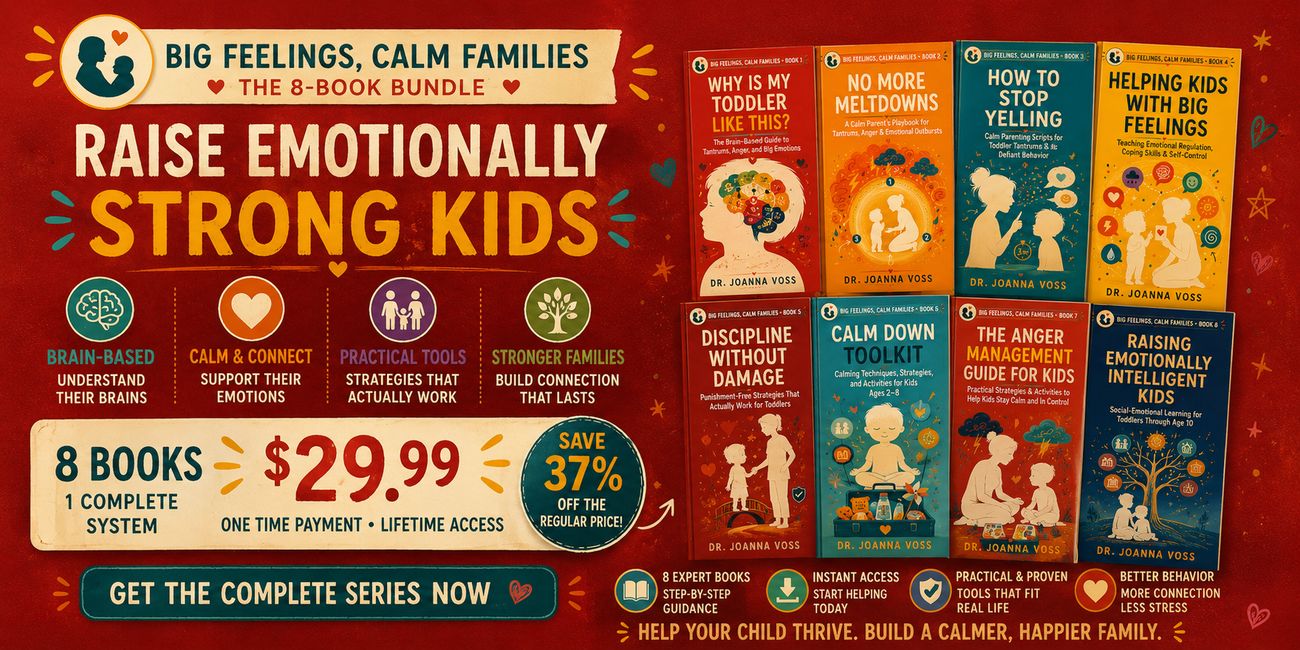
No More Meltdowns is Book 2 in the Big Feelings, Calm Families series, but it can be read as a complete standalone guide.
Read the first chapter
Chapter One: The Meltdown Map: Understanding Your Child’s Triggers
You are standing in the kitchen.
Your child is on the floor.
The problem, apparently, is the banana.
Not the whole banana. Not even the existence of the banana. The banana itself was requested with great urgency thirty-seven seconds ago. You peeled it, because you are a generous and reasonably competent adult. You handed it over.
Then it broke.
And now your child is sobbing as though the banana has betrayed the family.
You look at the banana. You look at your child. You look briefly toward the ceiling, where all parents eventually look, as if there might be a small committee of calm experts hiding in the light fixture.
You hear yourself think, “What just happened?”
This chapter is for that moment.
Because yes, sometimes the banana really is the final straw.
But usually, it is not the whole story.
Most meltdowns do not come from nowhere. They look sudden because we notice them at the loudest point. We notice the scream, the collapse, the refusal, the hitting, the throwing, the kicking, the full-body protest. We notice the broken banana.
But the build-up often began earlier.
Maybe your child woke too early. Maybe breakfast was rushed. Maybe the seam in their sock bothered them all morning. Maybe preschool drop-off was hard. Maybe there were too many errands, too much noise, too much waiting, too much sharing, too many transitions, and not enough connection.
Then the banana broke.
The banana was the visible trigger.
The load was already there.
This is one of the most important shifts you can make as a parent of a toddler or young child: stop looking only at the moment of explosion and start looking at the build-up.
That build-up is your Meltdown Map.
The Trigger Bucket
Imagine your child has an invisible bucket.
All day long, little stressors drip into it.
Some drips are physical: hunger, thirst, tiredness, illness, teething, constipation, itchy clothing, too much noise, too much light, too much touch.
Some are emotional: disappointment, frustration, jealousy, fear, separation, feeling rushed, feeling left out, feeling powerless.
Some are relational: not enough attention, a missed moment of connection, conflict with a sibling, a parent who is present but distracted, a morning that moved too fast for the child to feel anchored.
Some are situational: transitions, waiting, changes in routine, public outings, crowded places, screen time ending, leaving something fun, being told no, being asked to cooperate when their nervous system is already overloaded.
Each drip may seem small.
One skipped snack does not always cause a meltdown.
One transition does not always cause a meltdown.
One loud room does not always cause a meltdown.
One disappointment does not always cause a meltdown.
But young children have small buckets.
They do not have adult emotional capacity. They do not have mature impulse control. They do not have reliable perspective-taking. They do not have the ability to say, “You know, I seem to be experiencing a cumulative regulation deficit related to fatigue, sensory overload, and insufficient parental attunement.”
They have “NO!”
They have floor.
They have scream.
This is why a meltdown may look wildly disproportionate to the event that triggered it. You see the broken banana. Your child’s nervous system is responding to the whole bucket.
The final trigger matters, but it may not be the cause.
The broken banana may simply be the last drop.
This does not mean your child is being dramatic. It means their system was already close to overflow.
And when you understand the bucket, you can stop asking only, “Why are they reacting like this?”
You can start asking, “What filled the bucket?”
That question changes everything.
Cumulative Load Versus Single-Event Cause
Parents often search for the single reason.
Was it because I said no?
Was it because they were hungry?
Was it because we skipped nap?
Was it because of screen time?
Was it because I gave the wrong cup?
Was it because Mercury is in retrograde and my child has sensed weakness?
Sometimes there is one clear cause. A child who is overtired at bedtime may fall apart because they are overtired. A child who has not eaten in four hours may explode because they are hungry. A child who is told they cannot have the toy at the store may tantrum because they want the toy.
But many emotional outbursts come from cumulative load.
Cumulative load means several stressors stack together until your child has very little capacity left.
This is why the same event can produce completely different responses on different days.
On Monday, you turn off the show and your child complains, but moves on.
On Tuesday, you turn off the show and your child collapses into a screaming heap.
Same show.
Same child.
Same parent.
Different bucket.
On Tuesday, perhaps they woke early, ate poorly, had a loud day, missed quiet time, and did not get much one-on-one connection. By the time the show ended, their nervous system had no room left for disappointment.
This is why the question “Why did this set them off?” is often less helpful than “Why today?”
Why this moment?
Why this transition?
Why this level of intensity?
Why this recovery time?
You are not looking for blame. You are looking for information.
Meltdown mapping is not a parenting trial where you gather evidence against yourself. It is not a way to prove that you should have packed a snack, protected nap, spoken more softly, planned better, or magically known that the green cup would become offensive at 3:14 p.m.
It is a way to understand patterns.
Patterns give you options.
And options are where prevention begins.
The Four Trigger Categories
Most meltdown triggers fall into four broad categories:
sensory, physiological, relational, and situational.
You do not need to memorize clinical terms. You only need to learn where to look.
Sensory Triggers
Sensory triggers involve what your child’s body is taking in from the environment.
Noise.
Light.
Clothing.
Crowds.
Smells.
Textures.
Touch.
Movement.
Visual clutter.
The hum of a store.
The echo of a birthday party venue.
The scratchy tag in a shirt.
The sock seam that feels, to your child, like a personal attack.
Some children are highly sensitive to sensory input. They may become dysregulated in environments that seem ordinary to adults. A grocery store can be a lot for a young nervous system: bright lights, carts rattling, people moving, music playing, cold freezer aisles, choices everywhere, and a parent saying, “Just sit still for five more minutes,” as if five minutes is a concept the child can hold with dignity.
Sensory overload does not always look like distress at first.
It may look like silliness.
Running.
Crashing.
Whining.
Refusing.
Covering ears.
Demanding to be held.
Clinging.
Bolting.
Becoming unusually loud.
Becoming unusually quiet.
A child who is overloaded may look defiant when they are actually flooded. That distinction matters because the solution is different. A flooded child does not need a lecture on listening. They need less input.
Lower the noise.
Lower the demands.
Lower the pace.
Move to a quieter space if you can.
Physiological Triggers
Physiological triggers are body-state triggers.
Hunger.
Fatigue.
Thirst.
Illness.
Pain.
Constipation.
Growth spurts.
Poor sleep.
Too much sugar and not enough protein.
A missed nap.
A late bedtime.
A child who needs to use the bathroom but does not want to stop playing, which is one of the great emotional mysteries of early childhood.
These triggers are not glamorous, but they are powerful.
A hungry child has less access to flexibility.
A tired child has less access to impulse control.
An ill child has less access to everything, including basic cooperation and sometimes polite human behavior.
Adults are not so different. Many of us become deeply unpleasant when hungry, tired, or overstimulated. We simply have better vocabulary. Sometimes.
Young children experience body discomfort as emotional emergency. They may not say, “I’m hungry and my blood sugar feels low.” They may say, “I HATE THIS HOUSE.”
They may not say, “I am tired and cannot manage the transition to pajamas.” They may throw the pajamas.
They may not say, “My body feels wrong because I’m getting sick.” They may scream because their sibling looked at them with the wrong style of eyeball.
Before you assume a behavior is purely behavioral, check the body.
Food.
Rest.
Illness.
Sensory load.
Bathroom.
Pain.
Your child’s body is part of their behavior.
Always.
Relational Triggers
Relational triggers are about connection, attention, separation, and emotional safety.
Young children are wired to seek connection with their caregivers. That does not mean they need your full attention every second. Please do not attempt that. You will become a husk.
But children do need regular moments of felt connection. Not elaborate activities. Not crafts involving seventeen supplies and parental optimism. Small moments.
Eye contact.
A warm greeting.
A hand on the back.
A shared laugh.
A few minutes of play.
A moment where the phone is down and the child feels, “You see me.”
When children do not know how to ask for connection, they may ask through behavior.
Whining.
Interrupting.
Clinging.
Demanding.
Refusing.
Doing the exact thing you just told them not to do while making meaningful eye contact.
This is not because children are tiny villains. It is because attention is a form of nervous-system fuel. A child who feels disconnected may become more fragile, more demanding, more reactive, and less cooperative.
Relational triggers can include:
a rushed morning
separation at preschool or daycare
a parent returning from work but not yet emotionally available
a new sibling
sibling conflict
a parent-child rupture
a stressful handoff between caregivers
too many commands without enough warmth
a child feeling unseen, left out, or powerless
Disconnection does not mean you are neglecting your child. It means the connection tank may be low.
Every family has low-connection pockets. Mornings, dinner prep, after work, after school, bedtime, and the hour when everyone in the house has apparently decided to need you at once.
The goal is not constant connection.
The goal is timely reconnection.
Sometimes two minutes of full attention can prevent twenty minutes of chaos later.
Not always.
But often enough to make it worth trying.
Situational Triggers
Situational triggers are the events and demands that young children commonly struggle to manage.
Transitions.
Waiting.
Being told no.
Leaving something fun.
Sharing.
Losing.
Changes in routine.
New places.
Public outings.
Screen time ending.
Sibling interference.
Adult time pressure.
A parent rushing.
A child being asked to shift from their agenda to yours.
Situational triggers are especially powerful because they often involve loss of control.
Young children live in a world where adults decide almost everything. When to wake up. What to wear. Where to go. When to leave. What is safe. What is available. Whether the blue bowl is clean. Whether the park trip is ending. Whether the toy can come into the bathtub. Whether pants are required by society.
Much of that adult authority is necessary. Children need adults to lead. But from the child’s point of view, daily life can feel like a long series of interruptions.
Stop playing.
Come here.
Put this on.
Get in the car.
Use the bathroom.
Wash your hands.
Stop touching that.
Wait.
Not now.
We’re leaving.
No.
A child with a full bucket may not be able to absorb one more demand.
The demand may be reasonable.
Their capacity may still be gone.
This is why situational triggers need support before they become explosions. Transitions need warnings. Routines need anchors. Limits need simple language. Waiting needs scaffolding. Public outings need realistic expectations.
You are not removing the demand.
You are making the demand more survivable.
The Meltdown Map
A Meltdown Map is a simple way to notice your child’s patterns.
It is not a diagnostic tool. It is not a moral inventory. It is not a spreadsheet you must maintain until your child leaves for college.
Please do not turn this into an intense research project unless you enjoy that sort of thing, in which case I admire you from a safe distance.
The Meltdown Map is a brief, practical way to answer one question:
What tends to happen before my child falls apart?
You do not need to track every emotion. You do not need to write a paragraph after every whine. You do not need to document family life like a wildlife biologist observing a rare but loud species.
Track the hard moments.
Briefly.
For five days.
That is enough to reveal a pattern for many families.
You are looking for repeated clues:
a time of day
a transition
a body state
a sensory setting
a relational need
a specific demand
a public environment
a post-screen crash
a pre-dinner collapse
a bedtime escalation
a preschool pickup unraveling
a sibling trigger
a parent stress pattern
The goal is not to eliminate every trigger. That is impossible.
The goal is to identify the few triggers that show up most often, then adjust one.
One.
Not twelve.
One pattern is enough to start.
Strategy: The 5-Day Meltdown Map
For the next five days, when a significant meltdown or emotional outburst happens, write down a few details.
Keep it simple.
You can use a notebook, a note on your phone, the template in the back of this book, or the back of an envelope you will later lose under the car seat. We are not aiming for elegance. We are aiming for useful.
Track these seven things.
1. Time of Day
Write down when the meltdown happened.
Morning?
Before lunch?
After preschool?
Before dinner?
During bath?
At bedtime?
Time of day is often the first pattern parents notice. Many children have predictable vulnerable windows. For some, it is the morning rush. For others, it is late afternoon. For many, it is the stretch between dinner and bedtime, also known as the emotional swamp.
If meltdowns cluster at the same time each day, you have important information.
The problem may not be the specific demand.
The problem may be that the demand is happening during a low-capacity window.
2. What Happened Right Before
Write down the visible trigger.
The show ended.
You said no to a snack.
A sibling touched their toy.
You asked them to put on shoes.
They had to leave the park.
The cup was wrong.
The banana broke.
This is the event you noticed first. It matters, but remember: it may not be the whole cause.
Still, visible triggers are useful. If the same visible trigger repeats, you can plan for it. If screen time ending causes daily explosions, you need a screen transition plan. If shoes cause daily battles, you need a shoe plan. If leaving the park causes chaos, you need a leaving-the-park ritual.
Specific patterns are workable.
Vague misery is much harder to solve.
3. What Happened in the Previous Two Hours
This is where the map becomes more interesting.
Ask yourself:
What happened before the visible trigger?
Was there a transition?
A conflict?
That is the end of chapter one.
The rest of No More Meltdowns is waiting for you.

Or take the whole collection
Big Feelings, Calm Families
A brain-based route through tantrums, meltdowns, anger and the emotional regulation nobody teaches you.
Get the series, from $29.99Joanna Voss · 8 books · instant download, read on any device
The series
Big Feelings, Calm Families



About the author
Joanna Voss
Calm Parenting Scientist
Joanna Voss is a developmental psychologist, certified parent coach, and the author of the Big Feelings, Calm Families series.
More about Joanna Voss