

Strength and Balance Exercises
A Practical Program to Improve Stability, Prevent Falls, and Stay Independent
Recovery271 pagesPublished 31 January 2026Kindle, paperback & hardcoverRecovery
If balance feels less certain than it used to, during turns, stairs, or late in the day, this book gives you a calm, safe, step-by-step plan to rebuild stability at home.
Strength and Balance Exercises is a practical training system for older adults and anyone concerned about fall risk, confidence, and independence. No complicated equipment. No risky “test yourself” drills. Just clear progression, supported options first, and the kind of strength that carries into real life.
Inside you’ll learn how to:
- Understand why balance changes over time, and what “fall risk” really means
- Train safely using stable support, smart progressions, and a clear “when to seek care” guide
- Reduce fear of falling and rebuild confidence through calm, repeatable practice
- Strengthen feet/ankles, hips, and core for steadier walking and better control
- Improve turning, stepping reactions, and coordination, without panic or chaos
- Build stair safety, transition strength, and a reliable get-up-from-the-floor plan
- Use a fatigue and recovery system so training helps instead of overwhelms
- Set up your home to reduce risk while keeping life normal and independent
- Follow a 30-day plan with decision rules for progress, hold, or regress
This book is written for real homes and real bodies. You’ll learn the “why,” then exactly what to do next, so your progress feels steady, not stressful.
Important: This is educational, not medical advice. If you have dizziness/fainting, chest pain, sudden weakness/numbness, new neurological symptoms, severe shortness of breath, unexplained falls, or severe pain, seek medical care.
Read the first chapter
Chapter One: Why Balance Declines Over Time
Margaret had always been active. She walked her dog every morning, tended her garden on weekends, and never thought twice about climbing stairs. Then one Tuesday afternoon she reached for a jar on the top shelf and felt something unfamiliar: a lurch, a momentary loss of control, a split-second where the floor seemed to tilt beneath her. She caught herself on the counter. Nothing happened. But everything changed.
From that moment, she became careful. She moved slower. She stopped reaching for high shelves. She avoided the garden path after rain. And here's the part that surprised her most: the more careful she became, the less steady she felt.
Margaret's experience follows a pattern researchers have studied for decades. When people start restricting their movements out of caution, they reduce the very inputs their balance system needs to stay sharp. The muscles that correct tiny wobbles lose their conditioning. The nerve endings in the feet that detect surface changes get less practice. The brain's ability to coordinate quick reactions starts to slow, not because of disease or dramatic decline, but simply because the opportunities to rehearse those responses have quietly disappeared.
What makes this pattern so tricky is that it feels like the right thing to do. Slowing down feels like common sense. Avoiding risky surfaces feels prudent. But the body doesn't distinguish between sensible caution and gradual withdrawal. It responds to what you do, and when you do less, it adapts by becoming less capable. That's not a moral failing. It's basic physiology.
The good news is that the same principle works in reverse. When you give your balance system appropriate challenges, in safe and supported conditions, it responds by getting sharper, faster, and more resilient. This isn't wishful thinking. It's one of the most consistently demonstrated findings in rehabilitation science. People in their seventies, eighties, and nineties can meaningfully improve their balance with the right kind of practice.
This chapter explains why balance declines happen, what drives them, and why understanding the mechanism matters before you start training. Because once you see the pattern clearly, the solution stops feeling like a chore and starts feeling like an obvious next step.
What this chapter will change for you
You’ll understand the three balance systems (sensing, strength, response) and why they drift with time.
You’ll learn why “being careful” sometimes reduces stability, and what to do instead.
You’ll get a simple map for training: support level + base of support + fatigue budget.
You’ll stop guessing and start using repeatable decision rules.
The real reason balance changes (it’s not one thing)
Balance is a conversation between your body and your brain. Your brain asks: Where are we? What’s under us? How fast are we moving? What’s the plan if something changes? Your body answers with sensation, strength, and coordinated reactions.
Over time, three categories commonly shift:
1) Sensing: your “inputs” get quieter
Feet and ankles: Nerve endings in the soles help you detect pressure, surface changes, and sway. With age, diabetes, past ankle sprains, or simply less barefoot movement, that signal can get duller.
Vision: Vision quietly does a lot of balance work, especially in dim light or busy environments.
Inner ear: The vestibular system helps with head movement and orientation. If it’s irritated or less responsive, turning and quick head movements may feel unsettling.
When inputs are quieter, your brain becomes more cautious. That caution isn’t weakness, it’s a normal safety response.
2) Strength: your “outputs” become less available
Even if you feel strong in daily life, balance requires specific strength:
ankle strength for micro-adjustments
hip strength to control side-to-side sway
leg strength to stand from a chair without momentum
trunk control to keep the center of mass over the base of support
If you move less, or avoid challenging positions, the system becomes less practiced. Strength is skill.
3) Response: timing and coordination drift without practice
Balance is not just holding still. It’s reacting:
catching a slip
taking a fast step
turning while carrying something
stepping over a threshold
If you haven’t practiced those responses in a controlled way, the brain defaults to “stiffen and slow down.” That can help temporarily, but over time it reduces options.
The stability triangle: sensing, strength, response
Think of balance like a triangle. If one side shrinks, the whole structure feels less stable. The goal of this book is to build all three, without provoking fear or risking falls.
Here’s the key: you don’t train balance by “proving” you can do risky things. You train balance by accumulating high-quality reps inside safe boundaries.
Your training levers: the two knobs you control
You can make any drill safer or harder by adjusting two things:
Knob 1: Support level
Two hands on a counter
One hand on a counter
Fingertips (light touch)
No hands (only when ready)
Support is not “cheating.” Support is a tool that lets you practice calmly.
Knob 2: Base of support
Wide stance (most stable)
Hip-width
Narrow stance
Split stance (one foot slightly ahead)
Single-leg (least stable)
You’ll progress by changing one knob at a time.
The practical system: how to train without guesswork
Step 1: Choose your “confident challenge” zone
Use a simple 0, 10 scale for balance confidence:
0, 3: very steady, almost too easy
4, 6: steady but alert (ideal training zone)
7, 10: wobbly, anxious, “I might need to grab” (too spicy)
Train mostly at 4, 6. That’s where your nervous system learns fastest.
Step 2: Respect your fatigue budget
Balance fades with fatigue before you notice it. Use these rules:
Stop a set when you need to grip hard, hold your breath, or rush.
End the session while you still feel “in control.”
If your legs shake uncontrollably or your head feels off: downshift (more support, wider stance, fewer reps).
Step 3: Build success reps (the real secret)
Your brain trusts what it experiences repeatedly. Aim for:
small doses, frequent (10, 20 minutes, 3, 5 days/week)
simple menus you can repeat
progress only when success is boring
Step 4: Progression and regression rules
Progress when, for two sessions in a row:
confidence stays in the 4, 6 zone
you can breathe normally
you can talk while doing it
you finish feeling steadier than you started
Regress (make easier) if:
you feel rushed or panicky
you need “emergency grabs”
your form changes (knees cave, hips twist, feet collapse)
fatigue makes you sloppy
Common mistakes (and what to do instead)
Mistake 1: Training balance like a test
Instead: Train like practice. Supported reps build skill faster than white-knuckle holds.
Mistake 2: “If I wobble, I should stop forever”
Instead: Wobble is information. Use it to choose more support or a wider base of support, then keep practicing.
Mistake 3: Doing hard drills on a bad day
Instead: Match the day. If sleep, stress, or soreness is high, choose Phase 1 options. Consistency beats intensity.
Mistake 4: Holding your breath
Breath-holding stiffens strategy and reduces adaptability.
Instead: Use a soft exhale during the hardest part of a rep.
Quick checklist / Weekly action plan
This week’s stability focus: build calm reps.
☐ Pick one stable training spot (counter + clear floor + good light).
☐ Practice 4 days this week for 10, 15 minutes.
☐ Stay in confidence 4, 6/10.
☐ Use two hands if needed, no shame, only smart practice.
☐ End every session feeling more steady than when you started.
☐ If you have dizziness, fainting, chest pain, new neurological symptoms, or unexplained falls: stop and seek medical care.
The pattern of balance decline follows a predictable trajectory that researchers have mapped in detail. In your forties, the changes are subtle: a slight reduction in ankle proprioception, a marginal slowing of reaction speed, a barely noticeable decrease in the brain's ability to integrate sensory information from multiple sources simultaneously. Most people in their forties have enough reserve capacity that these changes cause no functional impact at all.
In your fifties and sixties, the changes accelerate. Muscle mass begins to decline more noticeably (a process called sarcopenia), particularly in the lower legs and hips. Nerve conduction speed decreases, meaning the signals traveling between your feet and your brain take slightly longer to arrive. The vestibular system in your inner ear becomes less sensitive to small changes in head position. Vision changes, including reduced contrast sensitivity and slower adaptation to changes in lighting, further reduce the sensory input available for balance.
By your seventies and beyond, the cumulative effect of these changes becomes functionally significant. The margin between comfortable stability and challenging instability narrows. Tasks that once felt automatic, like walking on uneven ground or turning quickly, now require conscious attention. The body begins to adopt compensatory strategies: shorter steps, wider stance, slower pace, more reliance on vision and handheld support.
But here's the critical point that gets lost in the statistics: the rate of decline varies enormously between individuals, and the primary variable is activity level. People who maintain regular physical activity, particularly activity that challenges their balance, show dramatically less decline at every age compared to sedentary individuals. The difference isn't small. Active eighty-year-olds often outperform sedentary sixty-year-olds on standard balance assessments.
This means that while some decline is age-related, the majority is activity-related. And activity-related decline is, by definition, addressable through training.
Chapter at a Glance
Balance is a trainable skill, not a fixed trait. It responds to practice and declines with disuse.
The pattern of decline is predictable: reduced activity leads to reduced capacity, which leads to further activity reduction.
Three systems contribute to balance: vision, vestibular (inner ear), and proprioception (body position sense). All three can be trained.
Age-related balance changes begin in your forties and accelerate after sixty, but targeted training can slow and partially reverse these changes at any age.
The most important step you can take is to begin. Consistent, supported practice matters more than intensity or complexity.
That is the end of chapter one.
The rest of Strength and Balance Exercises is waiting for you.
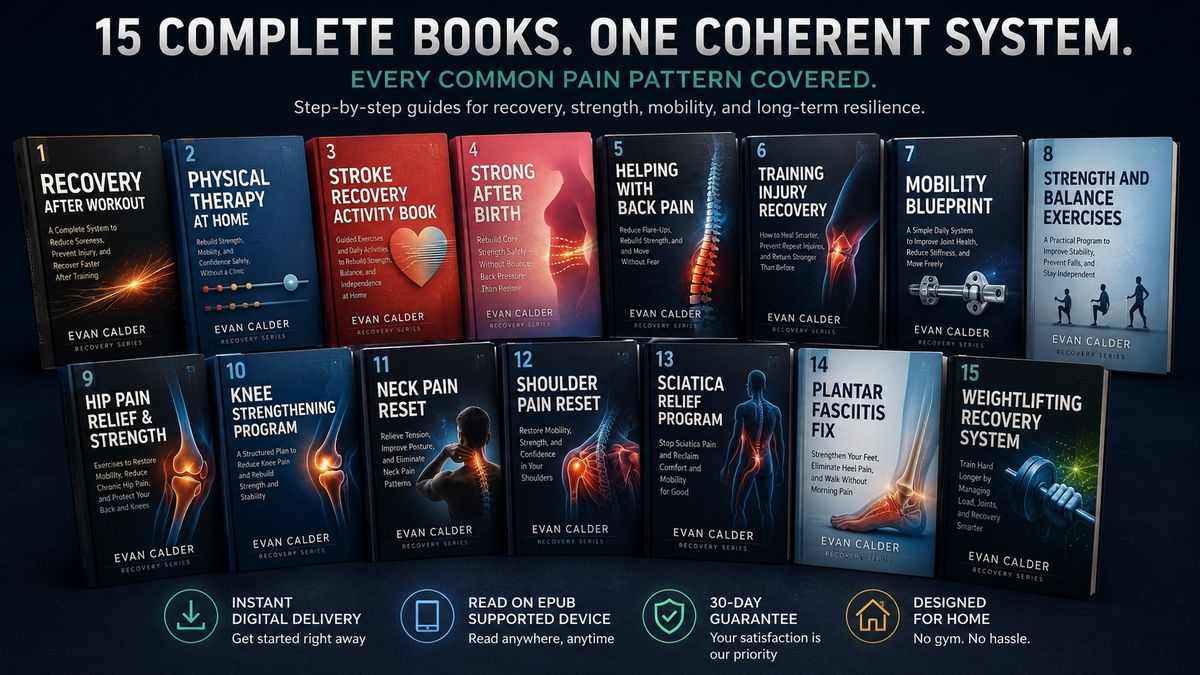
The series
Recovery Series
- Book 1Recovery After Workout

- Book 2Physical Therapy at Home

- Book 3Stroke Recovery Activity Book

- Book 4Strong After Birth

- Book 5Helping With Back Pain

- Book 6Training Injury Recovery

- Book 7Mobility Blueprint

- Book 8Strength and Balance ExercisesYou are here

- Book 9Hip Pain Relief & Strength

- Book 10Knee Strengthening Program

- Book 11Neck Pain Reset

- Book 12Shoulder Pain Reset

- Book 13Sciatica Relief Program

- Book 14Plantar Fasciitis Fix

- Book 15Weightlifting Recovery System


About the author
Evan Calder
Recovery Guide
Evan Calder is a movement and recovery educator specializing in injury rehabilitation, physical resilience, and long-term strength for everyday people. His work focuses on helping readers rebuild confidence in their bodies after pain, injury, illness, or major life changes, without relying on extremes, shortcuts, or fear-based advice.
More about Evan Calder