

Neck Pain Reset
Targeted Exercises to Relieve Tension, Improve Posture, and Reduce Headaches
Recovery209 pagesPublished 1 February 2026Kindle, paperback & hardcoverRecovery
Neck pain has a way of stealing your attention, tightness by midday, stiffness after sleep, headaches that seem to appear out of nowhere, and the constant feeling that you should be “fixing your posture.”
Neck Pain Reset offers a calmer, more reliable approach.
Instead of chasing perfect alignment or aggressive stretching, you’ll follow a structured plan built around three principles: reduce fear, build tolerance, and progress intelligently. You’ll learn why neck pain persists, how tension and headaches often connect, and exactly what to do next, using short daily routines that fit real life.
This book is educational, conservative, and practical. It includes clear red flags and decision rules so you know when self-care is appropriate and when to seek medical support.
Inside you’ll learn:
- The most common neck pain patterns, and how to choose the right tools for yours
- Red flags and medical considerations (especially important for headaches)
- Posture myths vs. real solutions: why posture variety beats rigid perfection
- A conservative 7-Day Neck Relief Plan to settle symptoms and build confidence
- A simple, safe Neck Mobility Assessment to guide progression
- How thoracic mobility and shoulder blade control unload the neck
- Deep neck flexor training and breathing strategies to reduce tension
- Two structured strength phases:
- Phase 1: Endurance
- Phase 2: Control and Load
- Practical chapters for desk/screen use, phone habits, sleep, driving, and travel
- Conservative return-to-exercise guidance so you can train without flare-ups
- A calm, practical chapter on stress and pain sensitization
- A complete 30-Day Neck Reset Program with weekly progression rules
- A long-term plan to keep results, without living in “perfect posture” mode
This is for you if:
- Your neck tightens during desk work, phone use, driving, or stress
- You get recurring stiffness and want a plan that actually sticks
- You want strength and control, not temporary relief and guesswork
- You’re tired of fear-based advice and “one magic stretch” promises
Healing happens when calm, consistency, and intelligent progression replace urgency and guesswork.
Start your reset today, and build a neck that can handle real life.
Read the first chapter
Chapter One: Why Neck Pain Persists
Sarah had been stretching her neck every morning for three years. Every night, the tension returned. She'd tried foam rollers, massage guns, ergonomic pillows, and two different chiropractors. Each new solution helped briefly, then stopped working. She was beginning to wonder if something was seriously wrong. The truth was simpler than she feared, and more fixable than she expected. Her neck wasn't damaged. It was deconditioned. The stretching relieved symptoms temporarily but never addressed why they kept coming back. What Sarah needed wasn't a better stretch. She needed a system that built her neck's capacity to handle her actual life.
How this chapter helps you
Identify the real drivers of recurring neck tension and headaches (without scary stories)
Learn why “tight” often means overworked, not “needs stretching harder”
Use a simple model, capacity vs. demand, to guide every decision you make
Start shifting from “fixing” to building tolerance in a predictable way
The recurring neck pain loop (and why it makes sense)
If you’ve had neck pain for months or years, you’ve likely done some version of this:
Neck feels tight → you stretch or crack it
It feels better briefly
You go back to normal life (screens, stress, sleep, training)
Tightness returns → you stretch harder / search for a “cause”
You start avoiding movements or positions that feel risky
Your neck gets less tolerant, not more
This isn’t because you’re doing everything wrong. It’s because the neck is a high-sensitivity area with a lot of sensory input. It’s designed to:
keep your eyes level
stabilize your head during movement
respond fast to perceived threat
When the system is irritated, the neck tends to respond with protection: more tone, more caution, fewer movement options.
Your job isn't to “force it to relax.”
Your job is to teach it safety through graded input.
Capacity vs. demand: the calmest explanation that actually works
Think of your neck as having a daily capacity, how much load it can manage before it complains.
Demand comes from:
long, still positions (desk work, driving)
repeated small actions (checking phone, side glances)
emotional load (stress, time pressure)
sleep debt
training volume and intensity
jaw clenching and breath holding
headaches and light/sound sensitivity (which can heighten overall threat)
Capacity is built from:
endurance of stabilizers (deep neck flexors, scapular support)
thoracic mobility and rib movement (so the neck doesn’t do everything)
nervous system confidence (lower threat interpretation)
movement variety across the day
strength that is introduced gradually
When demand exceeds capacity, you don’t just get pain, you get guarding. Guarding is the body’s way of restricting choices to keep you safe. Helpful short-term. Annoying long-term.
This is why you can feel worse during:
busy weeks
travel
poor sleep
emotionally intense seasons
even if “nothing happened” to your neck.
Why “posture fixes” often backfire
Many people try to solve neck pain by holding themselves “correctly.” They pull shoulders back, lift the chest, tuck the chin hard, and brace the abs like a statue.
It can feel supportive for 10 minutes. Then fatigue hits.
Rigid posture strategies fail because they:
increase sustained muscle activity (more demand)
reduce natural movement variety (less recovery)
create a threat narrative (“If I slouch, I’m damaging myself”)
turn every moment into a self-monitoring task (more tension)
Better goal: posture options.
We’ll build a neck that can tolerate upright, slouched, leaned, turned, and moving, because life requires all of those.
The “tight muscle” misunderstanding
Neck tightness often feels like shortness. But in persistent cases, the common reality is:
the muscles feel tight because they’re tired
they’re tired because they’re doing too much
they’re doing too much because other regions are not sharing the load (thoracic spine, shoulder blades, breathing mechanics)
Stretching can be helpful, when used gently and briefly. But stretching harder is rarely the missing ingredient.
What helps more reliably:
low-threat mobility (small range, frequent)
endurance training (light load, longer time)
control training (smooth movement without gripping)
load management (breaks, setup changes, pacing)
Neck pain and headaches: a shared threshold story
A neck-driven headache pattern often behaves like a threshold. Your symptoms rise when multiple “inputs” stack:
forward head drift + screen glare + jaw tension
rushed breathing + coffee + skipped lunch
poor sleep + long drive + stress
gym session + next-day desk marathon
The goal isn’t to eliminate every input. It’s to raise your threshold by increasing capacity and reducing unnecessary demand.
You’ll learn two key skills:
De-stack the day (reduce total demand)
Train the system (increase capacity)
The practical system: your first reset rules
Here are the rules you’ll use starting today. They’ll show up again throughout the book, because consistency is the intervention.
Rule 1: Build a “tolerable baseline”
A baseline isn't “pain-free.” It’s “manageable.”
Choose 2–4 movements or drills that:
feel easy to moderate in the moment
don't spike symptoms later
leave you feeling looser, steadier, or calmer
That baseline becomes your anchor on stressful weeks.
Rule 2: Train frequency before intensity
With neck pain, the most effective dose is often:
low intensity
high consistency
short sessions
Start with 5–10 minutes, most days, rather than 45 minutes once a week.
Rule 3: Mild symptom change is acceptable; lingering escalation is not
Use a simple response rule:
During practice: symptoms can move up to +1–2/10 if they settle quickly
After practice: you should return to baseline within 1–2 hours
Next day: you shouldn't feel noticeably worse than your normal pattern
If you break these rules, don’t panic. You regress the dose.
Rule 4: Spread load across the day
Your neck hates one thing more than “bad posture”: unbroken time.
Micro-resets beat perfect setups:
30–60 seconds every 30–45 minutes
2–3 bigger resets during the day (3–5 minutes)
Rule 5: Make calm the default
A stressed nervous system reads more threat from the same physical input.
Calm practices that matter:
slower exhale breathing for 60–90 seconds
jaw unclenching checks
soft eyes (reduce visual strain)
easing your grip on “correctness”
This isn’t “all in your head.” It’s load management for the whole system.
A simple daily menu (start here)
Pick one from each category. Total time: 6–10 minutes.
Category A: Movement snacks (1–2 minutes each)
Gentle neck turns (comfortable range): 5 each side
“Yes” nods (small range, slow): 6–8 reps
Shoulder rolls: 6–10 reps
Thoracic extension over chair back (small range): 6 reps
Category B: Endurance primer (1–3 minutes)
Supported chin nod hold (we’ll teach precisely in Ch.9): 3–5 holds of 10–20 seconds
Wall-supported scapular set (gentle): 3 holds of 15–20 seconds
Category C: Calm downshift (60–90 seconds)
Long exhale breathing: inhale 3–4 sec, exhale 5–7 sec, 6–8 cycles
If you do only this for a week, you’re already changing the loop: you’re training the system to expect safe input.
Common errors (and the better move)
Error 1: Waiting for pain to disappear before moving
Better: Use movement to lower threat, small, frequent, tolerable.
Error 2: Testing your neck repeatedly (“Does it still hurt?”)
Better: Test once in the morning, once mid-day, once evening. Too much testing increases vigilance.
Error 3: Going hard on stretches or self-mobilization
Better: Keep mobility gentle, then build endurance and control so the “tight” muscles don’t have to work overtime.
Error 4: Trying to fix everything at once
Better: Choose two daily anchors:
a 6–10 minute reset
two micro-breaks during work
Quick checklist: your action plan
Identify your baseline symptoms and pattern today
Do a 6–10 minute daily menu for 5–7 days
Add two micro-resets to your workday
Use the response rules: progress / hold / regress
Stop chasing perfect posture; aim for posture options
That is the end of chapter one.
The rest of Neck Pain Reset is waiting for you.
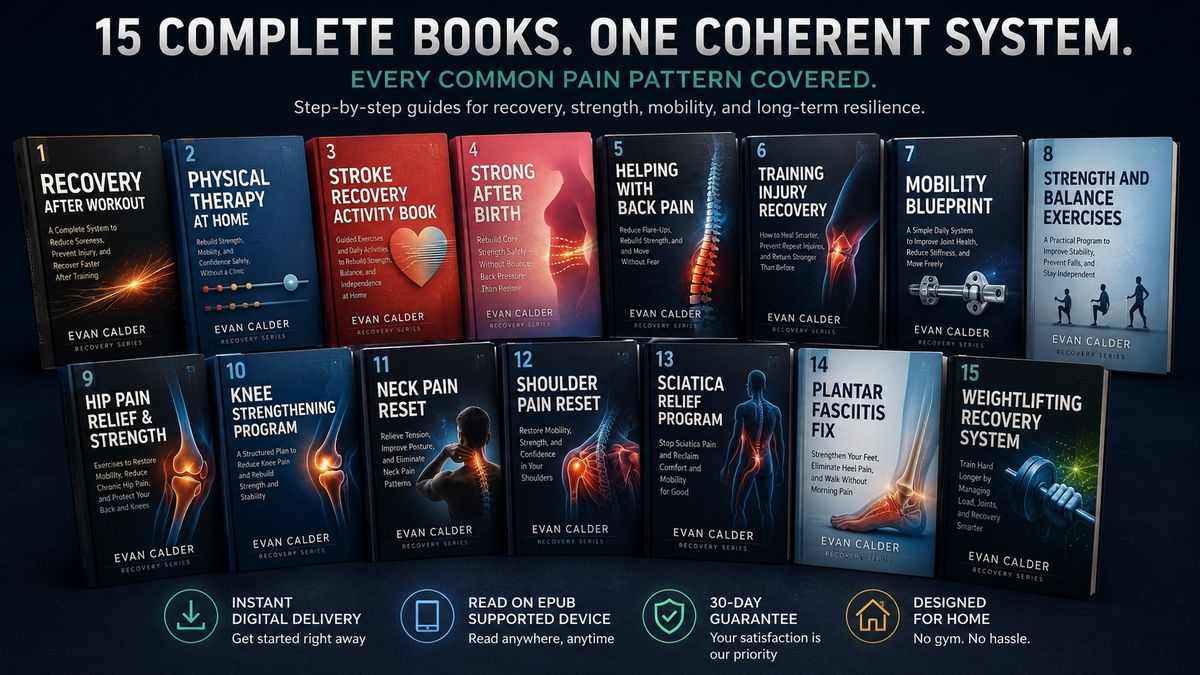
The series
Recovery Series
- Book 1Recovery After Workout

- Book 2Physical Therapy at Home

- Book 3Stroke Recovery Activity Book

- Book 4Strong After Birth

- Book 5Helping With Back Pain

- Book 6Training Injury Recovery

- Book 7Mobility Blueprint

- Book 8Strength and Balance Exercises

- Book 9Hip Pain Relief & Strength

- Book 10Knee Strengthening Program

- Book 11Neck Pain ResetYou are here

- Book 12Shoulder Pain Reset

- Book 13Sciatica Relief Program

- Book 14Plantar Fasciitis Fix

- Book 15Weightlifting Recovery System


About the author
Evan Calder
Recovery Guide
Evan Calder is a movement and recovery educator specializing in injury rehabilitation, physical resilience, and long-term strength for everyday people. His work focuses on helping readers rebuild confidence in their bodies after pain, injury, illness, or major life changes, without relying on extremes, shortcuts, or fear-based advice.
More about Evan Calder