

Knee Strengthening Program
Step-by-Step 30-Day Plan
Recovery257 pagesPublished 1 February 2026Kindle, paperback & hardcoverRecovery
Build stable, pain-free knees with a calm, step-by-step system, without extremes, gimmicks, or fear-based advice.
If your knees feel sore on stairs, irritated after running, “creaky” after time off, or unpredictable during sport, you don’t need a miracle fix, you need a plan that raises your knee’s capacity safely and steadily.
Knee Strengthening Program is an educational, movement-based guide that teaches you how knee pain really works (load vs tolerance), how to reduce flare-ups, and how to rebuild strength and confidence with clear progression rules.
Inside you’ll learn:
- Why knee pain is so common, and what it usually means (without panic)
- How to use the 24-hour response and swelling rules to train safely
- The biggest knee rehab mistakes, and what to do instead
- A conservative 7-Day Knee Reset Plan to calm irritation and rebuild confidence
- A simple, repeatable Knee Strength Assessment you can retest every 2–4 weeks
- How ankle mobility and hip strength protect the knee (without “perfect form” pressure)
- Quadriceps strengthening without aggravation, plus pain-range decision rules
- Step and stair mechanics: how to go up and down with less irritation
- Three progressive phases: Isometric Control → Controlled Range Strength → Power & Impact
- How to return to running and sport with graded exposure (no boom-bust cycles)
- Bracing/taping basics as optional short-term tools (not dependence)
- A complete 30-Day Knee Strength Plan with weekly structure and progression rules
This book is for you if you:
- Have knee pain or instability with stairs, squats, running, or sport
- Want a structured plan you can follow at home or in the gym
- Prefer calm, practical guidance over hype and harsh “push through it” messaging
- Need clear rules for when to progress, hold, regress, or seek medical care
Important: This book is educational and not medical advice. It includes clear red flags and guidance on when to seek professional evaluation, especially for major swelling after injury, inability to bear weight, locking/catching, severe instability, infection signs, calf swelling/pain, new numbness/weakness, or rapidly worsening symptoms.
Start where you are. Train what you can repeat. Build knees you can trust.
Read the first chapter
Chapter One: Why Knee Pain Is So Common
Sarah was 34 when stairs started to feel wrong. Not painful exactly, but uncertain. Like her knee needed a moment to decide whether it was going to cooperate. She’d always been active, a regular at the gym, a weekend hiker. But somewhere between a busy season at work and a month of skipped workouts, her knees started talking. She did what most people do: she Googled it. The results were overwhelming. Torn meniscus? Arthritis? Patellofemoral syndrome? She tried stretching, then foam rolling, then rest. Nothing stuck. What she didn’t realize was that her knees weren’t broken. They were deconditioned. And the fix wasn’t complicated. It just needed to be systematic.
What this chapter will change for you
You’ll stop treating knee pain as a single “thing” and start seeing patterns you can influence.
You’ll understand why normal activities (stairs, sitting, running) can flare a knee that looks “fine” on scans.
You’ll learn the three most common reasons knees become sensitive: capacity gaps, load spikes, and control leaks.
You’ll begin building your personal baseline with fewer false alarms and less guesswork.
Knee pain isn’t rare, because knees do a lot
Knees are asked to do two jobs at once:
• Transmit force between the ground and your body
• Manage angles while you move (bend, straighten, rotate slightly, stabilize)
Every step, your knee handles load. Add stairs, hills, speed, fatigue, or extra bodyweight and the demand rises quickly. Unlike a machine part, you don’t swap a knee out when it’s tired, you adapt it. That adaptation is the entire point of training.
Pain often appears when the adaptation process gets outpaced.
The three big reasons knees get cranky
1) Capacity gaps (strength and tissue tolerance lag behind life)
Your knee’s capacity includes:
• Quadriceps strength (especially control near mid-range)
• Tendon tolerance (patellar tendon, quad tendon)
• Joint tolerance for compression (often relevant in kneecap-related pain)
• Coordination and control (how smoothly you load/unload)
A capacity gap can come from:
• Time off (injury, illness, busy seasons, new parent life)
• A long stretch of low activity
• Doing “some exercise,” but not enough targeted knee loading to build tolerance
• Translation: Your knee may be healthy, but under-trained for what you’re asking.
2) Load spikes (too much, too soon, too often)
Load spikes are the classic trigger:
• First week back to running and you also add hills
• You play sport Saturday, hike Sunday, then do leg day Monday
• You increase steps at work and keep training unchanged
Your knee doesn’t get one vote. It gets a vote every time you load it, and the total matters.
Key idea: Most flare-ups are math problems, not mystery diseases.
3) Control leaks (the knee doing extra steering)
Your knee is a strong load manager, but it’s not meant to do all the steering alone.
Common control leaks:
• Stiff ankles limit shin movement → the knee compensates
• Weak hips/pelvis control → the thigh rotates/leans in, increasing knee demand
• Foot mechanics collapse under fatigue → the knee gets a less stable platform
• Speed + poor braking strategy → the knee takes abrupt, spiky load
This is why two people can do the same exercise and have different knee reactions: same move, different distribution of work.
Common knee pain patterns you’ll see in this book (and why they persist)
We’ll go deeper in Chapters 2 to 3, but it helps to name the usual suspects.
Patellofemoral-type pain (often “around/behind the kneecap”)
Common clues:
• Worse with stairs, hills, deep squats, prolonged sitting (“movie sign”)
• Feels achy, stiff, “pressure-y”
Often driven by:
• Compression tolerance + quad capacity mismatch
• Technique, volume, and control (not “bad kneecaps”)
Tendinopathy-type irritation (often below kneecap or above it)
Common clues:
• Pain with jumping, sprinting, sudden accelerations, heavy knee-dominant training
• Warm-up helps, but it bites later if load is too high
Often driven by:
• Tendon capacity lagging behind power demands
• Spiky loading without enough progressive buildup
Post-time-off weakness and “creaky knees”
Common clues:
• Stiffness, clicking without major swelling, discomfort with getting up/down
Often driven by:
• General strength and control deficits
• Low exposure to loaded knee bending
Important: these are patterns, not diagnoses. The point is to match your training strategy to the pattern, and to your knee’s current tolerance.
The calm approach: irritation vs injury
Here’s a simple, practical distinction:
Injury (higher concern): often linked to a clear trauma (twist, pop, fall), major swelling, instability, locking, inability to bear weight, or rapidly worsening function.
Irritation (common): symptoms fluctuate with load. you can often walk. swelling is minimal or absent. it’s more “angry and sensitive” than “structurally failed.”
If you have injury-style features or red flags, you don’t self-manage with a book. You get assessed.
If it’s irritation, the system is:
• Find baseline
• Build capacity with progressive load
• Improve control and distribution (ankle/hip/technique)
• Return to sport with staged exposure
Your first decision rules (start using them today)
Rule 1: Establish your baseline in real life
For the next 3 days, note:
• What triggers symptoms (stairs? sitting? running? deep bend?)
• What calms symptoms (short walk? heat? gentle movement?)
• Whether symptoms are stable, improving, or worsening
• Baseline is the level where your knee is predictable.
Rule 2: Use a “traffic light” effort guide
• Green (go): discomfort 0 to 2/10, settles quickly, no next-day worsening
• Yellow (caution): discomfort 3 to 4/10, manageable, but watch 24-hour response
• Red (stop/modify): sharp pain, giving way, increasing swelling, or worse at 24 hours
• You’re not trying to be heroic. You’re trying to be consistent.
Rule 3: One change at a time
If your knee is irritated, don’t:
• increase running + add leg day + start jumping
• Pick one lever. Keep the rest steady.
Mistakes that make knee pain feel “random”
Chasing perfect form instead of building tolerance (form matters, but tolerance is the base)
Rest-only cycles: doing nothing until it feels better, then returning to the same load spike
• Testing daily: repeated deep squats, stairs “just to see,” constant poking at symptoms
• Ignoring swelling: swelling is a load intolerance signal, not a challenge
Quick checklist / Action plan
Identify your likely pattern: kneecap-related, tendon-related, or deconditioned sensitivity
• Start tracking: triggers, calmers, 24-hour response
• Set your baseline: what you can repeat for a week without trend-worsening
• Adopt traffic lights and one-change progression
If you have red flags (locking, major swelling after injury, inability to bear weight, severe instability, infection signs, calf swelling/pain, new numbness/weakness): get assessed
That is the end of chapter one.
The rest of Knee Strengthening Program is waiting for you.
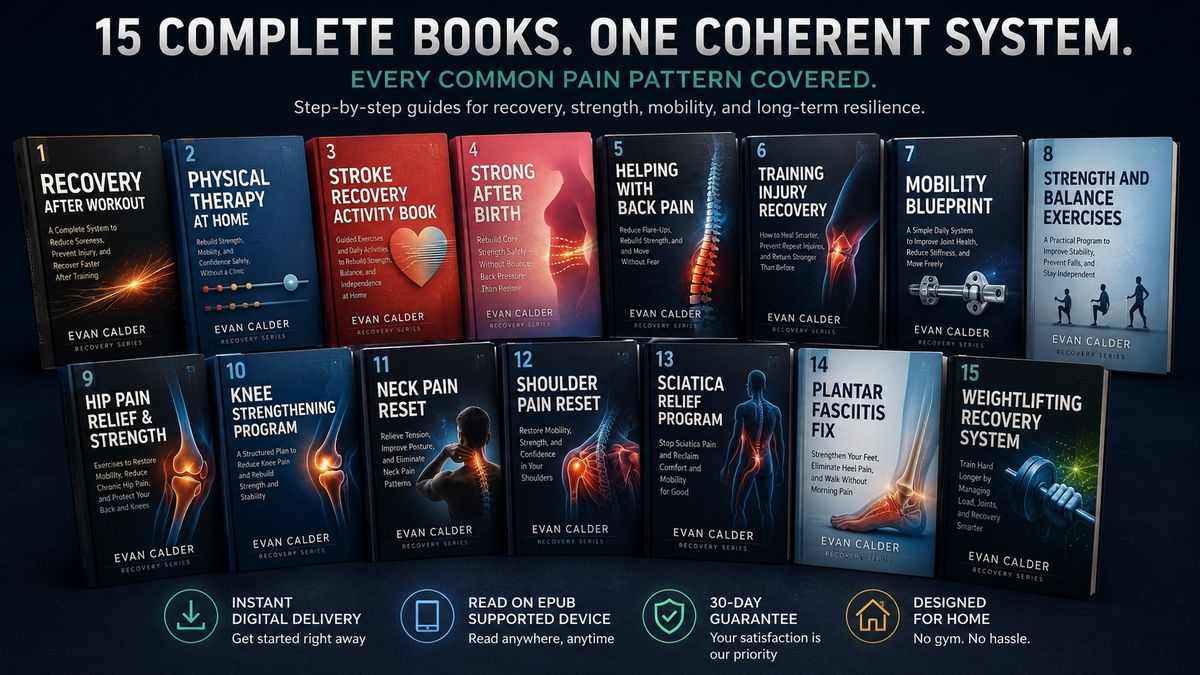
The series
Recovery Series
- Book 1Recovery After Workout

- Book 2Physical Therapy at Home

- Book 3Stroke Recovery Activity Book

- Book 4Strong After Birth

- Book 5Helping With Back Pain

- Book 6Training Injury Recovery

- Book 7Mobility Blueprint

- Book 8Strength and Balance Exercises

- Book 9Hip Pain Relief & Strength

- Book 10Knee Strengthening ProgramYou are here

- Book 11Neck Pain Reset

- Book 12Shoulder Pain Reset

- Book 13Sciatica Relief Program

- Book 14Plantar Fasciitis Fix

- Book 15Weightlifting Recovery System


About the author
Evan Calder
Recovery Guide
Evan Calder is a movement and recovery educator specializing in injury rehabilitation, physical resilience, and long-term strength for everyday people. His work focuses on helping readers rebuild confidence in their bodies after pain, injury, illness, or major life changes, without relying on extremes, shortcuts, or fear-based advice.
More about Evan Calder