
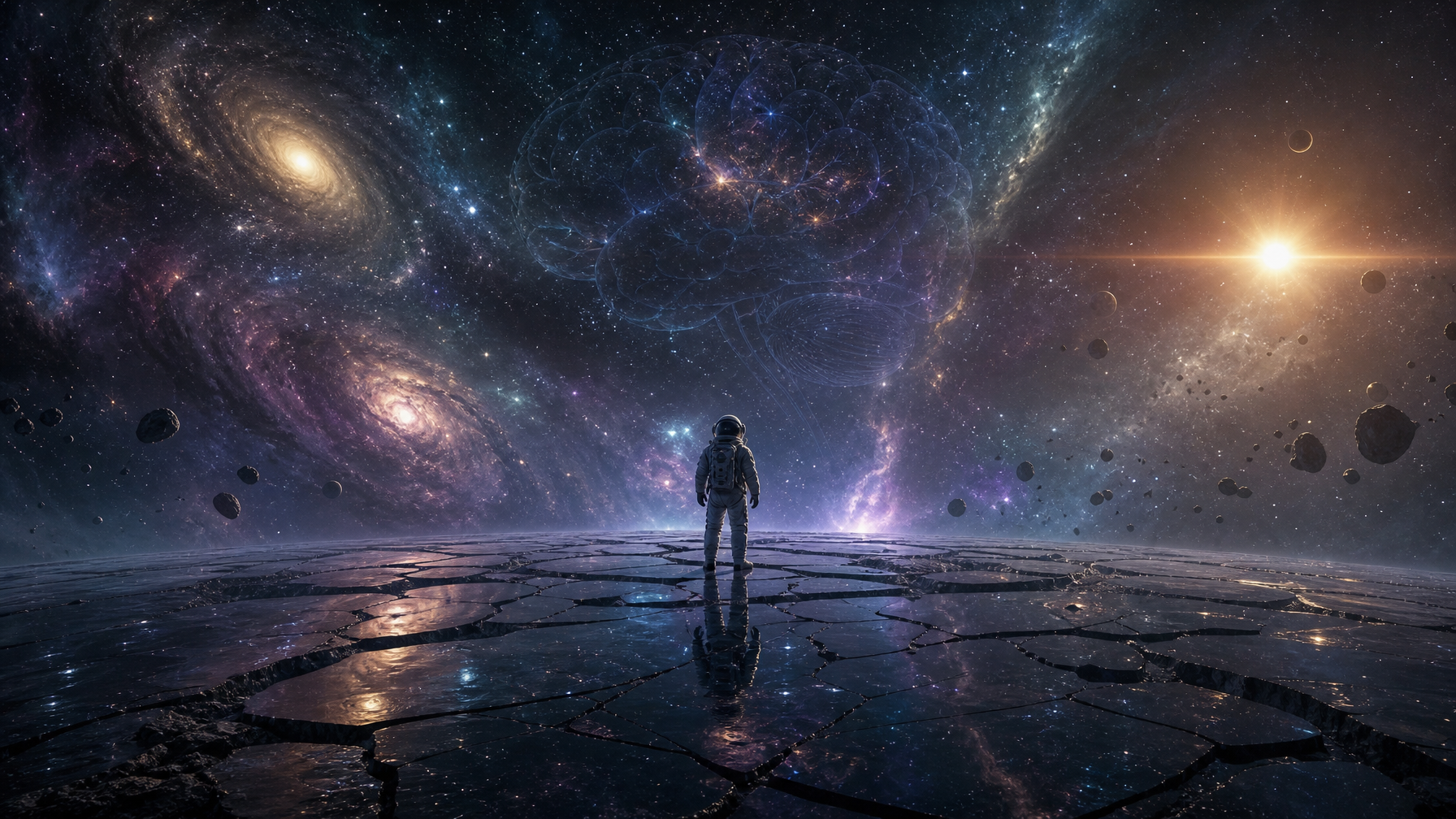
Best Existential Sci-Fi Books: 7 Stories That Will Rewire How You Think May 22, 2026 – Posted in: Books, Reading Lists, Science Fiction – Tags: best sci-fi books, existential sci-fi, Michael Tran, philosophical fiction, sci-fi books, science fiction reading list, speculative fiction, thought-provoking books
TLDR
Existential sci-fi asks the questions most fiction is afraid to touch — what it means to be conscious, whether free will exists, and what we owe to each other when the universe is indifferent. These seven books are essential reading for anyone who wants their brain (gently) broken.
There's a particular kind of book that stays with you for weeks after you finish it. You're making coffee, and suddenly you stop. You're staring out the window, but you're not really seeing the street. You're thinking about a scene — a character's choice, a single line of dialogue — and it's rearranging something fundamental in how you see the world.
That's existential sci-fi. And if you've never intentionally sought it out, you're missing one of the most rewarding corners of the reading world.
What Existential Sci-Fi Actually Is
Not all science fiction is existential. Plenty of sci-fi is about adventure, empire, alien contact, or the thrill of hard technology. Existential sci-fi is the subset that uses speculative premises to investigate the deepest questions of human existence: What am I? Why am I here? Does my life have meaning when set against the scale of the universe? What happens to identity when the body or the mind changes beyond recognition?
The genre isn't necessarily dark (though it can be), and it's not depressing (though it's honest). At its best, existential sci-fi is clarifying. It strips away the comfortable noise of daily life and holds a mirror up to the raw fact of being alive.
Michael Tran, one of Edenroot Press's most thought-provoking voices in this space, describes the genre as "philosophy with a heartbeat." The speculative setting isn't a gimmick — it's a laboratory where ideas that would feel abstract on the page of a philosophy textbook become viscerally, urgently real.
Why Readers Fall Hard for This Genre
Existential sci-fi has a devoted readership for a reason. These stories don't just entertain — they do something to you. Readers consistently report:
- A shift in perspective. After a great existential sci-fi novel, the ordinary world looks different. Sometimes smaller. Sometimes larger. Always more interesting.
- A sense of connection. These books tackle universal fears — mortality, meaninglessness, isolation — and in naming them, they make readers feel less alone in facing them.
- Emotional weight that lingers. The stakes in existential sci-fi aren't just "will the hero survive?" They're "does survival even mean what we think it does?"
If you've ever finished a book and sat quietly with it for a while, reluctant to move on — that's the existential sci-fi effect.
The Themes That Define the Genre
Before the book list, it's worth naming the themes that keep showing up in the best existential sci-fi. These are the ideas authors return to because they're genuinely unresolved, even now:
Consciousness and What Makes You "You"
If your memories were transferred to a new body, would you still be you? If an AI feels pain and longing and love, does that change its moral status? Existential sci-fi refuses to let these be easy questions.
Free Will and Determinism
Are your choices real, or are you following a path set by biology, physics, or fate? Some of the most compelling sci-fi in this genre puts characters in situations where that question has genuine, terrifying stakes.
Mortality and the Shape of a Life
What does it mean to live a meaningful life when it ends? How does that calculus change if lives could be extended, copied, or uploaded? The best existential sci-fi makes you feel the weight of your own finitude — not as a source of dread, but as the thing that makes meaning possible.
The Individual vs. the Cosmos
There's a particular vertigo that comes from a story that zooms out far enough to show how small humanity is — and then zooms back in to show that small humans still matter enormously to each other. That tension is existential sci-fi's native territory.
7 Existential Sci-Fi Books Worth Your Time
1. Never Let Me Go by Kazuo Ishiguro
Technically literary fiction, but existential sci-fi at its soul. Ishiguro builds a world that feels almost normal, then reveals something quietly devastating about what was always there beneath the surface. The questions it raises about the value of a life — and whether we see each other clearly — are ones readers carry for years.
2. Exhalation by Ted Chiang
Chiang is the modern master of the philosophical short story wrapped in speculative fiction. The title story alone — about a universe discovering its own thermodynamic fate — is one of the most beautiful pieces of writing in the genre. Every story asks a precise, genuine question and follows it honestly to its end.
3. Sea of Tranquility by Emily St. John Mandel
A novel about time, simulation, and the strange grief of living through collapse — personal or civilisational. Mandel writes with warmth and precision, and the result is a book that feels like it's quietly asking whether the beauty of ordinary moments is enough. (It might be.)
4. Death's End by Liu Cixin
The final book in the Three-Body trilogy is existential sci-fi at its most cosmic. Liu Cixin takes humanity's place in the universe and makes it feel genuinely precarious, then asks what we do with the choices that remain. Heavy, absorbing, and unlike anything else in the genre.
5. Flowers for Algernon by Daniel Keyes
One of the earliest and most enduring examples of existential sci-fi. The story of Charlie Gordon — a man whose intelligence is surgically altered — remains one of the most searching explorations of what intelligence, personhood, and love actually mean. Few books make readers feel the texture of a human life so sharply.
6. The Left Hand of Darkness by Ursula K. Le Guin
Le Guin dismantles the assumptions we carry about gender, identity, and belonging by simply removing them — and watching what's left. A slow, careful, irreplaceable book. Le Guin understood that the best speculative fiction doesn't ask "what if the world were different?" It asks "what do we assume about the world we already live in?"
7. Stories from Edenroot Press — Existential Sci-Fi for Modern Readers
If you're looking for fresh voices in this tradition, the Edenroot Press sci-fi collection brings together writers exploring exactly these themes for contemporary readers. Michael Tran's work sits in the rich lineage of Chiang and Le Guin — fiction that uses the speculative to make the real more legible. Alongside him, authors like Sarah Bennett (fractured civilisations) and Jason Clarke (algorithmic rebellion) push the genre into territory that feels urgently relevant to the world we're living through right now.
A Few Signs You Might Be an Existential Sci-Fi Reader Already
Not sure if this genre is for you? These signs point pretty clearly in one direction:
- You've ever finished a book and felt like the world looked different when you walked outside
- You think about questions like "what would I do if I knew exactly when I'd die?" — not morbidly, but curiously
- You prefer stories where the internal conflict matters as much as the external one
- You appreciate fiction that respects your intelligence and doesn't tie everything up neatly
- You've ever recommended a book by saying "it's difficult to describe, but just trust me"
If more than two of those landed, you're already a reader of this genre at heart. You just might not have found the right books yet.
Why This Genre Matters Now More Than Ever
In an age of AI, accelerating technology, climate uncertainty, and genuine questions about what human society is for, existential sci-fi isn't escapism — it's preparation. It rehearses the questions we're going to need to answer as a species, in a space where the stakes are contained on the page rather than playing out in the world.
That's not a small thing. Fiction that makes you think more clearly about who you are and what you value is one of the most useful things you can read.
Start Here
If you're new to existential sci-fi, start with Exhalation by Ted Chiang — short stories are lower commitment, and Chiang's work is as close to perfect as the genre gets. From there, let the questions pull you forward.
And if you want to explore more titles in this tradition, including fresh voices publishing today, head over to edenrootpress.com and browse the sci-fi shelf. Michael Tran and the rest of the Edenroot sci-fi authors are writing for exactly the kind of reader who made it to the end of this post.
You'll know who you are.