
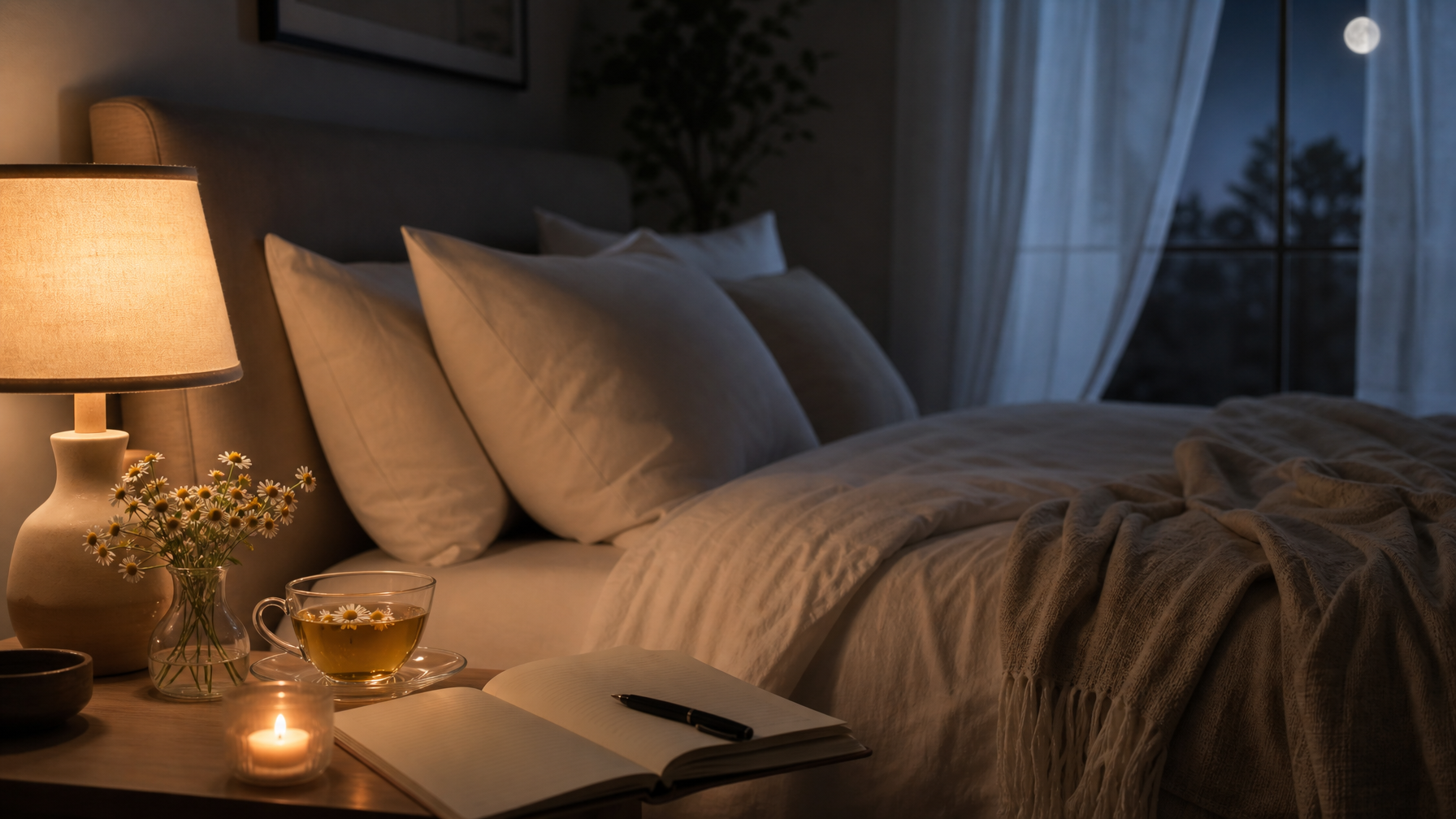
How to Build a Night Routine That Actually Helps You Sleep June 5, 2026 – Posted in: Night Routine, Self-Help, Sleep, Wellness – Tags: bedtime routine, better sleep, how to sleep better, insomnia, Marina Kowalska, night routine, sleep hygiene, sleep tips, wind down routine
Description
Struggling to fall asleep no matter how tired you are? A structured night routine for better sleep can rewire your brain's wind-down signals and transform your rest — starting tonight.
You know that feeling. You're exhausted. You've been running on fumes since noon. You crawl into bed, close your eyes… and your brain decides that right now is the perfect time to replay every awkward conversation from 2019.
You're not broken. Your brain just hasn't been given a clear signal that the day is over.
That's exactly what a proper night routine does. It's not about rigid schedules or turning your bedroom into a wellness spa. It's about giving your nervous system a reliable sequence of cues that say: we're safe, we're done, it's time to rest. And the science backs it up — consistently.
Here's how to build one that genuinely works.
Why Your Brain Needs a Wind-Down Window
Sleep doesn't arrive on command. Your body starts preparing for it well before your head hits the pillow, through a gradual drop in core temperature, a rise in melatonin, and a shift in brain activity from alert to calm.
The problem? Most of us spend our evenings doing exactly the opposite of helping that process along. Bright screens, stimulating content, late-night snacks, work emails at 10pm — all of these tell your nervous system to stay sharp, not slow down.
Research from the Sleep Foundation consistently shows that a predictable pre-sleep routine is one of the most effective ways to improve both how fast you fall asleep and how deeply you stay asleep. Even 30–45 minutes of intentional wind-down time makes a measurable difference.
The goal isn't perfection. It's consistency.
The Core Habits of an Effective Night Routine
1. Set a "Screens Off" Boundary (and Actually Keep It)
This one gets repeated so often it's started to sound like a cliché — but it still matters. Blue light from phones and laptops suppresses melatonin production, and the stimulating content keeps your brain in problem-solving mode long after you've put the device down.
Try setting a specific time, say 9:30pm, when screens go off or go on Night Shift mode. It doesn't have to be dramatic — just consistent. Within a week or two, your brain starts recognising that boundary as the start of the wind-down.
If you genuinely can't avoid your phone in the evenings, at least shift away from social media and news. Something calmer — a quiet playlist, an audiobook, or even just a phone call with someone you like — is far less disruptive to your sleep onset.
2. Cool the Room, Warm the Body
This sounds counterintuitive, but it's one of the most well-supported sleep hacks out there. Your core body temperature needs to drop slightly for deep sleep to kick in. A warm bath or shower about 60–90 minutes before bed actually helps this happen faster by drawing heat to the surface of your skin, which then dissipates more quickly.
So: warm bath or shower in the early evening, then set your bedroom to somewhere between 16–19°C (60–67°F). That mild coolness is one of the strongest environmental triggers for quality sleep.
3. Dim the Lights an Hour Before Bed
Artificial lighting at night tricks your circadian rhythm into thinking it's still daytime. Swap overhead lights for a lamp, use warm-toned bulbs, or invest in a simple dimmer switch. It sounds small, but lighting is a powerful biological signal.
If you wear glasses, blue-light filtering lenses in the evening can also help — though getting off the bright screen is still more effective than filtering it.
4. Give Your Brain a "Done for the Day" Ritual
One of the biggest sleep thieves is an unfinished mental to-do list. Your brain keeps running in the background, trying to hold everything together, because it doesn't trust that tomorrow is sorted.
A simple fix: spend five minutes writing tomorrow's three most important tasks in a notebook before bed. Research published through Johns Hopkins Medicine suggests that this kind of "cognitive offloading" genuinely reduces pre-sleep anxiety. You're telling your brain it can let go — the thinking is captured, nothing will be forgotten.
This doesn't have to be a full journaling practice. Even a quick bullet list does the trick.
5. Choose Calming Input Over Stimulating Input
What you consume in the hour before bed shapes your mental state as you fall asleep. A thriller podcast, a heated debate on social media, or a tense TV drama might be entertaining — but they're not going to ease you into rest.
Instead, reach for something quieter. A novel, a gentle podcast, soft music, or even a few minutes of slow stretching. The goal is to give your nervous system something to work with that doesn't require vigilance.
6. Be Consistent on Weekends (Yes, Really)
Your circadian rhythm doesn't take weekends off. Sleeping in on Saturday and Sunday can shift your internal clock by enough to make Monday morning feel like mild jetlag — something researchers have started calling "social jetlag."
You don't have to be rigid about it. But keeping your wake time within an hour of your weekday schedule, even when you've had a late night, will make it dramatically easier to fall asleep the following evening.
What to Do When You Still Can't Sleep
Even with a solid routine in place, there will be nights when sleep doesn't come easily. Here's what actually helps on those nights:
- Get up if you've been awake for 20 minutes. Lying in bed awake trains your brain to associate the bed with wakefulness. Get up, do something calm in dim light, and go back when you feel sleepy.
- Try 4-7-8 breathing. Inhale for 4 counts, hold for 7, exhale for 8. It activates your parasympathetic nervous system and genuinely takes the edge off a racing mind.
- Don't watch the clock. Turn it away. Time-checking spikes anxiety, which is the last thing you need.
- Skip the alcohol. It might help you fall asleep faster, but it fragments your sleep cycles and reduces REM sleep, leaving you feeling unrefreshed even after a full eight hours.
Building Your Own Routine: A Simple Starting Framework
You don't need to do all of this at once. In fact, stacking too many new habits overnight (pun intended) usually means none of them stick. Start with two or three changes and build from there.
Here's a bare-bones framework to get you started:
9:00 PM — Screens off or in low-stimulation mode. Write tomorrow's task list.
9:15 PM — Herbal tea, light stretching, or a warm shower.
9:45 PM — Dim the lights. Read a book, listen to something calm.
10:15 PM — Into bed. Cool room, no phone.
Adjust the timing to fit your life. The sequence matters more than the exact clock times.
The Bigger Picture: Sleep as a Foundation, Not a Luxury
Here's something worth sitting with: poor sleep doesn't just make you tired. Chronic sleep deprivation is linked to increased anxiety, impaired decision-making, weakened immunity, and a significantly higher risk of burnout. According to Mayo Clinic, consistently getting fewer than seven hours raises your risk for depression, weight gain, high blood pressure, and heart disease.
Sleep is the foundation that every other healthy habit rests on. You can't think clearly, train effectively, maintain healthy relationships, or manage stress well if you're running on four to six hours a night.
The night routine isn't a self-care indulgence. It's maintenance.
Ready to Go Deeper?
Marina Kowalska is Edenroot Press's Sleep and Night Routine Expert, and her work focuses on exactly this: using behavioural science and practical habit design to help people finally get the rest they've been chasing.
If you want to go beyond the basics and build a truly personalised sleep system, explore more from Marina and the wider Edenroot Press collection at edenrootpress.com/shop/. From sleep science to burnout recovery to emotional wellbeing, there's a book for wherever you're starting from.
Good sleep isn't a luxury you earn after a perfect day. It's something you build, one small habit at a time — and tonight is as good a place as any to start.