
Dark Fantasy Tropes Fans Can’t Get Enough Of (And Why They Work So Well) May 15, 2026 – Posted in: Book Recommendations, Dark Fantasy, Genre Fiction – Tags: ashen crowns, book recommendations, dark courts, dark fantasy, dark fantasy tropes, fantasy books, fantasy fiction, Lucien D'Aramont, morally grey characters
Description
A deep-dive into the dark fantasy tropes that readers obsess over — from fallen empires and corrupted magic to morally grey antiheroes who ruin your life in the best possible way.
Dark Fantasy Tropes Fans Can't Get Enough Of (And Why They Work So Well)
There's a reason dark fantasy has exploded in popularity over the last few years. It's not just about magic and kingdoms — it's about moral complexity, impossible choices, and worlds where the line between hero and villain is barely a smudge. If you've ever stayed up until 2am because you couldn't put down a book featuring a crumbling empire and an antihero you probably shouldn't be rooting for, you already know what we're talking about.
Dark fantasy pulls readers in and doesn't let go. But what are the specific tropes that keep us hooked — and why do they work so well? Let's break it down.
1. The Morally Grey Antihero
This is the big one. The reason half of us are here.
A morally grey character doesn't fit neatly into "good" or "evil." They make brutal choices. They lie, manipulate, and sometimes do genuinely terrible things — but for reasons that, when you sit with them long enough, start to make an uncomfortable kind of sense. They're not cartoon villains. They're complicated, and that complexity is exactly what makes them magnetic.
The best dark fantasy antiheroes carry real weight. You don't love them despite their flaws — you love them because of them. There's something deeply human about a character who has seen the worst of the world and still keeps moving, even if the way they move would make a lawful good paladin faint.
Lucien D'Aramont, whose Ashen Crowns series lives and breathes this trope, builds characters who operate in shadows and half-truths — where allegiance is a currency and survival demands a cost you might not be willing to pay.
2. Fallen Empires and Crumbling Courts
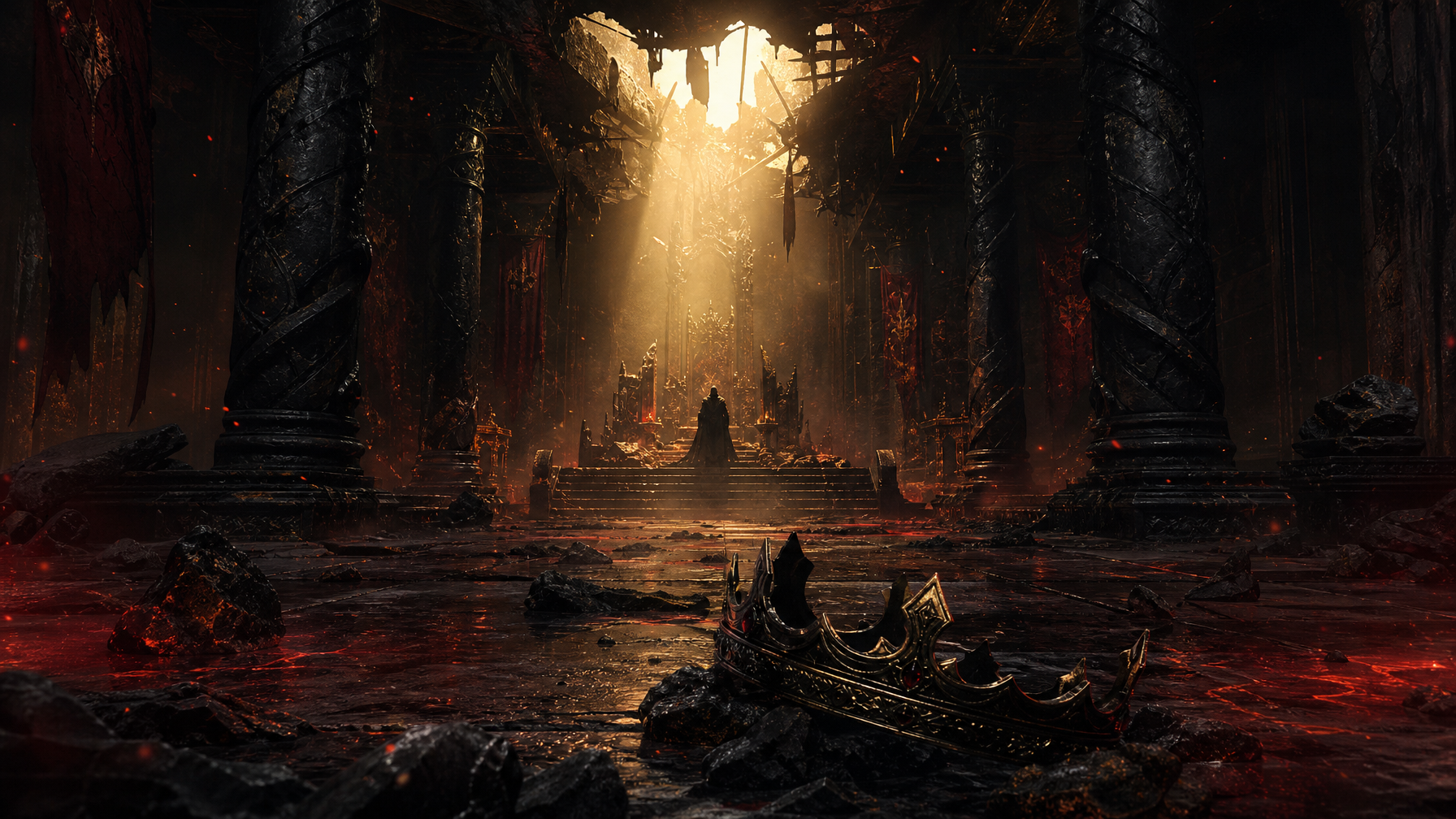
There's something irresistible about a world that used to be glorious and isn't anymore. Collapsed civilisations, courts built on blood and beautiful lies, thrones held together by fear — dark fantasy worldbuilding at its best uses decay as the backdrop.
Why does it work? Because it adds stakes. When an empire is already fracturing, every character decision feels consequential. There's no safety net. The world itself is hostile. And readers who love dark fantasy don't want a safety net — they want to feel the ground shifting under their feet.
Ashen kingdoms and dark courts work so well because they reflect something true: power corrupts, structures collapse, and the people left standing in the rubble are rarely the ones you expected.
3. Forbidden and Corrupted Magic
Clean, rule-following magic systems are fine. But dark fantasy readers often prefer magic that costs something.
Maybe every spell slowly erodes the caster's sanity. Maybe the power itself is sentient and hungry. Maybe you made a bargain you don't fully understand yet, and the debt is coming due. This kind of magic system creates built-in tension — a ticking clock layered beneath every plot thread.
When magic is dangerous and unpredictable, it stops being a tool and becomes a character in its own right. The best dark fantasy treats power as something that warps the people who hold it, which feeds directly back into those morally complex protagonists we love so much.
4. The Chosen One — Who Probably Shouldn't Have Been Chosen
Dark fantasy has a habit of taking the "chosen one" archetype and putting it through a paper shredder in the best way.
The protagonist is marked for greatness, sure. But they're also deeply flawed, possibly traumatised, and making decisions that raise real questions about whether the prophecy had any idea what it was doing. Dark fantasy deconstructs destiny and asks: what if the person destined to save the world is kind of a disaster?
This subversion of expectation is part of what draws readers away from traditional high fantasy and into darker territory. We've had enough chosen heroes who do the right thing every time. Give us the chosen one who sometimes does the necessary thing instead.
5. Enemies to Reluctant Allies (With a Body Count)
The enemies-to-lovers trope gets a lot of attention in romance, but in dark fantasy it takes on a different shape. It's less about romantic tension (though that can be part of it) and more about two people who should be opponents who are forced into an uneasy alliance — and who slowly, painfully, start to trust each other against every instinct they have.
This works because trust, in a dark world, is the most dangerous thing you can give someone. Watching characters extend that trust step by agonising step is genuinely tense, and when it finally pays off — or catastrophically doesn't — readers feel every bit of it.
6. Betrayal That Actually Lands
In lighter fantasy, betrayal often feels like a plot device. In dark fantasy, it feels inevitable and still devastating. The best dark fantasy writers set up betrayals so carefully that when they arrive, you're gutted even though, looking back, you saw every breadcrumb.
This is a hallmark of the genre: the world is cruel, characters are complex, and loyalties shift. Great dark fantasy earns its betrayals. They're not cheap — they mean something. They reshape the characters involved in ways that carry through to the end.
7. A World That Has No Easy Answers
Perhaps the defining quality of dark fantasy as a genre is its refusal to offer neat resolutions. Light doesn't always triumph. The villain sometimes has the best argument. The ending might not be happy — but it's honest.
This is what separates dark fantasy from darker-flavoured high fantasy. Dark fantasy acknowledges that power is messy, survival has a price, and moral clarity is a luxury most characters can't afford. Readers who are drawn to this genre tend to find that honesty refreshing. Real life doesn't have clean endings either.
Where to Find Your Next Dark Fantasy Fix
If any of these tropes speak to you — the crumbling courts, the antihero you can't stop thinking about, the magic that comes with a price — you're exactly the kind of reader Lucien D'Aramont writes for.
The Ashen Crowns series is built on every one of these elements: a world in collapse, characters who operate in moral grey zones, and a power system that doesn't care about your intentions — only your choices.
You can explore the full collection of dark fantasy, thriller, and genre fiction from Edenroot Press at edenrootpress.com/shop/. If dark courts and morally complex antiheroes are your thing, there's a whole world waiting.
Also worth checking out if you want to explore the broader Edenroot dark fantasy lineup: Cassandra Vale (Hidden Courts) and Thorne Ashvale (also writing in the Ashen Crowns world) — two more authors who understand that the best fantasy worlds are the ones that don't play by the rules.
Discover more reads at edenrootpress.com.