

How to Forgive and Move Forward in Relationships
Let Go of Resentment, Heal Emotional Wounds, and Reclaim Peace in Your Heart and Relationships
Relationships191 pagesPublished 11 August 2025Kindle, paperback & hardcoverRelationships
You can’t change the past, but you can free yourself from it.
Whether you’ve been hurt by betrayal, left with emotional wounds from childhood, or find yourself struggling to forgive in your closest relationships, this book is your compassionate roadmap to healing.
In How to Forgive and Move Forward in Relationships, bestselling relationship coach Sophie Hartman guides you through a powerful, step-by-step journey to let go of resentment, release emotional burdens, and finally find peace, within yourself and with others.
This isn’t about forcing forgiveness, pretending you’re fine, or letting people off the hook. This is about your freedom. Your healing. Your peace of mind.
Inside, you’ll discover how to:
- Understand what forgiveness really is (and what it’s not)
- Let go of the pain without pretending it didn’t happen
- Forgive others, even if they never apologise
- Rebuild broken trust, or walk away with clarity and strength
- Make meaningful amends when you’ve caused harm
- Release guilt, shame, and perfectionism through self-forgiveness
- Live with emotional lightness, compassion, and resilience
With emotionally safe guidance, practical tools, powerful stories, and real exercises you can return to again and again, this book helps you heal the invisible wounds that keep you stuck, and walk forward with a lighter heart.
Forgiveness is not about forgetting. It’s about choosing peace over pain.
Whether you’re working through a fresh hurt or a wound that’s lingered for years, this book will help you let go, not to condone what happened, but to reclaim your power and finally move on.
If you’re ready to stop carrying what’s been weighing you down, this book is for you.
Read the first chapter
Chapter One: Why Forgiveness Matters for You (More Than for Them)
The Quiet Weight We Carry
I
once sat across from a woman in my office, a woman I will call Rachel, who had been divorced for more than a decade. The marriage had ended painfully, after years of betrayal and silence. She had rebuilt a great deal of her life since then, a new home, a career she was proud of, even a circle of friends who genuinely cared for her. But as she spoke about her former husband, I could hear it. The sharpness crept into her tone. Her breath caught. Her jaw tightened around the words.
“I don’t think about him that much anymore,” she said, her eyes narrowing, “but I will never forgive him.”
Rachel was not alone in that sentiment. Many of us believe forgiveness is optional, something reserved for saints or unusually gentle people. We imagine that holding on to our anger is a way of holding on to justice, proof that what happened to us mattered. Yet here is what I have seen, over and over, in my years of sitting with people in pain. When we refuse to forgive, we keep ourselves bound to the very thing we most want to escape.
Forgiveness, as it turns out, is not about the other person. It is about you. Your freedom. Your health. Your peace of mind. That single shift in understanding changes everything that follows, and it is where our work together begins.
What Forgiveness Is, and What It Is Not
One of the first barriers to forgiveness is a simple misunderstanding of what the word even means. We resist a version of forgiveness that no one is actually asking of us. So let us clear the ground. Forgiveness is not any of these things.
Saying that what happened was acceptable.
Forgetting the harm or erasing the memory.
Rebuilding trust with someone who has not earned it.
Forcing yourself to feel good about a painful event.
And here is what forgiveness genuinely is. It is the slow, deliberate act of releasing the grip that pain holds on your heart. It is choosing to stop letting the past dictate your present. It is giving yourself permission to live unburdened by resentment, whether or not the other person ever changes, apologises, or even knows.
Think of forgiveness as unhooking yourself from an anchor. The anchor still exists. The event happened, the memory remains, the knowledge of it does not vanish. But you are no longer chained to it, dragged backward every time the current of life tries to carry you forward.
Why We Resist Letting Go
If forgiveness is so freeing, why do we cling so tightly to its opposite? Because resentment, strange as it sounds, feels useful. It gives us something to hold when everything else feels out of our hands.
Resentment can feel like protection. As long as I stay angry, I tell myself, I will never be foolish enough to be hurt this way again. It can feel like loyalty to our own pain, as if softening would betray the part of us that suffered. It can even feel like power, the one lever we still control when the other person controls so much else. These instincts are human and understandable. They are also, almost always, mistaken. The anger we keep as armour slowly becomes a cage. What was meant to guard the heart ends up sealing it shut.
Recognising this is not a reason for shame. It is the beginning of choice. Once you can see why a part of you wants to hold on, you can thank that part for trying to keep you safe, and then gently show it a safer way.
The Cost of Carrying Emotional Weight
When we carry resentment, we are not merely holding an idea in the mind. We carry it in the body, in the emotions, and in every relationship we touch. Unforgiveness is like wearing a backpack filled with heavy stones. At first you believe you are strong enough to manage it, and you are. But over time the weight changes you. Your posture shifts. Your muscles ache. You tire more quickly, and you have less energy left for whatever lies ahead.
The mental cost
Resentment takes up valuable mental real estate. You replay conversations, rehearse the perfect comeback, or wish quietly for some cosmic justice. That is energy you could be spending on something joyful, something creative, something that actually builds the life you want.
The physical cost
Research consistently links chronic anger and resentment with elevated stress, higher blood pressure, weakened immunity, and even heart trouble. Your body does not draw a clean line between holding a grudge and facing real danger. It simply stays on alert, releasing the same stress hormones it would summon to flee a threat, except the threat is a memory, and it never leaves.
The relational cost
When your heart is preoccupied with an unresolved wound, it becomes harder to be present in the relationships you have now. You may feel less trusting, more guarded, quicker to read a threat into an innocent moment. The past leaks into the present, colouring connections that had nothing to do with the original injury.
How Unforgiveness Shapes Health and Happiness
Forgiveness is not only a moral choice. It is, quite literally, a health choice. People who practise forgiveness report lower levels of depression, anxiety, and hostility, alongside higher life satisfaction and a greater sense of wellbeing. On a neurological level, releasing resentment can shift activity away from the brain regions tied to rumination and threat, and toward those linked with empathy and steadier emotional regulation.
In plain terms, forgiveness can make you feel lighter, clearer, and more alive. It is one of the few decisions you can make entirely on your own, without anyone’s permission, that improves your mind and your body at the same time.
Story: Finding Peace Without Changing the Past
Rachel’s turning point came when I asked her a single question.
“Do you want to be right, or do you want to be free?”
Her eyes filled. She had been waiting for her former husband to apologise, to admit he was wrong, to somehow reach back through the years and undo the pain he had caused. Deep down, she knew that day would never come.
Over several weeks, Rachel began to loosen the knot between her peace and his remorse. She wrote letters she never sent. She noticed when her thoughts drifted back to old hurts, and she practised redirecting them with patience rather than force. She let herself grieve the years she had lost, and then reminded herself, gently, that staying in the same emotional place would only cost her more.
One afternoon she said something I have never forgotten. “I am not angry anymore. I do not even want revenge. I just do not care in the same way.” She had not changed the past. She had changed her relationship to it. And in doing so, she felt free for the first time in years.
Practice — Beginning to Release
If you are starting your own forgiveness journey, you do not need to leap. You need only to begin. Try these four small steps, one at a time.
Write your own definition. Put into words what forgiveness means to you. Then cross out anything that makes it about the other person’s behaviour or worthiness, and keep only what is about your freedom.
Name the costs of holding on. List the ways resentment touches your daily life, your health, your mood, your relationships, your ability to move forward. Seeing the cost makes the choice clearer.
Name what you are releasing. Forgiveness becomes real when it is specific. Rather than “I forgive everything,” try “I am letting go of replaying that argument every night before bed.”
Separate forgiveness from reconciliation. Remind yourself daily that you can forgive without re-entering a harmful relationship. The two are different choices, and you hold both.
Takeaways
Forgiveness is for your freedom. It is the choice to release yourself from the grip of the past.
You forgive to release, not to condone. Letting go never means approving of what happened.
Holding on keeps you tied to the wound. When you forgive, you finally cut the cord.
Closing Motivation
Forgiveness is not a gift you hand to the person who hurt you. It is a gift you give yourself. It is the decision to live in the present rather than the long shadow of the past.
You do not have to feel ready. You do not have to have it all figured out. You have only to be willing to loosen your grip on the hurt, even a little, and let your heart breathe again. Your peace matters more than your pain, and this journey is where you begin to reclaim it.
Reflections
Before we move on, give yourself a few quiet minutes with these questions. There are no right answers, only honest ones.
What am I still carrying that I would like, one day, to set down?
If I imagine living without this weight, what becomes possible for me?
What has my anger been trying to protect me from?
That is the end of chapter one.
The rest of How to Forgive and Move Forward in Relationships is waiting for you.

Or take the whole collection
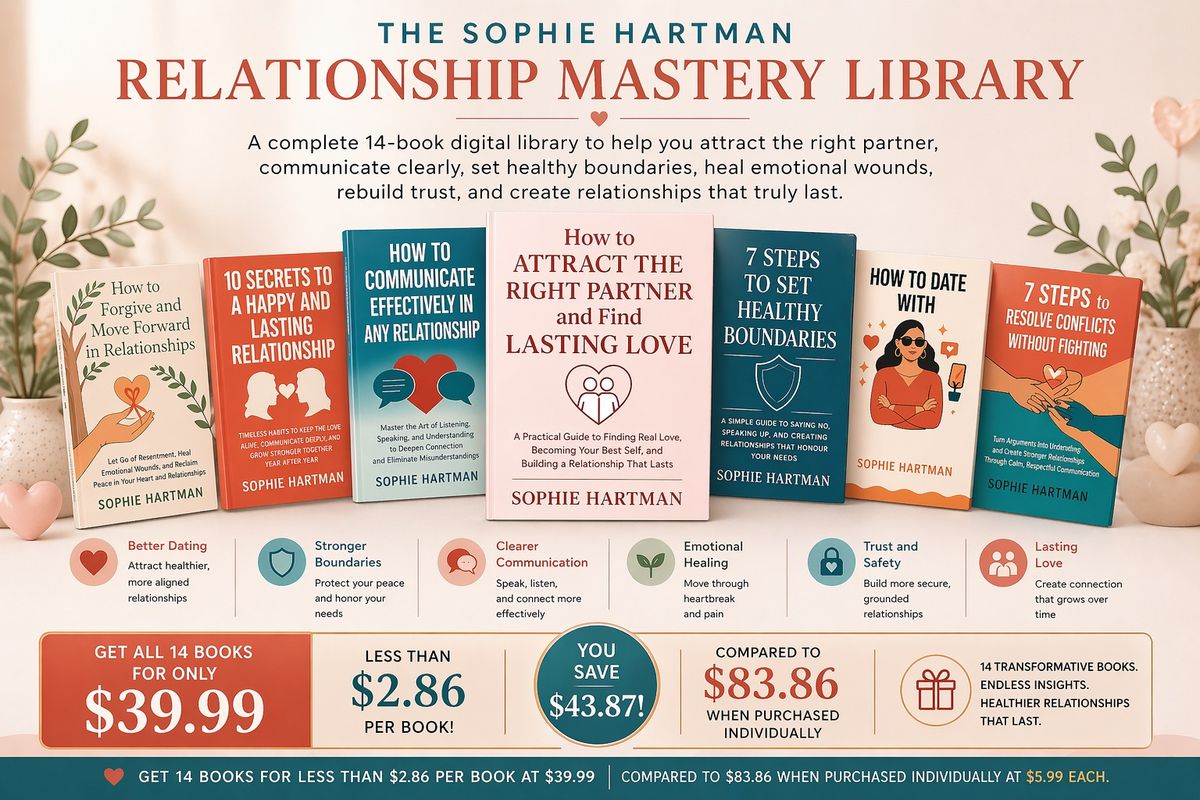
The Relationship Mastery Library
Attract the right partner, communicate clearly, set boundaries that hold and repair what is worth repairing.
Get the library, $39.99Sophie Hartman · 14 books · instant download, read on any device
The series
The Emotionally Intelligent Relationships Series
- Book 1How to Attract the Right Partner and Find Lasting Love

- Book 2How to Communicate Effectively in Any Relationship

- Book 3How to Make Friends as an Adult

- Book 47 Steps to Set Healthy Boundaries

- Book 5How to Deal with Toxic People

- Book 6How to Get Over a Breakup and Move On

- Book 77 Steps to Reignite the Spark in Your Relationship

- Book 8How to Build Trust in a Relationship

- Book 97 Steps to Resolve Conflicts Without Fighting

- Book 10How to Overcome Shyness in Social Situations

- Book 1110 Secrets to a Happy and Lasting Relationship

- Book 12How to Be a Better Listener

- Book 13How to Date with Confidence

- Book 14How to Forgive and Move Forward in RelationshipsYou are here

- Book 15The Relationship Operating Manual


About the author
Sophie Hartman
Relationship Expert
Sophie Hartman is an internationally recognized relationship coach, bestselling author, and emotional wellness expert. With over 15 years of experience helping women and couples worldwide, she’s known for her warm, relatable guidance that blends psychology, emotional intelligence, and real-life strategy.
More about Sophie Hartman