

Mobility Blueprint
A Simple Daily System to Improve Joint Health, Reduce Stiffness, and Move Freely
Recovery263 pagesPublished 31 January 2026Kindle, paperback & hardcoverRecovery
If you feel stiff, tight, or restricted, this isn’t a motivation problem. It’s a system problem.
Most mobility advice falls into two traps: overly complicated routines you won’t stick to, or extreme stretching that leaves you sore, irritated, and right back where you started.
Mobility Blueprint gives you a calmer, smarter approach: a simple daily framework that restores range and control, so mobility actually sticks.
Inside, you’ll learn the core ideas that change everything:
- The difference between mobility vs flexibility (and why it matters)
- Why stiffness happens (and why forcing range often backfires)
- A joint-by-joint priority map so you stop guessing
- The 10-minute rule: a daily minimum that fits real life
- A quick self-assessment to identify your 1–2 focus joints
- Joint-specific plans for ankles, hips, thoracic spine, shoulders, and neck
- Controlled Articular Rotations (CARs) taught simply and safely
- Strength Through Range: the missing link that makes mobility durable
- Practical routines for recovery days, pre-workout, post-workout, desk workers, runners, and lifters
- A full 30-day plan plus a lifelong maintenance model that stays minimal and doable
This book is built around one philosophy:
Healing happens when calm, consistency, and intelligent progression replace urgency and guesswork.
No gimmicks. No complicated flows. No “stretch harder” culture.
Just a clear system you can use daily, at home, in the gym, or between meetings.
If you want to move freely again, start with the minimum effective dose, done consistently, done well.
(Educational only, not medical advice. Includes clear safety guidance and red flags.)
Read the first chapter
Chapter One: Mobility Vs Flexibility
The body achieves what the mind believes, but only if the joints allow it.
S
arah had been stretching her hamstrings every morning for three years. She could touch her toes with ease, a party trick she was quietly proud of. Yet every time she tried to deadlift at the gym, her lower back screamed within the first set. She had flexibility to spare, but she couldn't use it when it mattered. The range was there when gravity helped. It vanished the moment her muscles had to do the work alone. Sarah didn't need more stretching. She needed mobility, the ability to own her range under load, with control, and without her body slamming on the brakes. This chapter draws a clear line between the two concepts and gives you a framework you'll use for the rest of this book.
What this chapter will change for you
You’ll stop confusing “stretch sensation” with progress, and start building usable range.
You’ll learn the three ingredients of mobility: range + control + tolerance.
You’ll know when stretching helps, when it backfires, and what to do instead.
You’ll leave with a simple “access → control → integrate” template you can repeat for any joint.
Range isn’t the prize, usable range is
Flexibility is a capacity: how far a joint and surrounding tissues can be taken, often with help, momentum, or leverage. Mobility is a skill: how well you can create, own, and use that range under your own control.
Here’s the simplest distinction:
Flexibility. Can you be placed there? (passive range)
Mobility. Can you get there and come back smoothly? (active range)
If you’ve ever stretched and felt looser… then tightened right back up an hour later, that’s a clue. Your body may have briefly permitted more range, but it didn’t trust you to control it. So it reclaimed protection.
That’s not failure. That’s your system doing its job.
The three-part formula: range + control + tolerance
Think of mobility as a three-legged stool:
Range, the motion available at a joint
Control, strength and coordination through that motion
Tolerance, the ability to repeat and load that motion without symptoms
Most “stretching culture” focuses on the first leg only. But mobility sticks when you earn the other two.
A quick self-check
Try this: lift your knee toward your chest while standing tall, no leaning back, no grabbing. Then lower it smoothly.
If the movement is shaky or you have to brace hard, you may have range you can’t control.
If you can do it smoothly but it irritates afterward, you may be missing tolerance.
Your plan changes depending on which leg is missing. This is why generic routines often fail, wrong input for the actual limiter.
Why your body “guards” a range
Your nervous system is constantly running a question in the background:
“Is this position safe, right now?”
If the answer is “maybe,” stiffness shows up as a seatbelt. It reduces motion to protect you from a range that feels unpredictable, overloaded, or unfamiliar.
Common reasons the answer becomes “maybe”:
You haven’t used that range in months (low exposure)
You can’t control it well (low strength through range)
You’ve been loading it hard (high training stress)
You’re under-recovered (sleep, stress, nutrition)
The area is irritated (sensitized tissues)
When you treat stiffness as an enemy, you tend to force it. When you treat stiffness as information, you start building trust.
When stretching helps, and when it’s the wrong tool
Stretching can be useful. It’s just not always the main event.
Stretching helps when:
You need a temporary increase in comfort before activity
You’re not irritable, and the stretch doesn’t linger as pain
You follow it with control work (so the range becomes usable)
Stretching is a poor first choice when:
You have sharp pain, nerve symptoms, or a recent flare-up
You feel “looser” during the stretch but worse afterward
Your joints feel unstable and you’re chasing more end-range
You’re using stretching as punishment for being “tight”
Decision rule:
If a stretch gives relief that lasts minutes, you probably need control.
If a stretch worsens symptoms or creates a “raw” feeling, you likely exceeded tolerance.
The repeatable template: access → control → integrate
This is your mobility blueprint in miniature. You’ll use it for every joint chapter in this book.
1) Access (1, 3 minutes)
Goal: show the joint the range gently, without threat.
Options:
slow rocks, gentle oscillations, supported positions
breathing that lowers guarding tone
low-effort reps that explore the edges without forcing them
Cues. quiet face, easy breath, smooth tempo.
Stop if. sharp pain, pinching that escalates, numbness/tingling.
2) Control (3, 6 minutes)
Goal: build strength and coordination in the range you just accessed.
Options:
controlled reps at slow speed
pauses (isometrics) at mid-range and near end-range
light resistance that you can manage without bracing
Control is where mobility becomes “owned.” Without this step, your body has no reason to keep the range.
Cues. move like you’re balancing a glass of water, steady, precise.
Dose. 2, 4 sets of 4, 8 controlled reps, or 20, 40 seconds of holds.
3) Integrate (1, 3 minutes)
Goal: teach your new range to show up in real movement patterns.
Options:
squat pattern, hinge pattern, lunge pattern
overhead reach patterns
carries or light locomotion (walk, step-ups)
This is how mobility stops being a “mobility session” and starts being how you move.
Cues. reduce effort, improve quality.
Dose. 1, 2 easy sets, stop while it still feels good.
“Tightness” isn't always short tissue
One of the most freeing ideas in mobility work is this:
Feeling tight doesn't guarantee the tissues are short.
You can feel tight because the area is:
doing too much work (overloaded)
doing too little work (deconditioned)
lacking coordination (poor timing)
guarding because of stress or sensitization
That’s why two people can have the same “tight hamstrings” complaint with opposite needs. One needs gentle exposure and breath. Another needs strength through range. Another needs workload management.
We’ll address these patterns directly in Chapter 2 and make your plan less guessy.
Common mistakes (and what to do instead)
Mistake 1: Chasing intensity
What it looks like. stretching hard enough to grimace, bouncing, forcing joints.
Do instead. aim for a 3, 6/10 sensation, noticeable, not threatening. Keep breathing steady.
Mistake 2: Borrowing range with leverage
What it looks like. pulling yourself deeper with straps, hanging on joints, using momentum.
Do instead. earn the range actively. If you can only reach it passively, shorten the range and add control.
Mistake 3: Doing random drills without a priority
What it looks like. a different mobility video every day, no consistency.
Do instead. pick 1, 2 priority joints and repeat the same “access → control → integrate” plan for 2, 4 weeks.
Mistake 4: Ignoring tolerance signals
What it looks like. “no pain no gain” stretching, then soreness or flare-ups for days.
Do instead. use a 24-hour rule, if you feel worse the next day, reduce range, reps, or frequency.
Mistake 5: Forgetting maintenance
What it looks like. big mobility push, then nothing for weeks.
Do instead. keep a daily minimum even when you feel good. That’s when mobility sticks.
Quick checklist / Action plan
Today (10 minutes):
Choose one joint that feels most restricted in daily life (ankle/hip/t-spine/shoulder/neck).
Do Access: 2 minutes gentle exploration + calm breathing.
Do Control: 4, 6 minutes slow controlled reps or holds in a comfortable range.
Do Integrate: 2 minutes of an easy whole-body pattern that uses that joint.
Write one note: “Felt better / same / worse next morning.” That’s your tolerance data.
Progression lever (pick one):
Add a 2, 3 second pause at the hardest point
Make reps slower and smoother
Increase frequency (more days per week) before increasing intensity
Add a tiny load only after control is reliable
When to back off:
sharp or escalating pain
new nerve symptoms (tingling/numbness/weakness)
symptoms that noticeably worsen over the next 24 hours
That is the end of chapter one.
The rest of Mobility Blueprint is waiting for you.
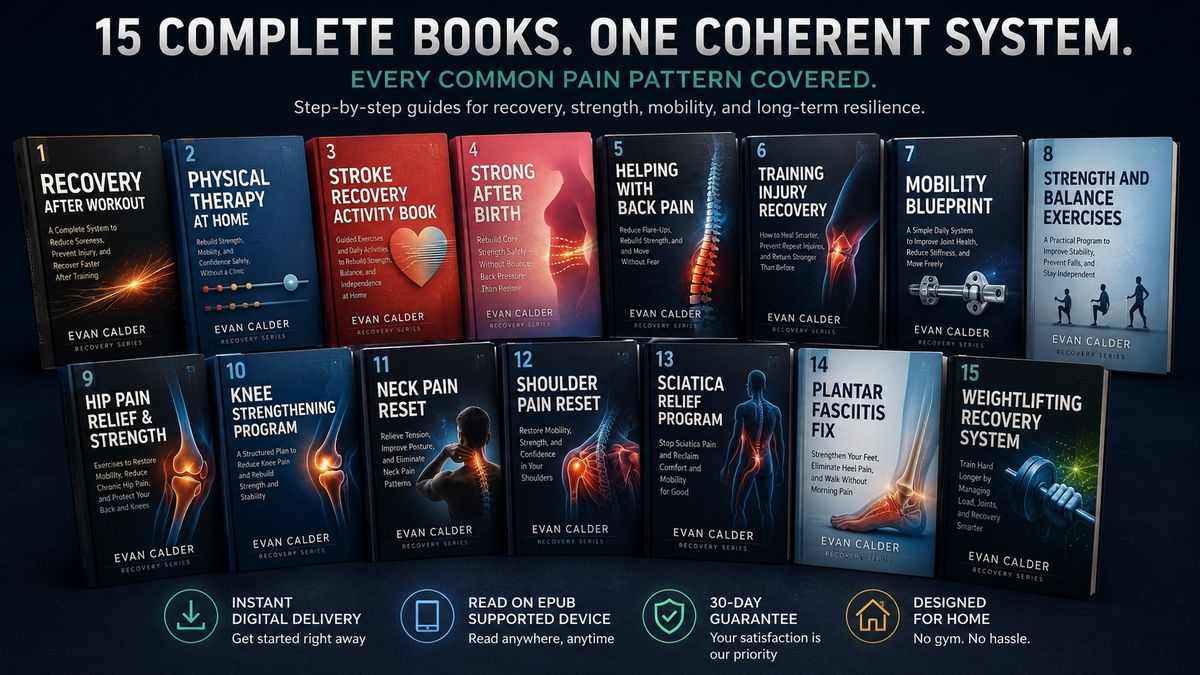
The series
Recovery Series
- Book 1Recovery After Workout

- Book 2Physical Therapy at Home

- Book 3Stroke Recovery Activity Book

- Book 4Strong After Birth

- Book 5Helping With Back Pain

- Book 6Training Injury Recovery

- Book 7Mobility BlueprintYou are here

- Book 8Strength and Balance Exercises

- Book 9Hip Pain Relief & Strength

- Book 10Knee Strengthening Program

- Book 11Neck Pain Reset

- Book 12Shoulder Pain Reset

- Book 13Sciatica Relief Program

- Book 14Plantar Fasciitis Fix

- Book 15Weightlifting Recovery System


About the author
Evan Calder
Recovery Guide
Evan Calder is a movement and recovery educator specializing in injury rehabilitation, physical resilience, and long-term strength for everyday people. His work focuses on helping readers rebuild confidence in their bodies after pain, injury, illness, or major life changes, without relying on extremes, shortcuts, or fear-based advice.
More about Evan Calder