

The River Crossing
An Oregon Trail Historical Fiction Novel
Pioneer Women's Historical Fiction265 pagesPublished 31 August 2026Kindle, paperback & hardcoverPioneer Women's Historical Fiction
Charles Vessey painted the family name on the wagon canvas so no one could mistake their outfit. By Oregon, it may be the only proof his wife was ever on the road at all.
Hannah Vessey leaves Independence in the spring with four hundred other wagons, a husband certain of his own judgement, and two thousand miles of country that does not care what any of them intended. The trail takes stock, then oxen, then people. What it cannot take is the record, and Hannah begins to keep one.
She writes down the names. The women buried under cairns with no marker, the ones entered in the ledgers only as wife of, the ones whose graves the next train will drive straight over. It starts as a small act of stubbornness and becomes the reason she survives the crossing.
The first novel in The Overland Women, a historical fiction series about the women the Oregon Trail recorded as an afterthought.
Read the first chapter
Chapter One: The Name on the Canvas
Charles bought the chalk on the Independence square for a penny, a fat white stick of it, and he stood now at the tail of the wagon using half of it up on their name.
VESSEY.
He made the letters tall as his forearm and went over every stroke twice, pressing until the chalk squealed against the canvas. Beneath the name, in smaller letters, he wrote For Oregon, and stepped back into the trampled grass to admire the work with his thumbs hooked in his suspenders, the way he stood at the edge of a field he'd just finished planting.
"There," he said. "Now nobody hauls off our outfit by mistake. Four hundred wagons on this prairie and every white top the same as the next. A man wants his name where God can read it."
"God knows our name," Hannah said.
"Then the teamsters can read it." He grinned at her over his shoulder. Twelve years married and the grin still worked on her, which she held against him a little, some days. "Come look. Tell me it isn't a fine hand."
It was a fine hand. Charles Vessey wrote the way he did everything, sure and quick and pleased with himself, and the name stood up on the canvas white as a healed scar. Hannah came around the wheel with the washing still wet over her arm and looked at it, their name six feet in the air on a house made of cloth, and she felt the strangeness of it move through her and settle somewhere under her ribs. In Putnam County their name had been on a deed, on a pew, cut into the lid of the cedar chest her father made. Now it was chalk. Now it was a mark on a wagon cover, and the wagon was pointed west, and everything else that had ever carried their name was sold or given away or standing in another family's parlor eleven hundred miles behind them.
Willa came around the far side of the wagon with her brother by the wrist. She was seven that spring, dark like Charles, with a way of studying a matter before she'd say a word about it. She studied the name.
"Is that how it's spelled?" she asked.
"You know how it's spelled," Charles said.
"I know how I spell it. I wanted to see if you did."
Charles laughed and swatted at her bonnet, and she ducked, satisfied. Jed pulled loose of her hand and reached both arms up at the chalk in his father's fist. He was four, and that April the whole world sorted itself into what Jed could reach and what Jed could not, and he tested the border of it hourly.
"Mine," Jed said.
"Not yours. This chalk's got work ahead of it yet." Charles held it high, then relented the way he always relented, broke off a thumb's length, and folded the boy's fingers around it. "Mark the wheel, then. Every man marks something."
Jed sat down in the grass against the rear wheel and began gravely whitening a spoke, and for a little while the four of them stood and sat in the mild April morning with their name over their heads, and around them on every side, as far as Hannah could see along the swells of the prairie, other families stood by other wagons doing the same kinds of work. Smoke went up thin and blue from a hundred breakfast fires. Somewhere a man was hammering an iron tire onto a wheel, a ringing that never seemed to stop from first light to dark, and under it ran the constant sound of the stock, hundreds of oxen and mules and loose cattle grazing the new grass down to the roots, bawling, bells clinking. The emigration of 1846 lay camped in a great loose crescent on the prairie south and west of Independence, waiting for the grass to come up strong enough to carry it, and the grass was nearly ready, and everyone knew it, and the knowing ran through the camps like weather.
Two weeks they had been camped here. Long enough that the mud of the first rainy days had dried to a gray crust marked all over with hoof and boot. Long enough that Hannah had learned her neighbors' fires by smell, who burned good oak hauled from the river bottoms and who made do with green brush. Long enough to stop flinching when rifles went off at the edge of camp, men sighting-in their guns against a country they'd been told was full of dangers, most of which, the older hands said, would turn out to be rivers.
She spread the washing on the wagon tongue and on the grass, Charles's spare shirt, the children's things, her second dress, and while her hands worked she made her list. She was always making the list now. It had started in Indiana in the winter, when the decision came down on her like a change in the weather, and it had not stopped since. The list was everything they owned, and where it rode, and what it weighed.
Eleven hundred pounds. That was the load, near enough, and she could walk it in her mind from the front box to the tailgate without opening her eyes. Seven hundred pounds of flour in double sacks, laid flat along the bottom like courses of brick. Bacon, two hundred pounds, packed in barrels of bran so the fat wouldn't turn in the heat, and the barrels wedged so they couldn't shift. Coffee, sugar, salt, saleratus. A keg of vinegar. Dried apples, which Charles had called an extravagance until the storekeeper told him scurvy could take a family's teeth by the Sweetwater, after which Charles had bought them and called them his own idea. The plow point and the broadax and the auger riding low amidships. The seed potatoes. The medicine box with its laudanum and camphor and peppermint. Charles's rifle in its sling inside the bows, where he could reach it from the seat, and where, so far, the only mortal enemy it had faced was a supper of prairie chickens.
She knew the load the way she had once known her kitchen. That was the truth she kept arriving at, over and over, standing in a wagon camp in Missouri with wet washing in her hands. A woman could know anything, if it was set in front of her long enough. What she had not been given was any say in what got set in front of her.
Charles had decided Oregon in October, at the supper table, with the same voice he used to decide when to sell hogs. There was talk that fall all through the county, letters read out at the store from men already gone west, a lecture in the church hall by a man who'd been to the Willamette and come back to fetch his family, and Charles had gone to the lecture skeptical and come home lit up like a stove. Free land in quantities no Indiana farm could dream of. Wheat that came up like a miracle and no ague in the air, no shakes every autumn, none of the fever that had taken his brother and both of Hannah's parents within six years of each other. He had reasons, and the reasons were good, and he laid them out for her that night and every night after, and at no point in any of it did he ask her a question. He told her. She had understood, listening to him, that her agreement was a formality he was collecting on the way to a decision already made, and she had given it, because that was the shape of their life and she had never known another. Her father had decided she would marry Charles. Charles had decided the farm, the church, the year they'd try for a third child. He decided Oregon.
And she had sold her mother's walnut bureau to Delia Prather down the road for nine dollars, and watched two men carry it out the door with the drawers still smelling of cedar and lavender, and she had not cried, because Charles was watching to see if she would.
One theft she had allowed herself. In the bottom of her sewing basket, folded into a length of muslin, rode a dozen paper packets of seed. Beans, squash, cucumbers, her mother's particular musk-melon that no one else in Putnam County could grow, hollyhocks, which were dead expense by any measure Charles kept. Seeds weighed nothing. That was the beauty of them. A whole garden, a whole summer of her mother's yard, and it weighed less than his chalk.
"You've gone off somewhere," Charles said.
"I'm counting flour."
"The flour's counted." He came and stood by her, and together they looked at the wagon, the great patient box of it, the white top with their name on it stirring a little in the wind. He put his hand flat on the canvas the way another man might lay a hand on a horse. "Rain'll take the chalk off, I expect. First good storm."
"Then why write it?"
"Because past the Kansas River I'll do it in paint." He said it easily, a small plan among his thousand small plans. "First crossing's the proving of an outfit, that's what Teague says. Wagons that make the far bank of the Kansas in good order generally see the Columbia. So we'll cross, and I'll buy paint off the sutler at the first fort, and I'll put our name up there to stay." He knocked twice on the sideboard, wood on wood, satisfied. "Chalk to Kansas. Paint to Oregon."
Jed had finished his spoke and started on a second. Willa had taken out her sampler and sat on the cedar chest working at it, needle in, needle out, her lips moving with the count. The morning smelled of smoke and wet cloth and the sweet crushed grass and, under everything, the smell that lay over the whole encampment day and night, the warm animal smell of the stock, which Hannah had hated the first week and now no longer noticed at all. She would have said, if anyone had asked her, that she was not unhappy. It was a fine morning. Her children were well. Her husband was a good man, a proud man, a man other men listened to. It was only that the road west ran two thousand miles, and every mile of it was his idea, and she was going to walk it.
They went into Independence that afternoon, the last trip in, for a spare kingbolt and shoes for Willa, whose feet had outgrown Indiana somewhere on the road through Illinois.
Town was a roar. Hannah kept Jed's hand locked in hers and Willa's fist knotted in her skirt, and even so she counted heads every dozen steps. The square boiled with men and animals. Ox teams stood eight and ten yoke long, chained to freight wagons bound for Santa Fe, huge patient beasts standing in their own dust while Mexican teamsters in bright sashes cried at each other in Spanish over the tops of the loads. Emigrant men crowded the doors of the outfitters, and through the open doors came the din of trade, barrels rolled across plank floors, the crash of tinware, voices calling weights and prices. A man on a barrel by the courthouse preached the Oregon country to anyone who'd stop, a paradise where a farmer never sickened, and ten feet from him another man sold a pamphlet naming the same road a graveyard. Shawnee and Wyandot men, farmers themselves from the nations just west of the line, moved through the crowd selling corn and salt pork to emigrants who stared at them and then bought.
Charles went off after his kingbolt. Hannah bought the shoes, sturdy and a size long, room to grow, and it was coming out of the store with the parcel that she first saw the seamstress.
The woman had set up at the end of the porch with a wagon cover spread across two trestles, mending a long tear in the canvas. A Black woman, thirty or thereabouts, in a gray dress with the neatest cuffs Hannah had seen since Indianapolis, and she sewed the way Hannah's mother had sewed, so evenly that the eye lost the stitches unless it hunted them, a double row, waxed thread, each stitch drawn to the same tension as its neighbor. It was work you could trust in a storm. A crowd of a town like this, and the woman worked as if she sat in her own quiet room.
The storekeeper's clerk stood over her holding out coins. "It's what I said, and no more."
"It isn't what you said." The woman didn't raise her voice and didn't stop sewing. "You said four bits for the tear and four for turning the hem where it's chafed. The hem's turned. Look at it."
"I'll give you six bits for the lot."
"Then the hem will come out," she said, "of the canvas, in the wind, on the Platte, and the man who bought this cover will remember where he had it mended." She drew the thread through and snugged it. "Or you can pay a dollar, as you said, and he'll remember that too."
The clerk looked at the hem. Hannah, six feet off with her parcel, looked at it with him. Anyone who had ever held a needle could see what it was worth. The clerk paid the dollar, not graciously, and the woman thanked him as evenly as she'd argued with him, and bit her thread, and began folding the cover with her chin set, and her eyes came up briefly and crossed Hannah's, a level look, taking notice of who had watched.
Hannah nodded to her, an ordinary nod, one workwoman to another over a piece of good work. After a breath the woman nodded back.
"Mama," Willa said, when they'd gone on. "That lady sews better than you."
"That lady sews better than anyone in this town," Hannah said. "Don't point."
At the corner by the courthouse they passed a girl standing in a bonnet too big for her, holding a sack of sugar against her chest with both arms and waiting on a man twice her age who was in no hurry inside the doorway of a grog shop. The girl was fifteen if she was anything, small in the wrists, and she wore a wedding band that caught the light when she shifted the sack. She was watching the door the man had gone through with an expression Hannah knew and could not at once place, and then did place. It was the expression of someone minding weather she had no shelter from. Hannah looked away, because staring helped nobody, and looked back once anyway. The girl was still watching the door.
That is the end of chapter one.
The rest of The River Crossing is waiting for you.
The series
The Overland Women
- Book 1The River CrossingYou are here

About the author
Cora Stanfield
The Keeper of the Overland Ledger
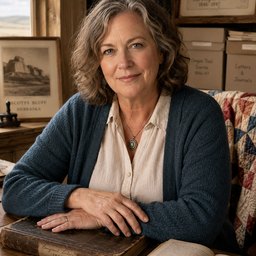
Cora Stanfield grew up in Scotts Bluff, Nebraska, where the actual ruts of the Oregon Trail run through the county and the wagon tracks are still pressed into the rock above town. She spent her childhood on field trips to Chimney Rock and her adulthood unable to stop wondering about the women whose names appear once in the emigrant journals and never again.
More about Cora Stanfield