

Camp Blackpine
A Summer Camp Horror Novel
Slasher HorrorKindle, paperback & hardcoverSlasher Horror
Seven counselors. One week. No signal. One survivor.
Camp Blackpine has been closed for seventeen years, ever since the night six boys walked the Roll Call trail into the pines and only five walked out.
A nostalgic new owner has bought the property and hired a skeleton crew to get it ready before the first campers arrive. One week alone at a lake with no cell service and a legend nobody read the fine print on.
Casey Meyer took the job for the money and the quiet. She gets neither.
On the first night, the rec hall phonograph starts playing by itself. A brass whistle that’s been missing for seventeen years is back on its nail. By morning, a counselor is gone. The bridge is washed out. A storm is building. And someone who knows the camp far too well is picking them off in the dark between the cabins.
As the crew is hunted through a week that mirrors the original massacre beat for beat, Casey discovers that the 1986 tragedy wasn’t a mystery. It was a cover-up.
The killer isn’t a legend. The killer isn’t a stranger.
Camp Blackpine is a propulsive, atmospheric summer-camp slasher with a fair-play mystery at its core. For readers of Riley Sager, Rachel Harrison and Grady Hendrix, and anyone who remembers what it was like when the generator went out and the dark between the cabins got very, very real.
Book 1 of The Camp Blackpine Horrors. Each book features a new killer, a new survivor, and the same secret that won’t stay buried.
Read the first chapter
Chapter One: Six In, Five Out
The last night of first session always smelled like pine sap and lighter fluid. Bobby Lenz crouched at the fire ring and blew on the kindling until the bark caught. The flame jumped and found the teepee of split pine he'd built over it, and the council ring filled with that good yellow light that made the trees lean in close. Thirty feet above the fire, the crowns of the red pines moved against a sky that had gone the color of a bruise sometime in the last hour. The air was heavy with the storm that had been sitting over the lake all day, waiting to make up its mind.
"You're using too much," Gil Hoyt said, pulling the lighter fluid away from him.
"You can't use too much. That's not a thing."
"It's literally a thing. It's on the label."
Bobby grabbed for the bottle and Gil held it over his head, which worked because Gil had three inches on everyone in Cabin Six and liked to use them. Bobby swatted at his arm. The fire popped and sent up a spray of sparks, and both of them flinched back and laughed at each other for flinching.
They were thirteen, all six of them. Born between January and May of 1973, which made this the summer everything was exactly the right size. The trails were long enough to feel real. The lake was deep enough to be worth the cold. The counselors let them walk to the council ring alone on the last night because they were the oldest cabin, and that meant something, and in the morning their parents would pull up the gravel road in station wagons and it would be over.
But that was the morning. Right now it was the night, and the night belonged to them.
Danny Prewitt came up the last stretch of the Roll Call trail at a jog, breathing hard. He was small for thirteen, knobby at the elbows and knees, and he ran the way he did everything, like he was a half-step behind the moment and working to close the gap. His brass whistle bounced against his chest on its red-and-white lanyard. All six of them wore their Thunderers on the trail. Camp rule. Not that any of them would have blown one out here. You didn't break the quiet on the ridge for anything less than blood.
"Fire's going," Bobby told him.
Danny dropped onto the log bench and pulled his knees up. "I can see that."
"Gil says I used too much lighter fluid."
"You always use too much lighter fluid."
"See, when Gil says it, it's annoying. When you say it, it's still annoying."
Danny smiled. It was the kind of smile that showed up slow, like he had to think about whether he meant it first. He meant it. Bobby could always tell.
Terry Vance and Pinch Amado came up the trail together, shoulder to shoulder, arguing about something that had started at lunch and apparently had never stopped. Terry was saying that a largemouth bass could absolutely take a northern pike in a fair fight, and Pinch was asking him to define "fair fight" as it applied to fish, and Terry was getting louder because volume was the only debate tactic he had. Pinch, whose real name was Peter but who'd been Pinch since the first day of camp when he'd pinched a nerve in his elbow doing a cannonball off the north dock and screamed loud enough to scare the loons, just kept asking follow-up questions in a flat voice until Terry ran out of places to go.
"Sit down," Gil said. "Both of you."
"He thinks a bass could beat a pike."
"I don't care."
"Nobody cares," Bobby said. "That's the whole point. Nobody has ever cared about this."
Terry sat down and crossed his arms and stared into the fire like it owed him money. Pinch sat next to him and patted his shoulder once, and Terry shrugged it off, and that was how they worked.
Neil Corcoran was last. He came up the trail slow, the way he always did, hands in the pockets of his hoodie, watching the ground like he expected it to do something. Neil was the quietest of the six. Not shy, exactly. He just didn't spend words unless the words were going somewhere. He sat on the far end of the log bench from Danny and stretched his legs toward the fire and said nothing, and nobody thought that was strange because it wasn't.
Six boys. One fire. The council ring at the top of the ridge, a half mile above camp on the Roll Call trail, ringed by red pines that had been standing since before the camp existed and would be standing long after all of them were somewhere else. Below and to the south, through the trees, Blackpine Lake was a dark plate under the sky. The lights of camp were small and yellow, scattered along the shore like something a kid would draw.
Bobby pulled a bag of marshmallows out of his jacket. He'd stolen them from the trading post that afternoon, and when he held them up the whole circle made the same sound, the one that meant yes, obviously, right now.
"Where'd you get those?" Gil asked.
"Don't worry about it."
"Teague's going to kill you."
"Teague's not here."
Mark Teague was their counselor, twenty years old, built like a fencepost, and convinced that sugar after eight o'clock was the reason nobody in Cabin Six could fall asleep. He was probably right. Nobody cared.
They roasted marshmallows on green sticks stripped from the birch at the edge of the ring. Danny burned his on purpose, the way he always did, blackening the outside until it cracked and the inside slid off in a single molten glob that he caught on his tongue. Pinch tried to build a perfect golden-brown one and dropped it in the coals and said a word that would have gotten him a talk with the camp director if anyone over eighteen had been listening. Terry laughed so hard he fell off the log bench. Neil smiled. Gil ate three in a row without speaking and then wiped his hands on his shorts and stared at the sky.
"Going to rain," he said.
"Not till tomorrow." Bobby looked up. The clouds were closer now, a low ceiling that turned the treetops into black shapes with nothing behind them. The air smelled different than it had an hour ago. Wetter. Like the lake had climbed up the ridge and settled in around them.
"It's going to rain tonight," Gil said, with the certainty of a kid who'd grown up on a farm and thought the rest of them were idiots about weather.
Danny turned his whistle over in his fingers. The firelight caught the brass and the stamped number on the barrel. Six. Their cabin. His nail on the board in the rec hall, third from the right, top row. At lights-out every camper hung their Thunderer on the board and every morning they took it back, and for two weeks the routine had been so fixed it was like breathing. You stopped thinking about it. The nail just had your whistle on it, the way the bunk had your sleeping bag on it, the way the pines had the sky on them. It was all the same thing. You were here and the world was a known shape and you'd do it all again tomorrow.
Except there was no tomorrow. Tomorrow was a station wagon and the back seat and the long drive to wherever you came from, and Bobby knew that Danny's wherever was not a place Danny talked about. Danny was a charity-slot kid, a ward of the state, and he'd shown up on the first day with a duffel bag that was too big for him and a look on his face like he was ready for this to be bad. It hadn't been bad. It had been the best two weeks of whatever Danny's life looked like when camp wasn't happening, and Bobby understood that without being told, the way you understand things about people you share a cabin with, by what they say when the lights go off and by what they don't.
"I don't want to go back," Danny said. Not to anyone. To the fire.
Bobby didn't answer because there was nothing to say that wouldn't be a lie. He threw a stick into the coals and watched it catch.
The wind picked up. The fire bent sideways and recovered. Somewhere in the pines below them, something moved through the brush, probably a deer, maybe a raccoon, and all six of them went still for the two seconds it took to decide it was nothing. Then they were loud again. Pinch threw a marshmallow at Terry and Terry caught it in his mouth and Bobby said that was the most impressive thing that had ever happened at this camp, and for a moment it was a perfect, stupid, ordinary night, the kind that only happens when you're thirteen and a long way from everything and the dark is still just the dark.
Then Gil said, "We should head back."
He was right. The wind was steady now, not gusting, and the fire was working to stay alive. The first drops of rain hit the council ring like thrown gravel, fat and cold, and the marshmallow bag was empty anyway. Bobby kicked dirt over the fire. Gil helped. Danny and Neil took the trail first, and Pinch and Terry followed them still arguing about the bass, and Bobby brought up the rear because that's where he put himself, always, a thing he didn't think about and wouldn't think about for seventeen years, the habit of counting heads and making sure the number held.
The Roll Call trail switchbacked down the ridge through the pines. On clear nights you could see the whole camp from the first turn, the cabins in their two rows, the lodge, the rec hall, the boathouse and the docks stretching into the lake like two dark fingers. Tonight the clouds were too low and the rain was starting to mean it. Bobby could see the boys ahead of him as shapes. Danny's whistle caught the light from somewhere below, a quick brass flash, and then the trail turned and the trees closed in and everything was sound. Footsteps on packed dirt. Rain on pine needles. Their breathing.
Bobby counted. A thing he did. Six went up. Six were coming down.
They came off the ridge and into the tree line above the north cabin row, and that was when Bobby noticed the light.
It was at the waterfront. Not the dock lights, which ran off the generator and were always on until ten. This was different. A flashlight, maybe. Moving. It swept across the front of the boathouse and then cut out, and in the dark after it was gone, Bobby could see another shape of light, warmer, spilling from the boathouse door, which was open. The boathouse door was never open after nine. That was a waterfront rule, and the waterfront director enforced it, and nobody argued with the waterfront director.
"Somebody's down there," Gil said. He'd stopped on the trail.
They all stopped. The rain came down harder. Bobby wiped his face and squinted at the waterfront. The light in the boathouse flickered. Somebody passed in front of it, a silhouette, and then it went dark again.
"Probably Teague," Pinch said.
"Teague's in the lodge."
"How do you know?"
"Because he's always in the lodge. He plays cards with Lampert after lights-out."
"So it's someone else."
"At the boathouse? Now?"
Nobody answered. The rain filled the silence. Bobby looked at the waterfront and felt something he didn't have a word for, something that lived in the space between that's weird and something is wrong, and he was thirteen, so he let it pass. You did that at thirteen. You felt the edge of something and you stepped back and you let the adults be the adults.
Danny was standing a few steps downhill from the rest of them, closer to the waterfront than to the cabin row. Bobby watched him stare at the boathouse for a long time. The rain was coming down on all of them now, steady and cold, and Danny didn't seem to notice.
"Danny. Come on."
Danny didn't move.
"Danny."
"I saw someone carry something out," Danny said. His voice was flat. Not scared, not yet. Just certain. "Out the side door. Toward the south dock."
Bobby looked. He couldn't see the south dock from here. Too many trees, too much dark, and the rain was turning the air into a gray wall. He looked back at Danny, and Danny was already moving. Not toward the cabins. Downhill, toward the waterfront, toward the boathouse and whatever was happening there in the wrong light at the wrong hour.
"Danny, don't."
"I'll be right back."
"Danny."
But Danny was quick, quicker than any of them in the dark, and the slope took him and the rain took him, and in three seconds he was a shape, and in five he was a sound, and in ten he was nothing. Just the rain on the trail and the pines creaking overhead and the five of them standing where six had been.
Gil said his name. Then Bobby said it. Then Pinch.
The rain came down.
Bobby waited. He counted to sixty, because sixty seconds was the longest anything could take, the longest you could be gone before being gone meant something. He counted to sixty again. The light at the boathouse was out. The waterfront was dark. The whole camp below them was dark, except the lodge windows, except the yellow square of the rec hall where the nail board held five brass whistles and one empty nail that would stay empty for seventeen years, and Bobby did not know that. He did not know that he was standing at the exact center of the rest of his life, that everything from here would be divided into the time before Danny walked down that hill and the time after.
He knew one thing. The number was wrong.
Six boys had walked the Roll Call trail to the council ring on the last night of first session at Camp Blackpine. Five stood at the tree line in the rain.
"We need to get a counselor," Gil said.
They went. They ran through the rain, down the trail, through the dark between the cabins where the grass was already pooling water and the air smelled like mud and pine and the cold breath of the lake. They found Mark Teague in the lodge, and Teague's face did something Bobby had never seen an adult's face do before, and twenty minutes later there were flashlights everywhere and people shouting Danny's name at the water, and the shouting went on for a long time and nothing shouted back.
That is the end of chapter one.
The rest of Camp Blackpine is waiting for you.
The series
The Camp Blackpine Horrors
- Book 1Camp BlackpineYou are here

- Book 2Coming soon
- Book 3Coming soon
About the author
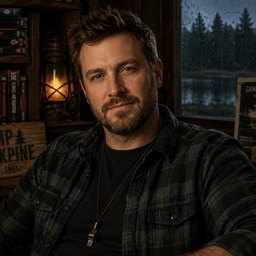
Cody Raines
The Warden of Camp Blackpine
Cody Raines spent six summers as a counselor at a real lakeside camp in the north woods of Wisconsin, which is where he learned the two things his books are built on: how genuinely dark it gets between the cabins when the generator cuts out, and how fast a tight crew of counselors becomes a family you'd do anything to protect. He has been reopening that camp, on paper, ever since — usually with much worse outcomes.
More about Cody Raines