

The Jarl’s Captive
A Viking Historical Romance
Viking Romance225 pagesPublished 14 September 2026Kindle, paperback & hardcoverViking Romance
Taken across the sea. Unbroken in spirit.
Aelfwynn of Wessex is the best healer in her Saxon village, which is exactly why the Norse raiders do not kill her. Bjorn Ravensblood, jarl of Ravensfjord, has a settlement dying of a wasting sickness his own volva cannot cure, and a captured healer is worth more than plunder.
Carried across the North Sea as a thrall, Aelfwynn makes a demand she is in no position to make: she will heal his people as a free woman, or not at all. Bjorn expected a cowering captive and got a Saxon woman staring down a jarl in his own hall. So he does the thing that shocks his clan and himself. He agrees.
As she drags Ravensfjord back from the sickness one patient at a time, a rival jarl comes for both his fjord and his prize healer. The only bond the old gods truly honor is the one freely sworn. But a thrall cannot wed a jarl, a Saxon cannot rule Norse, and the rival’s raid is coming with the spring tide.
The first book in The Jarls of Ravensfjord: a sensual Viking romance where the captive-to-consort bond is freely chosen, with a happy ever after.
Read the first chapter
Chapter One: The Raven-Sails
The girl’s skin burned like a hearthstone left too long in the coals.
Aelfwynn pressed her fingers to the child’s throat, counting the pulse against the rhythm of her own breathing. Too fast. Still too fast. Three days the fever had held Gytha, and three days Aelfwynn had fought it with everything she owned: yarrow steeped in boiled water, elderflower draught cooled in the shade behind the cottage, cloths wrung cold from the well and laid across the small forehead until the heat drank them dry.
“Yarrow,” she murmured, reaching for the bundle on the stool beside the bed. “Elderflower. Chamomile if the stomach turns.” The names came without thinking, an old habit from her mother’s teaching. Her mother had made her say them aloud, every herb by its name and its use, over and over until the words wore grooves in her mind like water over stone. That way, her mother said, your hands will know what to do when your head is too frightened to think.
Her mother had been dead eight years. Aelfwynn’s hands still knew.
Gytha’s mother, Hild, crouched against the far wall of the cottage, twisting a rag between her fingers. She’d gone through the stages Aelfwynn had learned to expect from the families of the very sick. First the bustle, the cold cloths and the prayers and the willow-bark tea brewed too strong and brought back up before it could work. Then the silence, when the remedy failed and the child burned on. Hild had reached the silence.
“The fever is turning,” Aelfwynn said. She didn’t look up. She was measuring the yarrow draught with her mother’s bone-handled knife, using the flat of the blade to scrape the dried flowers into the wooden cup. A knife-tip’s measure, no more. Too much yarrow and the stomach cramped. “Her breathing has eased since this morning. Do you hear it?”
Hild said nothing. Then: “You said that yesterday.”
“Yesterday I was right.” Aelfwynn dipped two fingers into the draught, testing the warmth. “The fever dropped between dawn and midday. It climbed again because she wouldn’t keep the elderflower down. This time I’ve steeped it with chamomile and a scraping of dried ginger root. It will sit in her belly better.”
She lifted Gytha’s head, just enough. The girl’s hair was dark with sweat, plastered to her neck. Aelfwynn tipped the cup against dry lips and let the draught trickle in, a little at a time, the way her mother had shown her. Don’t rush the sick. They’ll fight you if you rush, and then you’ve lost the remedy and the trust together.
Gytha swallowed. Coughed. Swallowed again. Aelfwynn watched the small throat work and felt the first true easing under her fingers, the pulse slowing from its desperate hammer toward what could almost be called rest.
“Good girl,” she said, and laid the child’s head down.
Through the open doorway the light fell long and golden, late summer thickening toward harvest. Ashwick sat in the fold of land between the low hills and the sea, a scatter of timber houses with their wattle-and-daub walls and heavy thatch, the small timber church with its wooden cross catching the afternoon sun. The barley fields rolled south toward the tree line, and the sheep grazed the high ground to the west where the soil was too thin for plowing. A village of sixty souls, more or less, depending on the year and the fevers and the sea. It appeared on no map. It mattered to no one who didn’t live there, and entirely to those who did.
Aelfwynn’s cottage stood apart from the rest, closer to the shore, the way her mother’s had before her. The village preferred it that way. A healer’s cottage attracted the sick, and no one wanted a coughing stranger at their own door, so they gave her the cottage nearest the water and the furthest from the church and called it respect. Aelfwynn called it what it was. She’d lived apart her whole life. She knew what it meant to be needed and kept at arm’s length in the same breath.
The herb garden spread in careful rows behind the cottage. Mint and yarrow, elderflower and woundwort, chamomile and rue. She could name every plant from the doorway by the shape of its leaves. She’d planted most of them herself, from her mother’s cuttings, and tended them through eight summers and eight winters, weeding the rows on her knees every morning before the village woke. The soil knew the shape of her. She was rooted here the way the herbs were, because she’d been put here and because she’d grown.
The day smelled of cut barley and salt wind. The men were bringing in the last of the harvest, working the fields in the gold light while their wives stacked sheaves against the walls of the church. Father Wulfstan stood in the church doorway, watching the work, his hands folded over the wooden cross at his belt. Children ran between the houses. Old Aldred the cowherd was driving his two best milkers back from the high pasture, his stick tapping the ground in a rhythm the cows followed like a heartbeat. Somewhere a dog barked at nothing worth barking at.
Beyond all of it, the sea. Flat and bright and empty, the way it was supposed to be in late summer, when the worst of the Channel storms had passed and the trading ships ran their routes along the coast and the world was, for a handful of weeks, simply the world.
Aelfwynn wrung out the cloth in the bucket beside the bed, folded it, and laid it across Gytha’s forehead. The child flinched, then settled. Her breathing was slower now, each inhale less ragged, the spaces between them widening toward sleep. Good. If the yarrow held and the chamomile kept her stomach from turning, the fever would break properly by nightfall. One more draught at sunset, another at first light, and the girl would be asking for bread by tomorrow.
Aelfwynn sat back and let herself breathe.
Then Hild screamed.
It was not the sound of a woman watching her child die. It was the sound of a woman looking through a doorway at something she understood all at once and too late. Aelfwynn turned, and the light from the door was still golden, still late summer, but across it, on the flat bright sea that had been empty one breath ago, dark shapes moved.
Sails. Square, wool, dyed the gray-brown of old blood. One, two, three of them cutting the water in a line, low and fast, the oars working beneath them in a rhythm she could almost hear. The prows were carved. She couldn’t see the shapes from this distance, but she didn’t need to. She knew what carved prows meant. Everyone on this coast knew.
Norsemen.
Hild was on her feet, dragging at Aelfwynn’s arm. “We have to go. We have to run, the woods, we have to...”
“Gytha can’t be moved.”
“Aelfwynn, please.”
“She can’t be moved, Hild.” Aelfwynn’s voice came out flat and steady, the way it always did when the ground dropped away beneath her. “If she’s jolted now, before the draught works, the fever comes back and she won’t survive a fourth day of it. Take your other children. Take Aldred and Merewyn and go to the tree line, the deep part where the oaks are thick. Stay there until the fires go out or the ships leave.”
Hild stared at her. Her mouth worked. No sound came.
“Go.” Aelfwynn turned back to the child on the bed and put her hand on the small chest, feeling the heartbeat under her palm. “I’ll stay with her.”
She heard Hild’s footsteps, the sob that broke out of her as she crossed the threshold, the sound of her calling for her other children as she ran. Outside, the village was waking to the danger. Shouts from the fields. A man’s voice bellowing a warning from the shore. The bell on the timber church began to ring, iron on iron, the note flat and frantic.
Aelfwynn bent over her patient. She checked the pulse against her own breathing. Still fast, but steadier than it had been at dawn. She adjusted the cloth on the girl’s forehead, turning the cool side down, and reached for the cup on the stool. A half-measure of the yarrow draught, tipped against dry lips. Gytha swallowed in her sleep. Good.
Outside, the screaming had started. Not the sharp, startled cries of the first alarm, but the deeper sounds that came after. A woman wailing, the crash of a door being forced, a man’s voice raised in fury or prayer. Aelfwynn heard the clash of iron and the splintering of the livestock pen’s rails. The dog that had been barking earlier had stopped.
She murmured the names of the herbs in the draught, because her mother had taught her that a healer keeps working, and the work doesn’t care whether the world outside is ending or not. Yarrow. Elderflower. Chamomile. Ginger root. She could feel her own heartbeat in her throat, hard and hammering, but her hands didn’t waver on the cup. Her hands had always been the steadiest part of her. Everything else could shake.
The keels ground against the shingle. She’d heard the first one through the open door, the long scrape of timber on wet stone, and the shouts that followed in a language she couldn’t understand. She’d kept working through all of it. She smelled smoke before she saw it, the first sharp bite of thatch catching fire, and a thread of it drifted into the cottage and curled above the bed like a question.
She kept working.
Storm-Raven’s keel bit the beach and Bjorn was over the side before the hull settled, his boots hitting wet stone and his shield up by the time the crew piled in behind him.
Ashwick. A Saxon village smaller than his own steading, tucked into a dip in the coast with its fields running south and its houses clustered around a timber church that wouldn’t stop ringing its bell. Bjorn counted the buildings as he moved. A dozen houses, maybe fifteen. A handful of outbuildings, some of them sunken-floored, for weaving or storage. Thatch and wattle and daub. No palisade, no wall, nothing between the shore and the village but a stretch of cropped grass and a low stone boundary that a child could step over.
It was the fourth raid of the season and the last he intended to make. The others had gone well enough, corn and livestock and a few arm-rings of silver, enough to stock Ravensfjord through the autumn if the sickness didn’t take too many more. But nothing he’d brought back had changed what mattered. His people were dying, and he was raiding the Wessex coast for grain instead of finding them a cure.
“Leif, take four men through the houses. Grain, salt meat, anything in stores. Drive the livestock to Fenrir.” He jerked his chin toward the second ship beached down the shore, where Torsten’s crew was already spreading out. “No one kills unless they have to. I want the grain more than I want the dead.”
Leif grinned. He was younger than Bjorn by four or five years, lean where Bjorn was broad, and his grin had a way of making men forget he was holding a blade. “You always say that.”
“Because you always need to hear it.”
Leif jogged off with his four. Bjorn moved up the beach toward the church, where two of Torsten’s men were already pulling sacks of barley from inside. The villagers had stored their harvest in the house of their god, which either spoke to their faith or their lack of a decent granary. The sacks were full and dry. Good.
The village fell in the time it took a fire to catch thatch. Most of the Saxons had run for the tree line. A few hadn’t made it, or hadn’t tried. One old man stood in the door of his house with a hoe in his hands, as if a farming tool and a straight back would turn a Norse raiding party. Torsten disarmed him without cutting him, shoved him toward the fields, and the old man went.
A younger man was not so lucky. He came at Bjorn’s flank from behind a livestock pen with a long knife and a shout that might have been brave or might have been terrified. Bjorn sidestepped, caught his wrist, and hit him in the chest with the flat of his shield. The man went down hard. He tried to rise. Bjorn planted a boot on his knife-hand and looked at him until he stopped trying. Then he walked on. Behind him, the man lurched up a second time and threw himself at the back of one of Torsten’s crew. The warrior turned and cut him down without breaking stride.
There was no pleasure in this and no shame. Ashwick had grain, and Ravensfjord had dying children, and the calculation was not difficult. A jarl who could not feed his people through the winter was no jarl at all, and a settlement without a cure for the wasting sickness would be a settlement of graves by spring. Six dead so far. Solveig, the volva, doing everything she knew and failing. The finest seer-healer Bjorn had ever trusted, and the sickness was beating her. He could see it in her eyes, those last days before he sailed, the look of a woman who had spent her life certain that the gods spoke through her and was beginning to wonder if they’d stopped.
He needed grain. He needed livestock. He needed something he hadn’t named yet and wasn’t sure he believed in.
He found it in a cottage set apart from the others, close to the shore, with a trampled herb garden spreading behind it. The garden had been tended with a precision he could read even through the bootprints. Rows planted straight, each plant given its space, the soil between them turned and black with care. Someone had put real labor into this dirt. It struck him the way a well-built hull struck him, the proof of skill applied over years, and he was through the door before he’d fully decided to go in.
The lintel was low. He ducked under it and stopped.
A woman knelt beside a low bed where a child lay. The child was small, flushed, still, her dark hair plastered to her neck with sweat. The woman’s back was to the door, her shoulders square under a plain linen dress, her hands moving with a sureness that Bjorn recognized in his own bones. He knew that kind of steadiness. He’d seen it in the shieldwall, in the breath before the line held or broke, the moment when a man stopped being afraid because the work was too immediate and too important for fear. It was the focus of a person doing the one thing they were made for, with no attention left over for the world falling apart behind them.
That is the end of chapter one.
The rest of The Jarl’s Captive is waiting for you.
The series
The Jarls of Ravensfjord
- Book 1The Jarl’s CaptiveYou are here

About the author
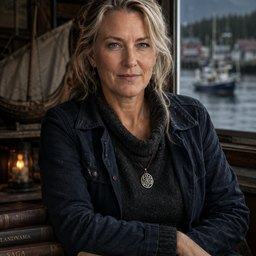
Ingrid Halvorsen
The Skald of Ravensfjord
Ingrid Halvorsen grew up in Petersburg, Alaska — a fishing town founded by Norwegians, where the boats still fly the Norwegian flag on Syttende Mai and her own great-grandparents crossed from Bergen with a Bible, a net, and a family saga they told until it wore smooth. She grew up on cold water, long light, and the certainty that her ancestors' world was worth writing about properly.
More about Ingrid Halvorsen