

The Wrecking Tide
A Maritime Historical Mystery of a Lighthouse Keeper, a Wreck in Dead Calm, and a Reef That Doesn't Add Up
Maritime Historical Mystery292 pagesPublished 26 July 2026Kindle, paperback & hardcoverMaritime Historical Mystery
Some ships aren’t lost. They’re lured. And Elinor Vale reads a wreck the way other people read a signed confession.
The schooner Mercy Bell struck Gannet Reef in the flattest water Elinor has seen all month. No storm. No swell. Nothing that should have put a loaded vessel on a ledge every local pilot knows to clear. Elinor keeps the light at Grey Cape, and she keeps a weather book too, and when she walks the wreckage field at dawn, the debris is lying in exactly the wrong direction for the story everyone is about to accept.
Reading tide and current is Elinor’s whole life’s work, and it tells her plainly that the Mercy Bell did not wreck by accident. Someone on this coast wanted a ship on that reef, and Elinor is the only person who kept careful enough records to prove it.
The Wrecking Tide opens The Grey Cape Mysteries, a series about a lighthouse keeper who solves what the sea leaves behind through tide tables and cargo, not intuition.
Perfect for readers of atmospheric maritime mystery, coastal historical fiction, and puzzles solved by a heroine who trusts evidence over everyone’s convenient explanation.
Read the first chapter
Chapter One: A Sea Like a Plate
29 Sept. Wind calm. Fog after nine, thick. Lamp lit 5:38. Wound 9, 12, 3. Oil expended 1 qt 4 oz. Gun from the reef 11:44.
S
he saw the wreck before she saw the water.
The fog was still on it, pale and low, thinning at the edges where the first light came through. Elinor stood on the cliff path with her lantern unlit and her weather book open against her hip, and she looked south-southeast toward Gannet Reef. The masts came first. Two of them, the foremast canted about fifteen degrees to starboard and the main still standing, though the gaff hung broken and the canvas was in the water. Then the hull, dark against the gray, sitting high on the ledge with her bow to the east and her port quarter stove in.
A schooner. A hundred tons or better, two-masted, loaded. Sitting on Gannet Reef in the flattest water Elinor had seen all month.
She wrote the date at the top of the page. 30 September 1887. Below it she wrote Wind, and beside that she wrote calm.
It was calm. The harbor pennant hung dead on its staff. The sea below the cliff was a plate of pewter, unbroken from the shore to the horizon, and the only movement on it was the last of the ebb pulling through the channel south of the reef. She could hear the bell buoy at Monhegan, fourteen miles off, which meant there was not enough air to stir a candle. No swell. No chop. Nothing that could put a vessel onto a ledge she knew was there.
She closed the weather book and held it against her side and looked at the wreck for a long time.
The schooner had been there since half-past eleven the night before. Elinor had heard the gun, a single flat report that punched through the fog and brought her upright in bed with her hand already reaching for the match safe on the nightstand. She'd struck a light, checked the clock on the watch-room shelf (eleven forty-four, which was how long it took her to get up the stairs), and gone to the lantern room. The lamp was burning. The lens was turning, the clockwork weight descending at its steady rate, the four panels throwing their flash every fifteen seconds into fog so thick she could not see the water at the base of the tower. She trimmed the wicks, checked the oil level, and stood at the gallery rail for ten minutes, listening. Nothing came back. No second gun. No shout. Only the bell on the ledge below her, its machinery grinding out two strokes every thirty seconds into air that would carry the sound about a mile and no further.
She'd written the gun in the log. One line, in ink, across two pages, as the regulation required. Then she had gone back to bed, because there was nothing else to do, and because she could not see fifty yards, and because she would need her hands in the morning.
Now it was morning. The fog was lifting and the schooner was on the reef, and four hours of ebb tide had pulled the water out from under her and left her sitting on granite with her full weight bearing down.
Elinor put her weather book in her coat pocket and started down the cliff path toward the shore.
The path dropped two hundred feet in a quarter mile, switchbacking through juniper and bayberry scrub. She knew every rock on it. She'd walked it in the dark, in rain, in snow so thick she navigated by the pitch of the ground under her boots. This morning the stone was dry and the air was still, and the fog burned off as she descended, pulling back from the shore like a curtain drawn by an unhurried hand. By the time she reached the shingle at the foot of the cliff she could see the reef clearly.
The schooner was worse than she'd thought. The port quarter was open to the sea, the planking sprung from the turn of the bilge to the rail, and the deck cargo had gone over the side. She could see cotton duck bales on the reef to starboard, some still whole, most of them torn and trailing white fabric in the shallows. Rope. Barrel staves. A chicken coop, empty, riding the last of the ebb south of the ledge. The vessel's own dory, capsized, wedged between two shoulders of rock about a cable's length to the north.
Elinor stopped walking and looked at the dory.
Then she looked at the cotton bales on the reef. At the barrel staves in the shallows. At the spar that had fetched up on the gravel bar south of the channel.
She took the weather book out again and drew a rough circle for the reef and marked the position of each piece of wreckage she could see. The bales to the south and east. The staves south. The spar on the gravel bar, also south. But the dory was to the north, and a timber she hadn't noticed at first was on the beach a hundred yards north of where she stood, and there was canvas in the eelgrass to the north of that, inside the mouth of Sable Cove.
She frowned at the page.
The tide last night had been flooding from half-past eight. A flood tide on this shore set north and west, up the coast, carrying everything it touched in that direction. If the Mercy Bell (she had the name now, or part of it, painted on a plank that lay face-up on the shingle near her feet) had come in from the eastward and struck the reef head-on, her wreckage would have gone one way. North and west, the whole field of it, pushed by the flood.
Most of it had gone south.
Elinor stared at the wreckage map she'd drawn. She was not an educated woman in the way the District Inspector meant when he used the word. She'd had the school on Meetinghouse Hill until she was fourteen, and then her father's account books at the tide mill until those ran out, and then Matthew's charts and tables and pilot guides and the government's own publications, which he ordered from Portland and read the way other men read newspapers. But she could add a column of figures without copying it over, and she could read a chart, and she could look at a scatter of wreckage on a falling tide and know which way the current had been running when it got there.
This wreckage said the Mercy Bell had not come straight in from the east.
She'd been turning. The debris field off her port side (the stove-in side, the side that hit the rock) had scattered south, against the flood, which meant the ship's own speed had thrown it there. Momentum flung debris the way a wheel flings mud: away from the direction of the turn. If the wreckage went south off her port quarter, she'd been turning to port when she struck. Turning north.
The reef lay south-southeast of the light. A vessel standing in from the eastward, with the Light List open and a course laid to clear the cape, should have been heading west or west-northwest. There was no reason to turn north. North was Sable Cove, mud flats, and Ragged Point, and there was nothing at Ragged Point for any vessel that had ever sailed.
Elinor wrote drift pattern irregular in her weather book and underlined it. She did not write what she thought it meant, because she did not yet know.
Voices carried across the water. She looked up and saw three dories pulling out from the harbor, three-quarters of a mile to the northwest. The fog was off the harbor now and she could see the wharves, the fish sheds, the chandlery with its sign, the harbor office at the head of the town wharf. The first dory was already past Long Ledge, pulling hard. The men in it would be salvagers. They always were.
She watched them come. In the second dory she recognized the bulk of Silas Venn, sitting in the stern sheets while two men rowed. The harbor master did not pull an oar when there were younger backs to pull for him. He wore his good coat and his felt hat, and even at this distance she could see the leather case he carried his writing things in, the one with the brass catch that he polished. He was vain about his penmanship and vain about that case, and he brought them both to every wreck as though the act of recording a disaster in a copperplate hand somehow elevated it.
He would write his report today. He would write it on the harbor office clock, which ran twenty-four minutes ahead of hers but which he had never adjusted, because it had been his father's clock and Silas Venn did not alter what his father had set. She knew this the way she knew the tide tables, as a fact about the coast that did not require an opinion.
She did not yet know that the clock mattered.
The third dory carried Ezra Crowe and a boy she didn't recognize. Crowe was a salvager who drank, and he was always at the wrecks, the way gulls were always at the fish offal. He worked hard when he was sober and he was sober in the mornings, mostly. She did not dislike him. She had no particular reason to.
Elinor turned from the shore and started back up the cliff path. The lamp was still burning. Sunrise had come while she'd been on the beach, the light strengthening so gradually through the fog that she'd missed the change, but it was past six and the lamp should be out. She climbed steadily, her boots finding the rocks without looking, her breath even. She was thirty-five and her shoulders were wide from hauling, from carrying oil cans up seventy-two steps, from pulling herself along the gallery rail in a gale when the wind tried to peel her off the tower like a barnacle off a hull. She was not a small woman. She'd been strong before she married Matthew and she was stronger now, because the work had doubled when the district cut the station to one keeper six years ago, and again when Matthew drowned and there was nobody left to share it with.
Twenty months. He had been dead twenty months, and she had tended the lamp every night of them, and the Board had not confirmed her, and the Board had not replaced her, and the District Inspector had come twice and said nothing about either.
She reached the top of the cliff and crossed the granite head toward the tower. The oil house was locked, the padlock still dewy. The dwelling, a story-and-a-half Cape, white clapboard, needed paint on the south side where the weather hit it. She had put in for paint in April and the requisition had not come back. The tower door was open, as she'd left it, and she went in and climbed the stairs in the half-dark, her hand on the iron rail, counting the steps without thinking about it. Seventy-two to the watch room. Fourteen more to the lantern.
The lamp was burning clean. Five wicks, trimmed level, the flame steady behind the lens. The four panels of the fourth-order apparatus caught the light and bent it and sent it out through the glass in a beam that was, at this hour, invisible against the daylight. One revolution per minute. A white flash every fifteen seconds. She watched one full revolution, the clockwork ticking, the weight descending in its tube. Then she reached up and doused the wicks, one by one, with the cap. The glass was warm under her fingers. She cleaned the chimneys with a chamois while they cooled, then wiped the brass fittings and the chariot ring on which the apparatus sat.
She did this every morning. She would do it every morning for as long as the Board let her, and they had not let her yet, not officially, because her name was on nothing and her confirmation depended on a petition that lay in Ruth Ansel's chandlery with four signatures on it and needed twenty. The men of Grey Cape would not sign it. They had their reasons, and Elinor was not interested in their reasons, because their reasons would not light the lamp at dusk or wind the clockwork at midnight.
She was interested in keeping the light. That was the work, and the work did not care who she was or what the Board thought of a woman doing it. The lamp took oil and the clockwork took winding and the log took ink, and if she stopped doing those things the light went out, and if the light went out then the next vessel standing in for the cape in thick weather would have nothing to steer by, and that vessel would find Gannet Reef the way the Mercy Bell had found it, and more men would drown.
Four had drowned last night. She did not know the number yet, but she would know it by noon. She pulled the log from the watch-room shelf and opened it to the ruled page and looked at what she'd written at a quarter to midnight. Gun from the reef 11:44. Fog too thick to observe. Lamp burning, apparatus turning. One line, in ink, across two pages. The regulation did not leave room for more.
She wrote the morning entry. 30 Sept. Wind calm. Fog lifting, clearing by seven. Vessel on Gannet Reef, schooner, two-masted, name Mercy Bell observed on wreckage. Boats from harbor at daylight. She put the pen down and read it back. The ink was black and her handwriting slanted to the left, as it always had, because she was left-handed and had never been broken of it. The words on the page were plain and they were true and they were the only proof she had that the light had been kept.
She closed the log and set it on the shelf next to her weather book, next to the Instructions of 1881 with its cracked spine and its pencil marks in the margins that were Matthew's, and she went downstairs to put the kettle on, because the day was going to be long and she had not eaten since the night before.
Below the cliff, the dories had reached the reef. She could hear hammering. The salvage had begun.
She took her tea standing at the kitchen window, looking south toward the wreck. The fog was gone now. The sky was white and the sea was flat and the Mercy Bell sat on the ledge with her broken quarter open to a calm that could not have put her there.
That is the end of chapter one.
The rest of The Wrecking Tide is waiting for you.
The series
The Grey Cape Mysteries
- Book 1The Wrecking TideYou are here

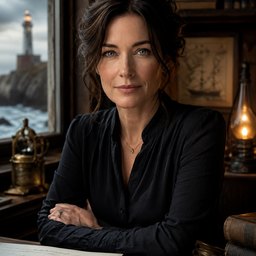
About the author
Evelyn Greyshore
Keeper of the Light at Grey Cape
Evelyn Greyshore writes atmospheric maritime historical mysteries where fog, tide, and lantern light hide crimes that respectable coastal towns would rather leave submerged. Her stories center on the concrete mechanics of the sea — wrecks, salvage, and the records kept by the people who watch the water.
More about Evelyn Greyshore